James Forsyth

James Forsyth

James Forsyth is former political editor of The Spectator.

A rather good Churchill quote

The New York Times has a fun round-up of commencement addresses, speeches by the great and the good to the graduating classes of US universities. Gavin Newsom, the mayor of San Francisco, used a line from Churchill in his which I hadn't heard before and is well worth committing to memory:   What is the secret of all success? Winston Churchill, he said it was moving from failure to failure with enthusiasm.

What should David Davis ask Brown?

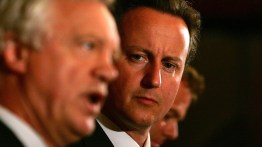
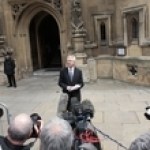
Ben Brogan reports that David Davis has put off resigning as an MP. The word in Westminster is that he is waiting until Wednesday as he intends to go out with a question to Gordon Brown at PMQs. (Considering that the Speaker refused to let Davis announce that he was standing down as an MP in the chamber, he really should—in the interests of fair play—call on Davis on Wednesday.) This is probably Davis’s last moment when he will be in full command of the news agenda and a killer question would keep the issue in the headlines for the next few days. Leave your suggested questions in the comments, if someone guesses right what Davis will ask we’ll happily send them a bottle of Coffee House champagne.

Is this cricket?

Kevin Pietersen’s switch hit six in yesterday’s one day international up at the Riverside was remarkable to watch. Yet, I have a certain sympathy with those who think it is not really fair. As Mike Selvey points out in The Guardian today if the bowler has to declare whether he is blowing right or left arm, shouldn’t the batsman have to say which hand he is batting with? Or, are those who want to ban the shot just being stick in the muds?

Today’s most worrying news story

The news that AQ Khan was selling the electronic blueprints for a modern nuclear device brings home just how close some rogue nations might be to a nuclear bomb. Here are the two key passages from The New York Times report: American and international investigators say that they have found the electronic blueprints for an advanced nuclear weapon on computers that belonged to the nuclear smuggling network run by Abdul Qadeer Khan, the rogue Pakistani nuclear scientist, but that they have not been able to determine whether they were sold to Iran or the smuggling ring’s other customers. The plans appear to closely resemble a nuclear weapon that was built by Pakistan and first tested exactly a decade ago. ...

Waste and waste again

Alasdair Palmer’s column in The Sunday Telegraph chronicles how the government makes the same mistakes again and again wasting more and more of our money yet no one carries the can for this. Palmer cites a Public Accounts Committee report into how the Home Office managed to spend £29 million on considering whether to build a centre to hold asylum seekers. Despite spending seven million pounds on consultants, the Home Office managed to sign contracts with the builders before planning permission had been obtained. So when the project was cancelled, the Home Office had to pay out £7.9 million in cancellation fees. What is most frustrating about this, as Alasdair notes, is how the government simply doesn’t learn from its mistakes.

Another set of big poll leads for the Tories

Two new polls this morning show the Tories with massive leads over Labour.  The Independent reports that the Tories were ahead 48-26 in the fieldwork for their poll which was carried out before Davis resignation but that dropped back to 41-26 after the shock announcement. However, as Anthony Wells notes the sample sizes involved are so small it is hard to draw any firm conclusions from this over whether Davis’ actions have hurt the party or not. The YouGov poll for The Sunday Times which has the Tories on 47, Labour on 25 and the Liberal Democrats on 18 shows that Brown has no chance of recovery unless the economic outlook improves considerably. It finds that more than two thirds of voters blame Brown to some extent for the current economic troubles.

If there is no Labour candidate, can Labour MPs campaign for Davis?

Bob Marshall-Andrews, the maverick Labour MP, has offered to campaign for David Davis, The Observer reports. Marshall-Andrews has encouraged other Labour MPs to join him and it is not hard to imagine a few of the other 42 day rebels doing so. This raises an interesting question, if there is no Labour candidate is it a breach of party rules to campaign for the candidate of another party? There is still no official word on whether or not Labour will field a candidate. Reportedly, Gordon Brown thinks that Labour should leave Davis to twist in the wind and decry the whole exercise as an expensive stunt while Geoff Hoon, the chief whip, is arguing strongly for the party to contest the by-election. Photo courtesy of Jill Fennell.

The Tories should accuse Brown of perpetrating a fraud against the public  

The Irish no vote provides the Tories with a golden opportunity to make Gordon Brown’s trustworthiness the defining political issue of the summer. Brown stood in 2005 on a manifesto that promised a vote on the European Constitution he then reneged on that promise; the Lisbon Treaty is nowhere near different enough from the constitution to justify going back on that manifesto commitment. When Brown did this he was popular enough to ride out the ensuing storm. Now, the situation is very different. David Cameron’s statement on Friday night was strong, accusing the government of the “height of arrogance” for pushing on with ratification.

A Coffee House challenge

The split between the Westminster Village and the public at large over whether David Davis’s resignation was a moment of madness or an act of profound principle is rapidly becoming the story. Matthew Parris turns his attention to it with his typical eloquence in his column in The Times today. Most people in Westminster think that Davis has made a huge mistake because they can not see how he keeps 42 days and his fight against it in the news 10, let alone 100, days from now. Indeed, his resignation has already been eclipsed as a story by the Irish no vote. I suspect that the fuel strike will push it further down the news agenda and the absence of a real challenge in his constituency means that the by-election is unlikely to get road-blocked coverage.

Tim Russert RIP

Tim Russert was the finest American political interviewer of his generation. People in Washington used to talk about the Russert primary, the idea that a candidate had only proved they could stand up to the scrutiny of a presidential campaign if they could get through the full-hour long interview on the show Russert hosted Meet the Press. What was so refreshing about Russert was that his interviews were tough but infused with a reverence for the process, a love for democracy. He never sneered at the politicians he interviewed but he did hold them to account more effectively than anyone else on television. Perhaps, Russert’s most memorable moment came on election night in 2000.

Union of denial

Denis MacShane, the former Europe minister, was not a happy man as he did interviews yesterday about the Irish no vote and his piece in today’s Times is a mixture of anger and denial. He starts by dismissing the no votes against the constitution in France and Holland and the rejection of the Lisbon Treaty in Ireland as mere “local difficulties” when set against the broader ambitions of the European project. He then indulges in some sophistry to try and dismiss the democratic importance of the Irish vote. Ireland represents 1 per cent of the EU's total population and some old-fashioned democrats may feel that 1 per cent does not outweigh the rest of Europe's nations which are saying “yes” to the treaty.

Barroso tries to come to terms with defeat and fails

Watching the BBC broadcast of Barroso’s press conference you realised how the EU just can not compute any result that does not go its way. Barroso said that he respected the Irish decision but then kept on insisting that the 27 EU members would have to find a way to ratify the treaty anyway. It really is quite comic. One wonders how many times the ideas embedded in the Lisbon Treaty will have to be rejected by the voters before the European elite finally gives up on trying to impose them on us. By my count, these ideas have already gone down to defeat three times—the referendums in France, Holland and Ireland.

A Grieve set of issues

David Cameron wasted no time in appointing Dominic Grieve yesterday but it might be a case of act in haste, repent at leisure. I’m picking up considerable concern in Conservative circles about Grieve’s appointment for the following reasons. 1). It unbalances the front bench: If one thinks of the Tory front bench as a see-saw, David Davis and William Hague balanced out David Cameron and George Osborne. While Cameron and Osborne were young, southern, privileged, modernisers, David Davis and William Hague were more experienced, sat for northern seats, came from humble backgrounds and were perceived as traditional Tories. Replacing Davis with Grieve, a barrister who was educated at Westminster and Oxford and sits for a Buckinghamshire constituency, upsets that balance.

David Davis throws down the gauntlet to Brown and the cabinet

David Davis’s Daily Telegraph piece makes clear that he will be running as a Conservative party candidate in the by-election, something about which there has been some confusion. He also presents Brown and his cabinet with this challenge: I will debate with any one of them - any time, anywhere - what Gordon Brown euphemistically referred to as the "next chapter of British liberty". I suspect that Nick Wood is already booking a venue and that Team DD is preparing to ‘empty chair’ the government. One other thing worth noting is that Davis inadvertently makes clear that Dominic Grieve did get  too forward on his skis in his first set of interviews as shadow Home Secretary.

What a way to start

It seems that Dominic Grieve has, as he did with grammar schools, forced a re-write of Tory policy. Last night, the Tory position was that they would almost certainly repeal the 42 days legislation but not that they would repeal it. That was still the position when David Cameron spoke to the press to announce that Grieve was the new shadow Home Secretary. But then in his first interview, the new man announced the Tories would definitely repeal it. There was no caveat about this being dependent on it being passed in its current form, no new evidence emerging or anything else. Just a definite commitment. There are three possible explanations for this. One is that Grieve slipped up. After all, it is an awfully big leap from being shadow Attorney General to shadow Home Secretary.

“The coldness necessary to command”

As so often, Charles Moore put it best when he used this phrase about Cameron. Charles was reflecting on Cameron telling Stanley Johnson straight out at a social occasion that he wouldn’t be allowed to have a run at Boris’s old seat but it applies perfectly to today’s events as well. Some thought on Dominic Grieve in a bit. Stay tuned.

Cameron responds to Davis

David Cameron’s ruthlessness was on full display just now in his statement on Davis' resignation. He has appointed Dominic Grieve as the new shadow Home Secretary. There was no indication that Davis would get his old job back once he wins his by-election—his bluff has been well and truly called. Also, worth noting that Cameron did not commit the Tories to repealing the 42-day detention measure if it passes.

Will David Davis be denied a publicity triumph?

The Lib Dems have announced that they will not stand against David Davis. Now, this is because they agree with him on 42 days. But if Labour were also not to field a candidate, David Davis would be denied any great publicity triumph and could end up looking rather silly.