James Forsyth

James Forsyth

James Forsyth is former political editor of The Spectator.

If Palin chokes tonight the presidential race could be over

From our UK edition

There are signs that the presidential race is on the verge of tipping decisively Obama’s way. A string of polls in battleground states have shown Obama moving into strong leads and even those swing states like Missouri and Florida that were leaning McCain are now going Obama’s way. In a sign of the McCain’s campaign difficulty, McCain is reportedly pulling out of Michigan—long regarded as his best chance for flipping a large, normally Democratic state—which would seriously limit his options for getting to 270 Electoral College votes. One of the reasons that the McCain campaign is in such trouble is Sarah Palin. She has gone from being an asset to the ticket to a drag on it.

Cameron shouldn’t be so complacent about the quality of his top team

From our UK edition

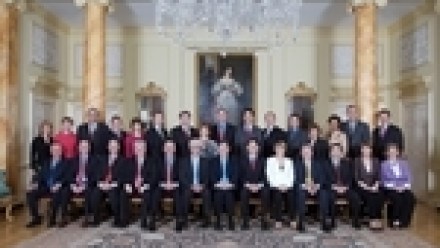
The Telegraph is reporting that David Cameron won’t reshuffle the shadow cabinet. This is a mistake. There’s some dead wood in the shadow cabinet that needs chopping out - last year The Spectator revealed that Cameron only thought 10 of its members were up to being ministers - some apparent conflicts of interest that need resolving and some talent that needs including. Cameron should start by telling his top team that the level of scrutiny on them is going to be turned up in the coming months so any second jobs that could in anyway be seen to overlap with their responsibilities must go. Anyone who isn’t prepared to comply with this should be dropped in the reshuffle.

Glowing press coverage for Cameron’s speech

From our UK edition

Team Cameron will be beaming about the press coverage that the  speech has garnered. The Sun pretty much endorses Cameron in a leader entitled ‘He’s ready.’ It offers him The Sun’s highest praise, declaring that his “speech could have been lifted straight from a Sun editorial.” The Mail is not quite as keen but does appear to be warming to Cameron.It concludes that “Mr Brown has an increasingly impressive rival for Number 10.” The traditionally conservative broadsheets, yes I know but there isn’t another word for them yet, give the speech a good review too. The Times writes that “His pitch for the top job was formidable enough that it answered the one question he really posed: can you imagine me as prime minister?

The Senate passes the bailout bill, the House expected to vote Friday

From our UK edition

The revised Paulson plan passed the Senate by the comfortable margin of 74 to 25 with both Obama and McCain voting for it. Most people expect that the House will now OK it on Friday, the addition of various tax breaks and an increase in the Federal Deposit Insurance limit have made it more palatable to House Republicans who voted against it by a two-thirds margin on Monday.

The fundamentals still favour Cameron

From our UK edition

The financial crisis might be giving Gordon Brown a temporary boost but when you consider the issues the next election is likely to be fought on you see that Cameron has quite a distinct advantage. By the time of the next election, the economy will be—or will have been—in recession, shining a light on Brown’s actual economic record and making it harder for him to claim that all the trouble has come from America. Huge amounts will still have been spent on public services without the desired results and the problems of a broken society will, sadly, still be with us. This is not where the Tory advantage ends.

Cameron’s chance

From our UK edition

These are not the circumstances that David Cameron would have wanted or expected to deliver his conference speech in. But today does provide him with an opportunity to show the electorate that he is ready to lead in these economically challenging times. Up to now, talking about the economy has not been Cameron’s strong point. For a PPE graduate and former Treasury special advisor he sounds oddly hesitant on the subject. (Perhaps this is why he turned down the shadow chancellorship when Michael Howard offered it to him after the 2005 election defeat). But Cameron must now show that he can do it, as the economy is going to be the dominant political issue for the foreseeable future. Cameron made a fine start yesterday with his statement to conference on the crisis.

Liabilities

From our UK edition

Martin Wolf’s column in the FT this morning well-worth reading, one statistic in it really does bring home the problem of over-leveraging: “the gross liabilities of the US financial sector have soared from just 21 per cent of gross domestic product in 1980 to 116 per cent in 2007.

McCain and Obama head to Washington to vote for the bailout bill

From our UK edition

The Senate is expected to vote on a mildly revised version of the bailout proposal sometime today. The bill will include tax breaks for both businesses and people designed to help the bill garner more support in the House when it returns there. With both Obama and McCain backing the bill as well as the leaderships of both parties, the plan should pass the Senate comfortably.

A crisis without a hero

From our UK edition

A crisis presents politicians with an opportunity. But no politician on either side of the Atlantic has seized the one presented by the current financial turbulence. Gordon Brown is benefitting not from anything he has said or done but because he is ‘experienced’ and voters think that because he was Chancellor he must know the way home from here. David Cameron and George Osborne have made the right noises  and struck the right tone. But as opposition politicians they are limited in what they can do. They also have not been ahead of the curve on this. In the US, Bush’s leadership has been pitiful, Hank Paulson has been politically tone-deaf and Nancy Pelosi’s partisan speech just before the vote was spectacularly ill-judged.

Back at the House

From our UK edition

There is talk coming out of Washington that the Senate will pass the bailout bill and send it back to the House, almost daring it to vote it down again. Speaking this morning, President Bush made it clear that he’s going to keep pushing for a bill, and enough House members might have been scared by yesterday’s fall on the Dow to get this passed second-time out.

Where will this end?

From our UK edition

There are few events that can break through the conference bubble but the failure of the $700bn bailout has undoubtedly been one of them. Most worryingly, no one knows what happens next. In Washington, the bailout seems doomed. It was never politically popular to begin with and neither the Democrats nor the Republicans will want to cop the flak for passing it. It says something about President Bush’s lack of political authority these days that not only did House Republicans vote the bill down but only four of the Texas delegation voted for the bill. Indeed, politically it is hard to see what upside there is to voting for the bill. Folk on the right, including myself, have not been keen on the bailout proposals. But something needs to be done.

The Ashcroft issue has to be resolved

From our UK edition

The general consensus here is that the Osborne speech did the business: yet another hurdle has been cleared by the Tories. However, folk here are buzzing about tonight's Dispatches programme on Tory funding. To my mind, the issue is not whether short sellers are donating to the Tories, but Lord Ashcroft's tax status. It is a huge strategic liability--and one that a half competent Labour party would exploit--that the Tories cannot say whether one of  their vice-chairmen and major donors is domiciled in this country for tax purposes.   I know CoffeeHousers get irritated when the Aschroft issue is raised. But it is reckless for the Tories to let this issue fester precisely because of the good that they could do for the country.

Will Miliband ever live that photo down?

From our UK edition

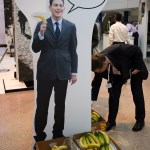
Dotted around this rabbit-warren of a convention centre are cut-outs of David Miliband based on that infamous photo of him posing with a banana.  The Tories might now not to get to run against Miliband, but he has replaced Nick Clegg as the man they love to mock.

Osborne’s speech

From our UK edition

This was new, serious George. In a soberly-delivered speech, Osborne went a long way to reassuring voters that he is ready to be Chancellor. He stressed financial and fiscal responsibility and deftly threaded the political needle on criticising the excesses of the City without committing to more regulation. Osborne was so keen to demonstrate his seriousness that he kept his trademark smirk under wraps. He even bit his lip during one bout of applause in a seeming attempt to stop it from breaking through. The headline from the speech is a freeze on council tax for two years. This will be achieved by returning government advertising and consultancy budgets to 1997 levels. To qualify for this funding, councils will have to keep their proposed council tax increases to 2.5 percent or less.

Another Cabinet minister gets the treatment

From our UK edition

Even though it is Tory conference week, I think the most important political story of the week might be the expected Cabinet reshuffle. If Brown gets it wrong, the chances of him being pushed out before the next election will increase dramatically. Judging from today’s papers, it seems that the Brownite poision is now being directed against James Purnell. This is unbelievably foolish. Purnell has been one of the very few successes of the Brown government and demoting him would likely prompt a rebellion in the Cabinet and the party. Brown’s principal reshuffle problem is that he can afford to move very few people but a minor reshuffle would be another demonstration of just how weak his position is. Of course, Brown could always put it off.

The Tory taskĀ 

From our UK edition

Martin Ivens has a fantastic column in The Sunday Times about what the Tories need to do this week in Birmingham. “Their task is to meld two seemingly contradictory messages into a seamless whole. First, they must steal two favourite words from Brown’s old lexicon, prudence and stability, and attach them to their own economic plans: a reassuringly small-“c” conservative message is required. Secondly, they have to offer a radical agenda of change in the public services. The charge that nobody knows what the new, slick Conservatives stand for can’t be allowed to stick.” The Tories need a set of promises that the voters understand akin to New Labour’s 1997 pledge card. It is good to see the Tories pushing their transformative schools policies.

Indiscipline should worry the Tories as much as complacency

From our UK edition

There has been a lot of talk about how the Tories must avoid becoming complacent. Indeed, one-half expects to find that champagne is only available under the counter in Birmingham. But just as great a danger is posed by indiscipline. Take today’s papers. Dominic Grieve, the shadow Home Secretary, has stepped on the Tory economic message by giving an interview to The Guardian in which he criticises multiculturalism and bemoans that "We've actually done something terrible to ourselves in Britain". The issue here is not what Grieve said but when he said it. His predecessor, David Davis, has talked to the Telegraph about his new role on the backbenches. He hasn’t been disloyal but has said just enough for his comments to be presented as a Tories split story. The Telegraph.co.

A draw was a good result for the front-runner

From our UK edition

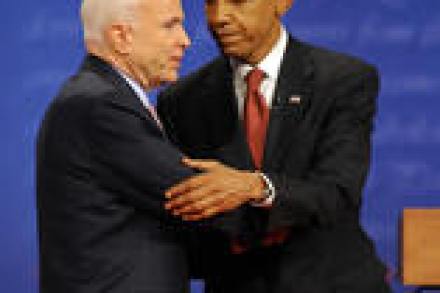
Having watched last night’s debate properly and read the press coverage of it, it seems pretty clear that it was a draw. There was no ‘global test’ moment for either candidate and neither of them managed to put the other on the canvas. Obama should be a lot happier with this result than McCain. First of all he is ahead so a debate that doesn’t change the dynamics of the race suits him. Secondly this was a debate on foreign policy and national security—admittedly, the first third of it was taken up with the financial crisis—which is McCain’s strongest suit. If Obama was going to have a moment where he came across as unready to lead it was most likely to be in this debate.