James Forsyth

James Forsyth

James Forsyth is former political editor of The Spectator.

Brown has little left to say

From our UK edition

It says a lot about Gordon Brown’s lack of a domestic policy message that the news line in his interview with The Times is that he has no intention of quitting any time soon. He does attempt to provide some kind of agenda on public service reform, what John Rentoul calls the Blair-shaped hole in British politics. But the idea of giving residents more of a say in whether CCTV is used and being able to call the police ‘get advice about matters such as crime hotspots’ is hardly the new frontier. Brown is also clearly preparing a new Brownie, he talks about how the government’s actions “will probably have saved up to 500,000 jobs that would otherwise have been lost.
A well-aged idea

From our UK edition

Reading this week’s Economist, I was struck by this point it is editorial on retirement: “only Denmark has taken the radical step of indexing the pensionable age to life expectancy.” This seems like an eminently sensible idea. Not only will it save money but by pegging the retirement age to life expectancy it is fair in inter-generational terms. I’d be interested in hearing what Coffee Housers think of the idea? Off the top of my head, I can’t think of a substantive objection to it.

Moussavi under house arrest?

From our UK edition

The New York Times is reporting that a Farsi-language web site, gooya.com, is claiming that Moussavi, the supposedly defeated candidate in the presidential election, is under house-arrest. More as we get it.

BBC executive expenses

From our UK edition

The BBC have now published the details of the expenses of some of their senior staff, you can see them here. But the salary of individual performers will stay private despite the fact that the license fee pays for them.

Brown’s plans

From our UK edition

Kevin Maguire, who is extremely well connected within the Brown circle, has an interesting little item about what Gordon Brown might do once the electorate, or the Labour party, have given him his marching orders: “Academia may not be Brown’s sole destination, whenever he departs No 10. The Talibrown speculate about the Lords. John Major and Tony Blair gave the rest home a miss, avoiding the need to register lucrative interests. But a Lord Brown of Kirkcaldy lecturing on economics for a living would have no huge earners to hide. I note Brown’s never supported a wholly elected upper chamber, voting to retain a fifth of seats for the great and, perhaps, the Gord.

Blair: Obama will face a hard power moment in the Middle East at some point

From our UK edition

Tony Blair is back in the news with the whole debate over the Iraq inquiry so I was intrigued to watch this interview of Blair by Graydon Carter, the notoriously anti-war, anti-Bush editor of Vanity Fair. It took place on Tuesday and what is striking about it is just how much more comfortable in his own skin than Brown, Blair is. Historians will puzzle over why the Labour party was so keen to jettison this triple election-winner and replace him with Brown. (Oddly, when Blair is asked what the best moment he spent with Brown was, he refuses to answer on the grounds he doesn’t want to be unhelpful). On a more substantive level, what intrigued me about the interview was Blair’s line about Obama and the Middle East.

Developments in Iran

From our UK edition

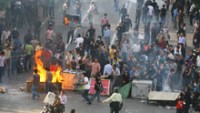
Judging from what Andrew Sullivan and the New York Times are hearing, there might have been considerable violence used to repress a demonstration in Tehran today. More as we get it.   Update: From the New York Times' Tehran reporter: It was impossible to confirm first-hand the extent of the new violence in the capital because of draconian new press restrictions on coverage of the post-election mayhem. But the witnesses reached by telephone said the confrontation, outside the national Parliament building, was bloody, with police using live ammunition. Defying government warnings, the witnesses said that hundreds, if not thousands of protesters, had attempted to gather in front of the parliament on Baharestan Square.

PMQs Live Blog

From our UK edition

Brown starts with condolences for the families of a solider killed in Afghanistan and the hostages who were murdered in Iraq. We start with a patsy question from a Labour backbencher about housing. Cameron goes straight in on whether Brown was accurate in what he told the House last week about spending. Darling looks particularly glum as Brown replies. Brown thumps the table saying the Tories will spend less every year than Labour. But that is not what Cameron is asking. Cameron keeps pushing for a correction of what Brown said last week. Brown reels off a list of figures but he looks distinctly uncomfortable. Cameron has a bit of fun with the Sunday Times report about how Darling and Cooper disagreed with the 10 percent line last week. Cameron pushes Brown again for a correction.

Army boss admits that Britain’s problems in Iraq came from a lack of troops on the ground

From our UK edition

The most important story in today’s papers is Deborah Haynes’ report on Sir Richard Dannatt’s speech to the Royal United Services Institute. In the speech, Dannatt makes clear that the reason the British operation failed in the south was that there were not an adequate number of troops on the groundL   “Our failure to deliver this . . . and our early switch to an economy of force operation, in favour of Afghanistan, sowed the seeds for the dissatisfaction that followed and the rise of the militias, supported so cynically by the Iranians in the south.” This country faces a moment of decision: we either properly fund and equip our armed forces or we retreat from our role on the world stage.

What would an economic recovery do to Labour’s poll rating?

From our UK edition

The big question of the next 11 months is whether Labour will benefit from any economic upturn. On this front, Anthony Wells’ post on the relationship, if any, between economic optimism and Labour’s poll standing is particularly interesting. Anthony concludes that: “The relationship seems to break down entirely though from the start of this year: economic confidence has returned, but doesn’t seem to have done Labour any favours at all. It appears economic troubles dragged the government down, but there’s no sign yet of economic recovery picking them up again.” The problem for Labour is that even if the economy is growing again by the time of the next election, unemployment will still be rising and so there will be little feel good factor.

Was Blair talking b—locks?

From our UK edition

Trevor Kavanagh‘s Sun column yesterday contained this classic quote from Tony Blair about the prospect of becoming President of Europe: "I would rather nail my testicles to a speeding train than be President of the European Union." Given the other likely candidates, I have little problem with Blair as President of Europe. He’s for free trade, the market and an Atlanticist which is not bad going. But if he does end up in the job after having said this, he will have set a new standard for a politician going back on his word. P.S. I should add as a note of caution that a quick cuts search doesn’t turn up the quote, but Kavanagh is reliable so I’d be taken aback if he has got this wrong.

Does Ed Balls think Gordon Brown lost his grip on reality in his final years at the Treasury?

From our UK edition

Ed Balls tells The Times today that: “The moment you stop wanting to do the job you are doing and start thinking about the future or next stage is the point when you start to lose a grip with reality.” Now, Balls is saying this as part of his attempt to deny that he wanted to be made Chancellor in the reshuffle. But it does make one think what Balls thought of Gordon Brown’s mental state during his final years at the Treasury when he spent so long agitating to move up to the top job. Indeed, one could make a case that by Balls’ definition, Brown has been losing his grip on reality ever since he made the deal with Blair at Granita in 1994. PS Balls is also not averse to thinking about his own future.

Western firms mustn’t help the Iranian regime repress the Iranian population

From our UK edition

Companies that do business with non-democratic regimes have a moral responsibility not to sell these regimes tools that can be used to aid repression. A story in the Wall Street Journal raises some disturbing questions about the behaviour of Nokia and Siemens and whether they have sold the Iranian government the technology that is being used to block communications inside the country and monitor those who are agitating against the regime: “Deep packet inspection involves inserting equipment into a flow of online data, from emails and Internet phone calls to images and messages on social-networking sites such as Facebook and Twitter. Every digitized packet of online data is deconstructed, examined for keywords and reconstructed within milliseconds.

Second round result, Widdecombe out

From our UK edition

Update: The candidates in third, fourth and fifth have withdrawn. So, it is now a straight Bercow Young contest. Bercow probably benefits more from it becoming a one on one fight now rather than after another round or two. Courtesy of Andrew Sparrow, the result of the second round of voting: Bercow: 221 Young: 174 Beckett: 70 Haselhurst: 57 Beith: 46 Widdecombe: 30 So, Widdecombe is eliminated.

David Maclean’s dedication to Parliament

From our UK edition

David Maclean has received a lot of criticism because of his efforts to exempt Parliament from the Freedom of Information act but we should all be applauding him and wishing him well today. I don’t agree with Maclean on the FOI issue but he does deserve a huge amount of credit for turning up to vote in the Speaker election despite being seriously sick and debilitated by multiple sclerosis. It says everything about Maclean’s dedication to Parliament that he is prepared to come to the House in an ambulance and in such a bad state that he has to be attended to by two medics so that he can vote. You normally only see people attending the House in this state when their presence makes the difference between a vote being won or lost or a government surviving or not.

The next Speaker: First round results

From our UK edition

Andrew Sparrow, who is running a typically excellent live blog, reports that the forst round results are as follows: John Bercow 179 George Young 112 Margaret Beckett 74 My gut reaction is that Bercow won't pcik up enough votes in the later rounds to win. But Young beating Beckett for second changes things a bit. This is the full set of results: Bercow: 179 Young: 112 Beckett: 74 Haselhurst: 66 Beith: 55 Widdecombe: 44 Dhanda: 26 Shepherd: 15 Cormack: 13 Lord: 9 Shepherd, who would have been my choice because of his commitment to transparency, and everyone below him has been eliminated because they failed to get more than five percent of the vote.

A sign of compromise?

From our UK edition

Intriguingly, the Iranian authorities are now conceding that the number of votes cast in 50 cities exceeded the number of people on the electoral roll in those places. However, the Guardian Council is still trying to claim that this is a “normal phenomenon” on the grounds that Iranians are allowed to vote in areas other than the one they are registered in. The announcement does, though, suggest that the authorities are considering trying to end the protests by announcing that Ahmadinejad’s margin of victory is far smaller than the lop-sided total that was announced straight after the vote. Whether that will be enough to assuage the anger on the streets seems doubtful.

Iran, the protests continue

From our UK edition

The situation in Iran is continuing to develop, though with the crackdown on reporting from there—the BBC’s correspondent has just been told to leave—it is hard to know quite what is going on. The New York Times’ story, written by journalists outside the country but based on information from inside Iran, gives a good senses of where things are at. State TV is saying that 13 people died in Saturday’s clashes and that five members of Rafsanjani’s family have been arrested, he is thought to be leading efforts to replace the Supreme Leader. The NYT also reports that the demonstrators are considering switching tactics and calling for a general strike.