James Forsyth

James Forsyth

James Forsyth is former political editor of The Spectator.

The EU plumps for obscure and even more obscure as its first president and foreign minister 

From our UK edition

You can say this for the European Union, it never misses a chance to disappoint. The first EU president is a Belgium Prime Minister who is obscure even by Belgium standards and its first foreign minister is a Brit who would be treated as a joke if they had been made Foreign Secretary.    From a British political point of view, Brown will be able to take credit for getting the foreign minister post for a Brit. But the price he has had to pay for this is accepting a federalist who believes in EU wide taxes as president.    Thinking from a Tory perspective, Van Rompuy is both an opportunity and a problem. He is an opportunity in that he makes the case for renegotiation, if this is the direction Europe is going we need opt-outs and safeguards.
Letting his opinions be known

From our UK edition

Today’s Evening Standard features an interview with Bernice McCabe, co-director of the Prince’s Teaching Institute. McCabe tells the paper that: “He [the Prince of Wales] is very passionate about the fact that children need a good grasp of literature and that all children need to understand the history of our country,” she said. “He is passionate that these subjects should remain there in the curriculum.” I happen to agree with the Prince of Wales on this point, but it is completely unacceptable that someone is speaking for him on what is a political issue. The monarchy survives in this country on the basis that it doesn’t express political opinions in public, a rule that the Queen has observed.

Why my money is on Balkenende

From our UK edition

When it comes to the position of the first European President, the worst thing to be is the frontrunner as Tony Blair found out the other week. As soon as you emerge as the favourite, everyone concentrates on why you might not be suitable for the job. So, I suspect that Herman Van Rompuy, the Belgian PM and current frontrunner, will not end up getting the job. It is hard to see how Britain could accept a candidate who is a federalist and aspires to EU-wide taxes. Also, as a friend who has his ear to the ground on these matters just told me, the rest of Europe will be unwilling to look like they just rolled over when the French and the Germans suggested a candidate.   But if not Van Rompuy who? Well, tucked up nicely on the rails is the Dutch PM Jan Peter Balkenende.

Even by the standards of Karzai’s government this is extraordinary

From our UK edition

The story, ‘Afghan Minister accused of taking bribe’ might seem depressingly predictable. But the accusations in today’s Washington Post are shocking even by the standards of the Karzai government. The paper reports that a US official has confirmed that there is a ‘high degree of certainty’ that the Afghan Minister of Mines took a $30 million bribe from a Chinese company in December 2007 to award it a $2.9 billion contract. It should be noted, that the Minister of Mines strongly denies the accusation. But the timing of this story and its source, a US official, is interesting. It seems to fit with a pattern of efforts to try and push Karzai into cleaning up his government’s act and cutting down on the most egregious examples of corruption.

Why doesn’t Brown go the whole hog?

From our UK edition

Today’s Daily Telegraph reports that: “As a prelude to next week’s announcement Mr Brown will today set out his plans for “a smarter, more efficient and more responsive government.” Among the plans Mr Brown wants 2,000 sets of data up and running and available to the public from January. It would include areas like the road traffic counts from last eight years; all legislation on a database for the first time; property prices listed with stamp duty yield; all motoring offences with the type of offence and the numbers, by county, for the top six offences. Farm survey data would also be available. The Prime Minister will point to the success of crime mapping as an example of where data openness helps citizens.” So far, so good.

Grayling goes Dutch

From our UK edition

Chris Grayling’s speech tonight to the Centre for Crime and Justice Studies at KCL is an attempt to set out the intellectual underpinnings behind the Tories’ home affairs policies. To my mind, the two most interesting things in it are how Holland is influencing Grayling thinking and his reassertion of the Tory commitment to elected police commissioners. To deal with the later first, there were murmurings in Westminster that Grayling was not keen on this idea which would transfer significant powers away from the Home Secretary. Indeed, word was that the leadership were becoming frustrated with Grayling’s failure to develop plans for how the implementation of this idea would work.

Going broke and going for broke

From our UK edition

The Times has a fascinating story on how Labour’s lack of cash is forcing it to give up on seats and groups of voters. The paper reports that seats with a majority of less than 3,000 have been effectively written off. So even before the campaign has begun, Labour is basically forfeiting 60 seats. By contrast, the Tory marginal seat operation — funded by Lord Ashcroft’s cash — is pushing further and further up the Tory list of target seats. (I was talking to one Tory candidate recently who thought that the resources poured into her seat — currently held by Labour — in the last 18 months or so had made it an almost certain gain for the party, barring disaster during the campaign).

Another government u-turn

From our UK edition

Towards the end of a government, the u-turns come thick and fast. So, after last week’s letter from a group of ex-ministers to Gordon Brown complaining about his plan to abolish a childcare tax break, the credit will now only be scrapped for those paying above the basic rate of income tax. (The Sunday Times reported the story this morning and Ed Balls pretty much confirmed it talking to Adam Boulton). Balls tried to argue that this is the Labour approach, support for those at the bottom paid for by taking away benefits from those at the top or taxing them more. But the u-turn means that the saving will only be a third of what was intended.

Obama, penny wise but strategically foolish on Afghanistan

From our UK edition

The Obama White House’s drift on Afghanistan, sadly, shows no sign of coming to an end. A report in the New York Times today suggests that the administration is now worried about the cost of sending more troops. The paper says that Obama is insisting that every option contains a quick exit strategy as part of an effort to keep costs down. When you consider the likely cost of many of Obama’s domestic priorities, especially health-care, it seems remarkable that he is so concerned about the costs of the Afghan mission. At some point soon, Obama will have to come to a decision on Afghanistan.

A technological surge

From our UK edition

This week’s National Journal has a fascinating piece about how in May 2007 the US used cyber-war tactics to decapitate the insurgency in Iraq. Here’s the magazine’s account of the importance of the effort: “Bush ordered an NSA cyberattack on the cellular phones and computers that insurgents in Iraq were using to plan roadside bombings. The devices allowed the fighters to coordinate their strikes and, later, post videos of the attacks on the Internet to recruit followers. According to a former senior administration official who was present at an Oval Office meeting when the president authorized the attack, the operation helped U.S. forces to commandeer the Iraqi fighters' communications system.

The trouble with Grieve: Cameron may regret leaving the law to a lawyer

From our UK edition

James Forsyth reviews the week in Politics After a good meal, Tory MPs like to play a game: guess the first resignation from David Cameron’s Cabinet. For a party that loves plots and intrigue, this goes some way to making up for the fact that everyone will be on their best behaviour between now and the election. When it comes to who might walk on a point of principle, one name comes up more frequently than any other: Dominic Grieve, the shadow justice secretary. This is, perhaps, appropriate given that Grieve was thrust into the limelight by David Davis’s self-immolation over 42 days.

How long can Obama leave Brown hanging on Afghanistan?

From our UK edition

Gordon Brown is in a nigh-on-impossible position on Afghanistan until President Obama makes up his mind about how many more troops he wants to send and what strategy he wants to pursue. Yesterday at PMQs, Brown said with a sense of relief that there would be a decision from Washington in days. The White House rapidly distanced itself from Brown’s comments. Now, the New York Times is reporting that the ‘announcement is still likely at least two weeks away – perhaps more.’ Two weeks where Brown can’t say that Britain is winning in Afghanistan but equally can’t announce a new strategy is going to be corrosive of support for the Afghan mission in this country.

An impossible position

From our UK edition

The moment that stuck out for me from today’s PMQs came right towards the end, the exchanges between the leaders were not particularly enlightening. Gerald Howarth, a member of the Tory defence team, rose from the backbenches to tell the House of an email he had received from a friend of one of those men killed in Afghanistan in recent days saying that the coalition is winning there. Howarth asked the PM to help spread this positive message — prompting Labour cries of ‘tell The Sun.’ But in his reply, Brown conspicuously did not say that we were winning. Instead, he concentrated on paying tribute to the bravery of the British forces serving there.

Brown on the rack

From our UK edition

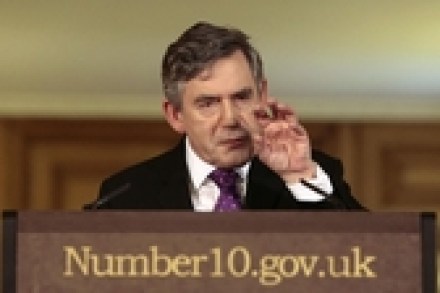
Watching Gordon Brown’s press conference you realise how on the ropes he is. The opening questions are all about the letter and Brown’s misspellings. Brown doesn’t have an answer that can shut this damaging story down and it is noticeable how he lacks the easy, public empathy of a Blair or a Cameron. Then the focus turns to Afghanistan and Brown lacks a compelling rationale for the presence of British troops there. All the while, everyone is forgetting the announcements on the NHS which Brown was trying to showcase this morning. When you consider that even with Brown acting as a drag on Labour’s electoral fortunes, some polls only suggest that the Tories are on course for a single figure majority, one wonders whether Labour will finally dump him.

Brown’s spelling mistakes prove how badly run Downing Street is

From our UK edition

The row over Gordon Brown’s spelling mistakes in a letter to the mother of a soldier who had been killed in Afghanistan shows how badly run Brown’s Downing Street is. It is well known in Westminster that Brown’s handwriting is poor because of his bad eyesight. There is little that can be done about that and it is rather unfair to criticise him for that. But someone in Brown’s office should be checking all his letters to the families of the fallen to check that all the names in them are spelt correctly. Because this basic fail-safe mechanism is not in place there is now a family whose grief has been compounded and a political situation that is damaging the Prime Minister; this is the kind of story that sticks in peoples’ minds.

A question of dates

From our UK edition

The news that Labour’s financial problems are restricting its campaigning activities with its call centres running at a quarter of their usual pre-election level does suggest that Brown might decide to go to the country earlier than the expected election date of May 6th, as Isabel Oakeshott notes. For Labour there is a real danger that the Tories could so out-spend and out–campaign Labour between now and the official start of the election campaign, with its attendant spending limits, that the Tory lead in the battle ground seats could be insurmountable even before the actual campaign has begun.

A healthy policy development

From our UK edition

Tory health policy is often criticised for not being radical enough. But Andrew Lansley’s announcement last week that the Tories would encourage John-Lewis style employee ownership and provision of services in the NHS is to be hugely welcomed. The scheme would cover outpatient clinics, health visitors and community nurses among others. The idea is what Phillip Blond, the Red Tory guru, argued for in The Ownership State. Blond’s aim is a “breakup of monolithic state provision by employee driven buyouts to form social enterprises making better use of public money by creating an organisation owned by its providers and users.” Mutualism is a politically attractive idea that actually works.

Obama’s three Afghan mistakes

From our UK edition

The Obama administration did not inherit a good situation in Afghanistan. But decisions it has taken have made the situation there worse. First, during the transition it flirted with the idea of withdrawing US support from Hamid Karzai but did not follow through. The result of this was that Karzai—worried about losing American support—came to rely ever more heavily on the support of the worst elements in his circle making him an even worse partner than before. Second it downplayed the importance of democracy promotion. Some might claim that this was sensible pragmatism.

The expenses scandal has delighted the Tories — it keeps Brown in power

From our UK edition

James Forsyth reviews the week in Politics To step into the House of Commons nowadays is like gatecrashing a wake. In happier days, its corridors were full of MPs quietly plotting. Now, the scene is members being offered a supportive squeeze of the shoulder by a colleague. The ones being consoled are those who have been ‘Legged’ — to use a phrase — ordered to repay substantial sums of money by Sir Thomas Legg. There is no gloating over the fate of these unfortunates; too many MPs know it could have been them. For scores of MPs, such concerns have supplanted normal politics.

Why the Euro-sceptics are quietly confident

From our UK edition

On Wednesday afternoon few of us would have thought that the row over the Tories’ Europe policy would appear to have died down by Friday afternoon. There have been a couple of resignations from the Tory front bench in the European Parliament, a few MPs have mouthed off and a French foreign minister has launched a spectacular—and stupidly phrased attack on it. But it is all quiet out there now. The main reason for this is that the Euro-sceptics are quietly confident. The overwhelming mood among those I have spoken to is that Cameron either has to get the powers back he said he would and show that his measure to prevent any further transfers of sovereignty are effective or there will have to be at some point after 2014 an in or out referendum.