James Forsyth

James Forsyth

James Forsyth is former political editor of The Spectator.

Labour drops a point, Tory lead up to six

From our UK edition

The new YouGov numbers have the Tories steady on 38 and Labour down one to 32 while the LibDems are on 19. Again, these numbers are within the margin of the error. The biggest impact of these numbers will be to strengthen the Tory view that the Ahscroft affair is a media obsession of little interest to the electorate. But I find it hard to imagine that the whole sorry affair is not doing reputational damage to the party.

Labour will relish this opportunity to prolong the Ashcroft story

From our UK edition

When Gordon Brown pulled out of PMQs this week because of Jacob Zuma’s state visit there was much chortling that he didn’t much fancy PMQs. But I suspect that Labour is rather glad that William Hague is up today; no Tory politician is more central to the Ashcroft peerage than Hague, and Hague’s appearance at the despatch box is Labour’s best chance of taking this story into a third day. Hague will have his line that Ashcroft would pay ‘tens of millions a year in tax’ thrown back at him repeatedly. Hague’s trips with Ashcroft to various foreign locales will also get an outing. There is something incredibly frustrating about the Ashcroft fallout.

The YouGov tracker has the Tory lead at five

From our UK edition

In tonight's poll, the Tories are down one to 38 and Labour up one to 33. These changes are within the margin of error. But it does seem that whatever momentum the Tories had after Cameron's speech has stalled. (We shouldn't forget that it might be that the two point poll was an outlier and that nothing has really changed over the past few days).

Restoring the educational gold standard

From our UK edition

Every August we go through the same debate, are A-Levels getting easier? However harsh it may be on those who have just received their results, it is hard to avoid the conclusion that they are. There is a justified suspicion that the bureaucracy’s over-riding aim is to see a larger and larger proportion of students get A grades. So it is welcome news that Michael Gove is planning to get the government out of A-Levels. Instead universities, exam boards and other groups will determine what is tested and how. These groups will neither be interested in nor appear to be interested in artificially pumping up the numbers of pupils getting the top grades.

Tories up by seven in new YouGov poll

From our UK edition

The YouGov poll out tonight will ease Tory worries. It shows the Tories ahead by seven points, 39 to 32. Ten days ago, the Tories would not have been particularly happy about a seven point advantage. But seven points is much better than the two point lead they had this weekend and adds to the sense that they are moving on from their wobble.  The key thing to watch is if the Tories, who have gained two points since the last poll, continue to trend upwards. The party will certainly breathe easier once it is back above the psychologically important forty percent mark. There is also a ComRes poll out tonight which has the Tories ahead by five. That would, on a uniform swing, make Labour the largest party in the Commons.

Are the Tories over the worst of the wobble?

From our UK edition

We are expecting at least one poll tonight, the YouGov tracker, and I think there will be one other. If these polls show the Tories ahead by six—a level that just last week was seen as rather disappointing—they will add to the sense that the Tories are over the worst of the wobble. Significantly, the Lord Ashcroft story, an irritating one for the party and particularly so today, is not being depicted as part of a Tories in crisis story. (One does wonder why Ashcroft didn’t choose to get the news out earlier after the Information Commissioner ruled at the beginning of February that the Cabinet Office should reveal what undertakings Ashcroft gave when he accepted a peerage.

The no notes speech does the trick for Cameron again

From our UK edition

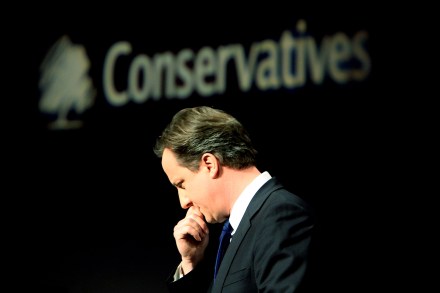
Whenever a sense of crisis is building around him, David Cameron delivers a speech without notes. This has the effect of bringing things to a head, of creating a moment which, if Cameron can make it through, the situation is defused. Today’s speech did that. It has, I suspect, moved the story on from Tory wobbles. This strategy is, obviously, not without risk. If Cameron had dried up on stage or mangled something beyond repair then the crisis story would have been escalated. The intensity with which George Osborne and Michael Gove, Cameron’s two closest shadow Cabinet allies, were listening to the speech showed how much was at stake. The Labour critique of the speecg is that it lacked ‘substance’.

Cameron’s speech delivers

From our UK edition

When you watch David Cameron speak without notes you wonder why they ever let him speak with a text. You can tell when Cameron is on form as he stops and sets himself before he delivers the bit that he hopes will be clipped for the news and he was back to doing that today. To be sure, the speech was not as good as the 2007 conference one. But it did the job which was to frame the election as a choice between Cameron and five more years of Gordon Brown. The speech was not as much about Brown as I expected it would be. But there were some sharp attacks on him. Cameron declared that ‘every day Gordon Brown is Prime Minister is a grey day for our country’.

Cameron to speak ‘from the heart’

From our UK edition

There is only one topic of conversation here in Brighton, the shrinking Tory poll lead. The optimistic take is that a poll suggesting Labour would be the largest party actually makes the prospect of five more years of Gordon Brown real to people and so lets the Tories emphasise that this election is choice between them and Labour. As Cameron’s spokesperson jokes, ‘Labour’s underdog strategy has been blown apart’ The poll does give David Cameron’s speech today a whole new level of significance. Cameron will reprise his walking and talking technique that served him so well in 2005 and 2007 today. He will speak ‘from the heart’ for about half an hour. I’m told there are no new policy announcements in the speech.

The Tory lead is down to two points, Cameron needs to deliver a brilliant speech

From our UK edition

The mood in the bars of Brighton is grim: the Tory lead is down to two points in the latest poll. (As UK polling Report notes, any individual poll should be treated with caution) The poll is, obviously, bad news for the Tories. But it does set the stage for David Cameron’s speech tomorrow. Cameron will deliver the speech without notes and from past experience we know that when he does that he tends to deliver a very good speech—see the 2005 and 2007 conferences for examples. If Cameron can emphasise to the country why it shouldn’t want five more years of Gordon Brown and how the Tories will change things, then the materials will be in place for a fight-back narrative.

The Tories deploy their strongest weapon, the prospect of five more years of Gordon Brown

From our UK edition

If you had a fiver for every time a Tory speaker today has said ‘five more years of Gordon Brown’ you would soon be rich enough to start worrying about the 50p tax rate. All the speakers in the economy debate stressed how the country ‘cannot afford five more years of Gordon Brown.’ George Osborne talked about how the Tories had to win three battles---the battles over the past, the present and the future.  Ken Clarke, who looked like he has taken to visiting Boris Johnson’s barber, was charged both with boosting George Osborne and emphasising that ‘Brown played a major role in making this crisis worse than it needed to be.’ Clarke is the perfect person to deliver this message.

Hague warns the country: If you don’t vote Conservative this time, it will be too late to reverse Britain’s decline

From our UK edition

As this morning papers’ show, the Tories know that their spring conference here in Brighton offers them a chance to change the narrative of this campaign, to get back on the front foot. William Hague’s speech, the first big set-piece of the event, tried to frame the choice facing the country at the election as being between ‘change or ruin’. Hague warned that if the country doesn’t return a Conservative government at this election, ‘it will be too late...too late to reverse the decline: the debt will be too big, the bureaucracy too bloated, the small businesses too stifled, the slope Britain is sliding down will be too steep.’ Labour will try and say that this language is shrill, a sign of Tory panic. But there’s a lot of truth to it.

The Tory situation is now verging on critical

From our UK edition

Why has the Tory lead halved since December? James Forsyth says that Cameron and his four top men — Osborne, Hilton, Coulson and Bridges — must take the blame for the party’s dismal performance and its lack of message and purpose One evening earlier this week a group of senior Tories gathered for a secret meeting in a house in Notting Hill. All of the most trusted members of Cameron’s inner circle were there — George Osborne, Steve Hilton, Andy Coulson, Michael Gove — but the atmosphere was not one of jubilation, or even excited determination. The predominant mood was despair. Osborne put their worries into words: What’s going wrong? he asked. Why are we slipping in the polls, even when Brown is so unpopular?

The election speculation has given Cameron an opening

From our UK edition

Tory spring forum gives David Cameron a chance to regain the momentum. The media will be there in numbers and I suspect that the rumours of an early election mean that it will get more attention than it otherwise would have done. Cameron’s speech is a real chance to show what the Tories are going to fight the election on. The speech isn’t as important as the one he gave at the 2007 conference when Brown appeared set to call an election, but Cameron would be well advised to reprise a couple of tricks from it. He should speak without a text—Cameron is just such a better speaker that way. He also needs to show—as he did in that 2007 speech—that he is up for an election.

The Tories need to talk about immigration

From our UK edition

As the Tories prepare to head to the seaside, Tim Montgomerie has published a ten point plan to get the Tory campaign back on track. The plan is already causing much discussion in Tory circles. His main points are that the Tories need to sharpen their economic message, use William Hague more, sort out the structure of the campaign, warn of the dangers of a hung parliament and ram home to voters just how badly Labour has failed.   What is getting the most attention, though, is Tim’s suggestion that the Tories should talk about immigration. I tend to agree with Tim on this point. It was a strategic mistake in 2005 to talk about immigration so much but it would be an equally large mistake not to talk about it at all this time round.

Getting the Tories back on track

From our UK edition

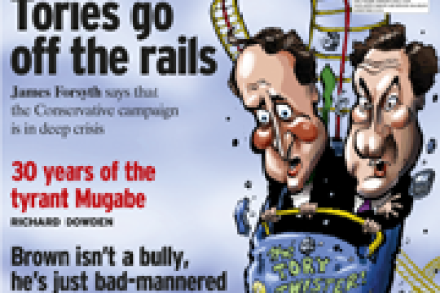
At the beginning of this week the key figures in the Tory election campaign gathered together in Notting Hill to try and work out what was going wrong with the Tory campaign, why the Tory lead has halved since December. Our cover this week attempts to answer this question. My take is that the problem is largely caused by the structure of the campaign. Successful campaigns tend to have a chief strategist and a campaign manager. The strategist's job is to work out what the election is about and the campaign manager's role is to implement that vision and take charge of day to day tactics. The Tory problem is that they have no campaign manager and four men - Steve Hilton, George Osborne, Andy Coulson and George Bridges - who appear to be vying to be chief strategist.

Worse off than you were in 2005

From our UK edition

The obsession of British politicians - and political journalists - with American politics is often mocked. But there's a clarity to American political messages that is often missing in this country. So it is good to see George Osborne borrowing a line from the Reagan playbook, and pointing out that people are now worse off than they were at the last election. The Tories desperately need to shift the focus of the campaign back onto Labour's failures and this is a start to that process. Osborne is delivering the Mais lecture tonight, one of the prestige dates in the British economic calendar. He's the first shadow Chancellor to deliver it, a sign of how much the markets and everyone else are waiting to see what Osborne does.

Darling calls McBride and Whelan the ‘forces of hell’

From our UK edition

I missed it but Alistair Darling’s interview with Jeff Randal seems to have been quite remarkable. He talked about ‘the forces of hell’ being unleashed against him by No 10 after he talked about how bad the recession would be in August 2008. When pressed on McBride and Whelan’s alleged involvement in the briefing against him, Darling replied:  Frankly, my best answer for them is: I'm still here. One of them is not.” It is unusual to see Darling taking such a public victory lap, but those close to him say that he was infuriated both by the briefing against him then and by the various efforts made to make Ed Balls Chancellor.

Post-Rawnsley YouGov poll has Tory lead at six 

From our UK edition

Last night I posted on a YouGov poll which had the Tories above forty and ahead by 12. It now turn out that those numbers were wrong and that the poll actually showed something very different—apologies for that. The real figures are Tories 39, Labour 33. Considering that this poll was conducted after the Rawnsley revelations had come out, it is going to add to the sense of nervousness on the Tory side.

Post-Rawnsley poll has Tories over 40 and ahead by 12

From our UK edition

Apology: The actual YouGov numbers did not show an increase in the Tory lead. Instead, they showed the Tories unchanged at 39 and Labour unchanged on 33. Apologies. The second poll of the night is much better for the Tories and will calm some jangled nerves. A YouGov poll carried out for the Sun after the Rawnsley revelations and has the Tories up two to 41 with Labour dropping four to 29. This poll has, obviously, been taken at the worst time for Labour but, at first blush, it does suggest that the bullying allegations have cut through.