Deeper into the mire
From our UK edition
It is just getting worse and worse for Brown. The woman he insulted is a widow whose husband died of cancer and who worked with handicapped children.

James Forsyth is former political editor of The Spectator.
From our UK edition
It is just getting worse and worse for Brown. The woman he insulted is a widow whose husband died of cancer and who worked with handicapped children.
From our UK edition
Brown calling Gillian Duffy that ‘bigoted woman’ from the safety of his car having ended his conversation with her cordially is, obviously, hugely damaging for Labour’s campaign. But I suspect Nick Clegg will also suffer some collateral damage as it will push immigration to the top of the political agenda, an area where the Lib Dems with their plan for an amnesty for illegal immigrants are on the wrong side of public opinion.
From our UK edition
Now we know why the Labour campaign was so keen to keep the Prime Minister away from ordinary voters. This moment is going to be replayed again and again. Already lobby journalists are calling their offices saying, ‘Shall we buy her up?’ The moment is so devastating for Mr Brown because it sums up what people hate about politicians. He didn’t tell the woman she was a ‘bigot’ to her face but waited until he was back in the car to say it. Next, it is going to be turned into a story about how Brown thinks that anyone who worries about immigration is a bigot. One final thought: spare some sympathy for those who work for Brown.
From our UK edition
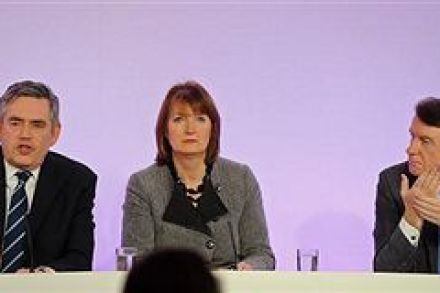
Labour’s press conference this morning highlighted the party’s problem. Labour is demanding that the media cover policy more than process and personality. But when the discussion turns to the biggest policy issue of the day—how to cut the deficit—Labour doesn’t want to engage. This morning, Nick Robinson, Adam Boulton, Andrew Neil all pushed Mandelson, Balls and Cooper on this issue. All of them were clearly frustrated by Labour’s lack of answers. Ironically, all the memorable lines from Labour’s press conference came when process and personality were discussed.
From our UK edition
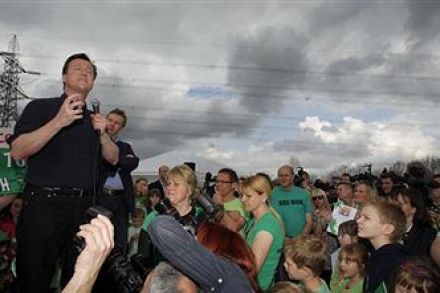
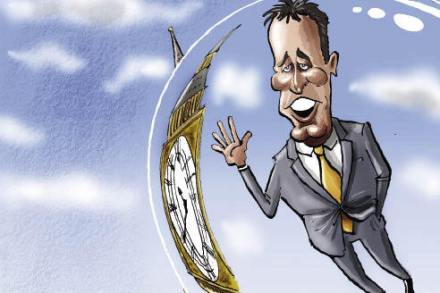
Cameron is now in Lib Dem held Romsey. After a walk-about, where he received a largely positive reception, he delivered a stump speech. His message was that Nick Clegg, with his comment that PR is a pre-condition to getting Lib Dem support, is trying to hold the whole country to ransom. “It is now becoming clear he wants to hold the whole country to ransom just to get what would benefit the Liberal Democrats." The aim is simple: portray Clegg as just another politician, interested in power and his own self-interest. As I say in the magazine this week, how quickly the Clegg bubble bursts will be determined by how quickly the public concludes that Clegg is not some tribune of the people but just another politician.

From our UK edition
David Cameron is visiting Hampshire today, hitting both Labour and Lib Dem held seats. In a visit to Southampton University, he was confronted by a feisty Lib Dem supporting student who accused him of planning changes that would make it more difficult for working class kids like her to go to university. Cameron dealt with the question well. He said that the Tories would keep bursaries and that there simply isn’t the money to abolish tuition fees. He also pointed out that currently only 40 odd children on free school meals go to Oxford and that Tory plans to bust open the state monopoly in the provision of education would improve the quality of state education and thus social mobility.
From our UK edition
There is clearly a real chance that the Conservatives will get the most votes and the most seats at the election but still be significantly short of a Commons’ majority. If Cameron is asked to form a government in these circumstances, he has two options. The first, as I say in the Mail on Sunday, is to play chicken with the Liberal Democrats; to compromise on nothing and dare the Lib Dems to bring down the government. The second is to make some kind of deal. The Lib Dems, who have had many internal discussions about what kind of deal they would cut, have a whole set of mechanisms—the triple lock—to ensure that the party is happy with any deal that their leader strikes. There are no such safeguards on the Tory side. A formal Tory Lib Dem coalition is highly unlikely.

From our UK edition
We’ve just seen the first Tory event designed to show—not tell—people what the big society actually is: David Cameron and Michael Gove speaking to a rally of parents in West Yorkshire who want to set up their own school, something that they’ll be able to do if the Tories win. At last, the Tories are selling their best policy: the right of parents, teachers and social enterprises to set up free, independent schools. The parents at the rally today are motivated by the fact that their local school has been shut down by educational bureaucrats and that their children now have an absurdly long journey to school.
From our UK edition
On Wednesday, Vince Cable said during the Chancellors’ debate that the Tories’ planned £6 billion of efficency savings really didn’t amount to that much. Here’s the exchange: Andrew Neil: ‘Vince you used to be an economist. Are you seriously arguing that 6bn would make a difference one way or the other to a 1.5 trillion pound economy’ Vince Cable: ‘No I wouldn’t. But what I would argue for is broad fiscal neutrality. On this issue of timing it’s absolutely right in the coming year’ AN: ‘What does that mean in English?
From our UK edition
The Nick Clegg bubble has been caused by the mistaken view that he is not a machine politician, says James Forsyth. But if this bubble doesn’t burst before polling day, then it could be the end of the Tory party as we know it Both Andy Coulson and the gaggle of journalists surrounding him agreed that there had been ‘no game-changer’ in the first leaders’ debate. As the Tory communications chief, it’s his job to be optimistic — but this was not spin. He believed it. And so did most of the Westminster insiders, who gave the debate to Clegg on points but thought there was no moment in the 90 minutes that was going to transform the campaign.
From our UK edition
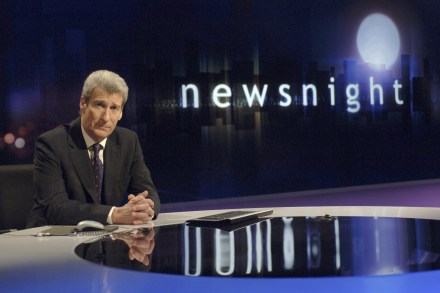
David Cameron is recording his interview with Jeremy Paxman at 5.15 today, it’ll air at 8.30. Cameron didn’t want to do this interview. Originally, Clegg was the only leader to agree to be interviewed by Paxman. But after the first debate, Brown said yes and the Tories decided that Cameron couldn’t be the only party leader not to do it. There is, of course, history between Paxman and Cameron. When Paxo interviewed Cameron during the 2005 leadership contest, Cameron turned the tables on Paxman spectacularly, attacking the whole Paxman school of interviewing. Cameron’s approach in 2005 was previewed by a very funny piece by Michael Gove in The Times which imagined Paxman interviewing Jesus.
From our UK edition
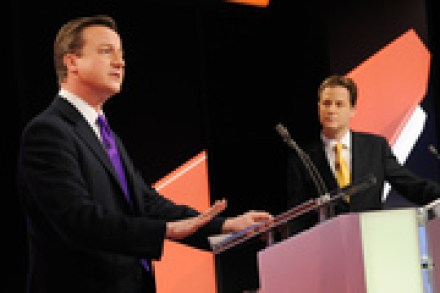
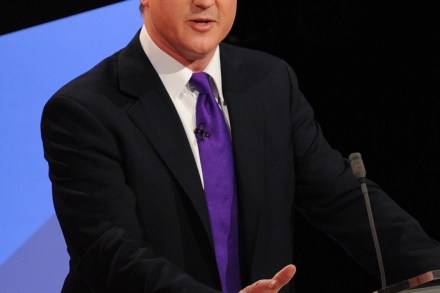
It seems that the general election of 2010 will turn on 90 minutes next Thursday. David Cameron was far better tonight than he was last week. This time he managed to bracket Brown and Clegg together and had the moment of the debate when he called Brown out on Labour’s leaflets claiming the Tories would scrap various things that pensioners currently get free. If there was a YouTube moment in the debate, it was that exchange when Brown said he didn’t authorise the leaflets making these claims. The Tory press team then delighted in pointing to a Labour party political broadcast where they had suggested the Tories would take away these things. Nick Clegg came under far more fire than he did in Manchester.
From our UK edition
The foreign policy portion of tonight’s debate offers Nick Clegg several opportunities to bracket Labour and the Tories together. Both of them supported the war in Iraq, both won’t take the military option off the table when it comes to Iran and both believe in the centrality of the alliance with the US to UK foreign policy. On this final point, it’ll be fascinating to see if Clegg launches a full-on assault on the view that the America alliance is the cornerstone of UK foreign policy. He sketched out the arguments against thinking about the special relationship in a speech the other day and there’s no doubt he could score some populist points by accusing the other two parties of being overly deferential to Washington.
From our UK edition
This poll is going to be rapidly overtaken by events, but tonight’s YouGov tracker has the Tories up one to 34, Labour up two to 29 and the Lib Dems down three to 28. We’ll have at least two instant post-debate polls tonight so we’ll have a good idea of who, if anyone, is going to get a boost from tonight’s poll before we go to bed. But this debate is expected to have a far smaller audience than last week’s so might not have quite the same impact. Although, I hear the Sky questions will aim to put the party leaders’ on the spot more than those last week did.
From our UK edition
If seven days ago, anyone had suggested that the first debate would propel Nick Clegg and the Lib Dems to the top of the polls we’d all have thought that their lunch had gone on rather too long. But that’s what happened. Tonight, the questions are whether Gordon Brown reprises his ‘I agree with Nick’ routine or tries to check Clegg’s momentum and whether Cameron can turn in the kind of performance that begins to turn things round for him. Cameron shouldn’t be angry tonight. But he does need to bracket Brown and Clegg together at every opportunity.
From our UK edition
There’s a great example of people power on the letters page of today’s Guardian. Last week, a bunch of the educational establishment wrote to the paper decrying the Tory plans to bust open the state monopoly in education and let parents, teachers and voluntary groups set up new schools. Today, 650-odd parent groups have written back, explaining why they want to set up their own schools and give to the many what is now preserved for the few: the right to choose a good school for their child. There isn’t anything equal about schooling in Britiain at the moment.
From our UK edition
In 2006 several businessmen—all declared Lib Dem donors—paid money directly into Nick Clegg’s private bank account on a monthly basis reports the Daily Telegraph on its front page tomorrow. The Liberal Democrats point out that this money was being used to pay half the salary of a member of Clegg’s staff and not for any personal purpose and that the money was declared to the parliamentary authorities. Clegg’s accounting is certainly sloppy. For obvious reasons, it is not ideal to have donors paying money directly into a politician’s bank account. Politically, the problem this poses for Clegg is that he has set himself up as being above the old politics and this arrangement seems very old politics.
From our UK edition
George Osborne put in a fiery and impressive performance in the Chancellor’s debate today, firing off some memorable one-liners as well as unveiling a letter from the former head of the anti-avoidance group at the Treasury questioning the sums on which the Lib Dems’ tax plans depend. Indeed, since the Lib Dems surged, Osborne has found another level to his public performances. Today’s debate win followed a good spot by Osborne on the Politics Show on Sunday. One striking thing about the debate was how it was Darling who signaled the assault on Cable when he started querying Vince’s numbers. It’ll be fascinating to see if Brown takes any similar swipe at Clegg tomorrow; his interview in the Indyhttp://www.independent.co.
From our UK edition
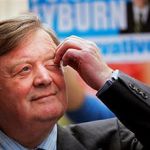
Ken Clarke delivered the IMF warning today at the Tory press conference. Clarke, a politician experienced enough to remember the last time no party had a majority in the Commons and the last time the IMF was called in, said that if the electorate did not put in a government with a working majority that is serious about dealing with the debt and the deficit then the IMF will do it for us. He scolded the electorate, saying that ‘not every single member of the electorate seems to realise how serious this election is.’ The Tories hope that this bucket of cold water will help end voters’ infatuation with Nick Clegg and the Liberal Democrats.
From our UK edition
Tonight’s YouGov poll has the Lib Dems three point ahead. They are on 34, the Tories on 31 and Labour on 26. In terms of working out what this would mean in seats, I doubt that uniform national swing is that useful. But for the sake of argument, let’s imagine that did occur. These poll numbers would leave Labour as the largest party in the Commons and the Lib Dems as the third party. One wonders what on earth happens then. The Palace would pretty much have to summon Brown, he’s the sitting Prime Minister and would be the leader of the party with the most seats. But I can hardly imagine the Lib Dems, if they had the most votes, agreeing to serve as junior partners in anyone’s coalition let alone Brown’s.