James Forsyth

James Forsyth

James Forsyth is former political editor of The Spectator.

David Cameron seems more and more committed to interventionism

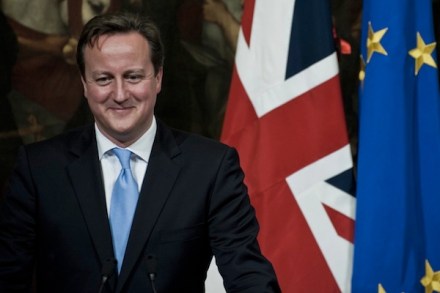
A visibly tired David Cameron has just completed his statement to the House of Commons on the hostage situation in Algeria. What was striking about it was the starkness of the language that the Prime Minister used. He talked about Al Qaeda in the Maghreb and other North African terrorists groups posing a ‘large and existential threat’, warned that they ‘thrive in ungoverned spaces’ and that ‘parts of Mali have become a safe haven for Al Qaeda’ and declared that if it is not confronted ‘the threat there will grow and we’ll face it as well’.
Tim Loughton vs the Department for Education

In a week where the inner workings of Whitehall have rarely been out of the news, Tim Loughton’s evidence to the Education Select Committee has made a particular splash. As Isabel reported yesterday, Loughton criticised the way the department was run and claimed that the children and families agenda ‘was a declining priority' in his time there and had been ‘greatly downgraded since the reshuffle.’ Inside the Department of Education, there’s real irritation at Loughton’s comments. One senior Department for Education source launched the following broadside: 'Tim Loughton opposed transparency on child protection and sided with those all over the country who want to maintain a culture of secrecy.

Cameron’s European moment has come – a year late

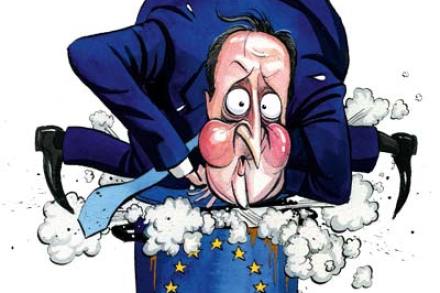
David Cameron should have given his big Europe speech a year ago. Having just threatened to veto a new EU treaty, he had proved that he was prepared to aggressively defend Britain’s interests, and he had reassured those in his party who worried he wasn’t really serious about Euroscepticism. An address delivered at that point, which was clear about his vision for Britain’s role in Europe but vague about how he intended to achieve it, would have received a fair wind. But there was no follow-up. The veto was left to stand on its own, unconnected to a broader European policy. There were several reasons for this. The first is that Cameron has always been slow to take advantage of his successes; he has failed to grasp that no currency depreciates faster than political capital.

PMQs: Miliband mocks ‘divided’ Tories

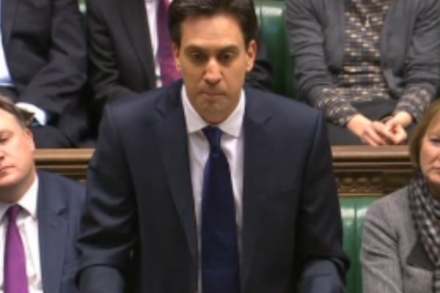
After PMQs today, David Cameron must be wishing he could just get on and deliver his much-trailed Europe speech. Ed Miliband took advantage of all the speculation to mockingly question Cameron on the subject, asking him to comment on every bit of process. Cameron wouldn’t rule out this morning’s James Chapman scoop that Tory ministers will be allowed to campaign on different sides of the referendum question. This made it all too easy for Miliband to get away the line: ‘ it's the same old Tories, a divided party and a weak Prime Minister’. For Miliband, that was mission accomplished. Those close to Cameron are arguing that Miliband has now shut the door to Labour offering a referendum, putting Labour on the wrong side of public opinion.

Hostilities deepen in Whitehall Wars

‘The relationship between my civil servants and me is summed up by trust and understanding. I don’t trust them and they don’t understand me,' one Secretary of State likes to joke. The quip sums up the current, tense mood in Whitehall. Today’s Times has done a superb job chronicling just how bad things have got. Many ministers and special advisers feel that they are being made to do huge amounts of work to compensate for the failings og the civil service and being made to carry the can when the permanent bureaucracy messes something up. But before this is dismissed as just griping from ministers who are struggling with mid-term, it is worth noting Tony Blair’s trenchant criticisms of the civil service.

No 10 has intensive work ahead to prevent Tory criticism drowning out Cameron’s EU speech

The date of David Cameron’s Europe speech has been moved yet again. But this time it has been pulled forward, to this Friday. Downing Street realised that they weren’t going to be able to talk about anything else until the speech was done. The mood in the party ahead of the speech is not good. There’s considerable irritation among Tory Cabinet Ministers that they haven’t been consulted about the speech. Another source of irritation for Eurosceptic ministers is that Ken Clarke has been allowed to — or, at least, not prevented from — joining up with Peter Mandelson and this new Centre for British Influence Through Europe.

The Britain in Europe crowd were wrong then, so why should they be right now?

Ed Miliband’s speech to the Fabians is being rather over-shadowed today by Lord Heseltine’s attack on David Cameron’s EU policy; the political media like nothing more than a 'Tories split on Europe' story. I suspect, though, that Labour won’t mind this too much. Heseltine’s criticisms make the Tories look divided and allow Labour to claim that even Cameron’s own growth adviser thinks his Europe policy is wrong. Of course, there is nothing surprising about Heseltine’s criticisms: he is an ideological pro-European. He wanted Britain to join the euro, something that would have been a total disaster for this country, and even now believes that we will join the euro one-day.

Exclusive: John Nash is the new schools minister

The new schools minister is John Nash. He succeeds Lord Hill who has gone off to replace Tom Strathclyde as leader of the House of Lords. Nash, a venture capitalist, is the sponsor of Pimlico Academy, one of the original Adonis academies, and has been a non-executive member of the Department for Education’s board for the past two years. This means that he already knows both the academy and departmental ropes. Given that he is close to Michael Gove and the other key figures in the department and part of what they are trying to do, there shouldn’t be much lost in transition. I suspect that there’ll be a media squall over the fact that Nash and his wife have donated £300,000 to the Tories over the years.

The accidental exit

If Britain leaves the European Union, historians will say that 30 June 2012 was when the great exit began. That day, David Cameron was due to write an article for the Sunday Telegraph and his advisers were frantic. It was a last-minute idea, to balance out some loose talk from the Prime Minister at a Brussels press conference. The piece was being drafted by committee and on the hoof. Aides stood at railway stations and in airport lounges emailing a line here and a tweak there. The result was Cameron’s gnomic pledge that ‘for me the two words “Europe” and “referendum” can go together’. What did it mean? Those who inquired were asked to show patience. The Prime Minister would have more to say in the autumn.

Andrew Marr recovering following a stroke

Andrew Marr is recovering from a stroke in hospital, the BBC has said this evening. We at Coffee House wish him well in his recovery. The BBC's statement on Andrew Marr's condition: “Andrew Marr was taken ill yesterday and taken to hospital. The hospital confirmed he has had a stroke. His doctors say he is responding to treatment. His family have asked for their privacy to be respected as he recovers. "We will continue to broadcast The Andrew Marr Show and Radio 4’s Start The Week with guest presenters in his absence. His colleagues and the whole BBC wish him a speedy recovery.” Acting Director-General, Tim Davie, said: "I am very sorry to hear the news about Andrew. I wish him a speedy recovery and hope to see him back at the BBC soon.

What David Cameron plans to say in his Europe speech

David Cameron’s big Europe speech is now less than a fortnight away. It will be, I suspect, the most consequential speech of his premiership. When you look at the challenges involved, one can see why the speech has been delayed so many times. Cameron needs to say enough to reassure his party, which has never been more Eurosceptic than it is now. But he also needs to appeal to European leaders, whose consent he will need for any new deal. At the same time, he’s got to try and not create too much nervousness among business about where all this will end up. I understand that he intends to argue that Britain needs to remain inside the single market. But he will commit to a renegotiation of Britain’s terms of membership, starting after the next election.

PMQs: Leaders trade dull insults as Andrew Mitchell holds court

No one could call today’s PMQs illuminating. Ed Miliband led on the whole embarrassment of a Downing Street aide being snapped with a memo about whether to release a full audit of the coalition’s performance. There followed some not particularly sharp PMQs knock-about. Miliband claimed the ‘nasty party is back’ while Cameron bashed Labour for having no policy and took his usual shot at Ed Balls. There was a brief flurry of excitement when David Cameron declared, unprompted, that he had never broken the broken the law. Lots of the press are now pointing out various incidents when we know that he has. But in the Chamber it was clear that Cameron was talking about the hunting ban, the subject of the question, rather than more generally.

Mid-term review: A return to the rose garden?

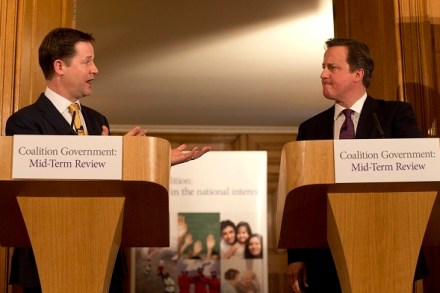
‘David Cameron and Nick Clegg get coalition better than anyone else in the government’ one Downing Street aide remarked to me recently, and watching the two men at today’s press conference you could see what they meant. Us hacks who came looking for disagreement or awkward body language went away disappointed. As they both talked about how the coalition had come together to deal with long-term challenges and, to quote Cameron, the ‘positive benefit’ of two parties working together on these issues, I wondered if they thought that a second term of coalition might be needed to deal with Britain’s long-term problem. Intriguingly, when asked Cameron refused to say that if he had a majority of one, he would definitely govern on his own.

Lord Strathclyde resigns over frustration with Lib Dem peers

Lord Strathclyde was a skilful leader of the House of Lords. An immensely charming man, he was — generally — able to coax legislation through a chamber where the government has no majority. But he was becoming increasingly frustrated at the behaviour of some Liberal Democrat peers. Shortly before Christmas and as Liberal Democrat Lords rampaged against the Cameron-Clegg compromise on secret courts, he remarked to one colleague that the ‘coalition had already broken down’ in the House of Lords. The lack of a government majority in the Lords and the fact that Liberal Democrat peers tend to hail from the left of the party means that even with Lords reform off the agenda, being Leader of the Lords is not an easy job.

Cameron readies childcare package

David Cameron and Nick Clegg will launch the coalition’s mid-term review tomorrow. There will be some announcements in it. But I understand that some of the most interesting, new coalition policies are being held out from it. The government wants to keep some of its powder back for later. There are also some final details to be worked out in certain areas. I’m informed that there’ll be a Quad on childcare this week. The coalition is close to agreement on a package which, as I say in the Mail on Sunday, would see working mothers receive thousands of pounds of help with childcare costs for the under fives. This will follow on from moves to liberalise the sector which will be announced in the next week or so.

In a preview of David Cameron’s 2013, Europe dominates his New Year interview

David Cameron’s New Year interview on Marr was dominated not by the economy but by Europe. In a sign of what the promise of a speech setting out his European strategy has started, Cameron was repeatedly asked about what powers he would like back. He didn’t give much away, repeatedly telling Andrew Marr he would have to wait for the speech later this month. But two interesting things did emerge. First, Cameron indicated that he wanted to toughen up the way that the free movement of people is applied. I presume this means that only those with work or a clear means of support could come here; Nick Boles and others have long argued that this is possible under the existing treaties. Second, Cameron indicated that the new terms-or-out referendum would take place within five years.

Parts of the Left are beginning to realise that they got the family wrong

One of the more interesting trends in British politics in the last few years has been sections of the left realising that the cultural changes of the 1960s and 70s too often chucked the baby out with the bathwater. Today, Diane Abbott has given an interview to Patrick Wintour in which she calls for more support for the family; arguing that stable families are the best way of preventing social breakdown. She also concedes that feminists were too ‘ambivalent’ about the family. Interestingly, Abbott also comes out in favour of school uniforms. She points out that they are a check against materialism and the designer label arms race. Now, I know that it is easy to mock Abbott — the left-wing fire brand who sent her son to a private school.

The Tory message in 2015: Vote Cameron for PM

One thing is already apparent about the Tories’ 2015 campaign, it will be even more dependent on David Cameron than the 2010 one was. Why, because as Anthony Wells points out again today, Cameron polls ahead of his party. There’ll be those who criticise this decision. They’ll point out that the big billboard posters of him in 2010 backfired badly. Others will wonder what more juice can be squeezed out of Cameron, given that by the next election he’ll have been leading the party for nigh-on ten years. But to the Tory leadership, the Cameron lead on the best Prime Minister question is one of their trump cards. It is key to their attempt to take seats off the Lib Dems.

The Cameron election

One of the first things that the coalition did on taking office was to announce the date of the next election. This was meant to prevent destablising speculation about when the two parties might split apart and go to the country. It has largely succeeded in doing that. But there has been an unintended side-effect. Knowing the date of the next election has made all the parties far more obsessed with election planning than they normally would be. When two or three Conservatives are gathered together, attention invariably turns to 2015. David Cameron’s New Year message read, deliberately, like the first part of an election address. In conversation with members of the Cabinet you would think that polling day is six months away, not 29.