Isabel Hardman

Isabel Hardman

Isabel Hardman is assistant editor of The Spectator and author of Why We Get the Wrong Politicians. She also presents Radio 4’s Week in Westminster.

Is the reshuffle the answer to Labour’s woes?

From our UK edition

More than 24 hours after he started trying to reshuffle his shadow cabinet, Sir Keir Starmer has finally got what he wanted. He has moved his shadow chancellor, sacked Nick Brown as chief whip and moved Angela Rayner. Yesterday he told the party’s deputy leader that he didn’t want her to be party chair or campaign coordinator, and instead that she should move to shadow cabinet. After hours of negotiations, Rayner is now confirmed as – deep breath – Deputy Leader, Shadow First Secretary of State, Shadow Chancellor of the Duchy of Lancaster and Shadow Secretary of State for the Future of Work.As I reported earlier, Rayner had been pushing for some aides to be sacked from Starmer’s team.

All quiet on the Labour front: Starmer’s delayed reshuffle

From our UK edition

After a day of furious briefings between factions, the Labour Party has fallen mysteriously – and ominously – quiet. Shadow cabinet members I’ve spoken to are none the wiser. They are waiting by their phones to hear the latest moves in a reshuffle that was expected to begin at some point today but which has only managed to achieve one thing so far: an almighty and very ugly row about the sacking of Angela Rayner. And that was 24 hours ago. I understand that there should still be something later this evening, but the main problem facing Starmer is that he is trying to move Rayner from party chair and also get a new chief whip, replacing the very long-in-the-tooth Nick Brown.

Leading article, Fiona Mountford, Laurie Graham and Isabel Hardman

From our UK edition

24 min listen

On this week's episode, Fraser Nelson starts by reading our leading article: the Prime Minister promised 'data, not dates', so should we reopen before 21 June? (01:15) Fiona Mountford is on next, saying she's had enough of corporate faux-friendliness. (07:20) Laurie Graham reads her piece afterwards, wondering what to put in her Covid time capsule. (13:00) Isabel Hardman finishes the podcast by reading her notes on Dandelions - perhaps the 'cheeriest of wild flowers'.

Is Keir Starmer destined to become a ‘Kinnock-esque’ figure?

From our UK edition

Sir Keir Starmer is planning a policy review as part of his plans to ‘change’ Labour after the dismal Super Thursday results. This sounds, to put it mildly, like a rather small response to a rather big problem. Talking to MPs and campaigners over the past 24 hours, I have noticed a shift in the way many of them describe Labour's challenge. The Hartlepool result has underlined that the party’s recovery hasn’t yet started, and that it is going to be a very, very long time before that recovery can take the party back into government. Starmer could become a Kinnock-esque figure, who might merely prepare the ground for another leader who wins.

Does Keir Starmer have a plan to ‘reconnect’ with voters?

From our UK edition

Sir Keir Starmer has just accepted that Labour needs to 'change' and 'reconnect' with voters, following the Hartlepool by-election result. In a rather stressed and evasive TV interview, the Labour leader repeatedly said his party needed to change, but refused to say whether there would be a reshuffle, or indeed what the party's message would be. He insisted that this went 'beyond' a reshuffle or other questions of personnel. https://www.youtube.com/watch?v=utFBBwoqvdY The reason that Starmer was asked so often about whether there would be a reshuffle is that many in his party are pressing for a number of big changes. The three people in the firing line are shadow chancellor Anneliese Dodds, Starmer's political secretary Baroness Chapman, and his chief of staff Morgan McSweeney.

What the Hartlepool loss means for Starmer

From our UK edition

14 min listen

The local election results are coming in over the weekend, but the bombshell came early with Hartlepool going to the tories in a massive 16-point swing. Isabel Hardman speaks to James Forsyth and Katy Balls about how much the red wall has left to give.

Labour is bracing itself for a set of bad results

From our UK edition

Labour has started bracing itself for a very unpleasant few days of results in elections across the country. As polls close in local, mayoral, devolved assembly and police and crime commissioner elections, as well as the Hartlepool by-election, a party source has said: These were always going to be tough elections for Labour. Keir has always been honest about the mountain we must climb to rebuild trust to win the next general election. Labour is listening and we will continue to change in order to win back the trust of working people in Britain and their communities. Meanwhile, on the BBC’s Question Time, the party’s shadow housing secretary Thangam Debbonaire accepted that Labour’s message wasn’t getting through to voters.

Can Sarwar reverse Scottish Labour’s fortunes?

From our UK edition

Has Anas Sarwar got what it takes to woo Scottish Labour's lost voters? I joined the recently-elected leader of the party while on the campaign trail in Glasgow and you can read my interview with him in this week's magazine. His analysis is that Labour was in danger of becoming part of the past for many Scottish voters. His solution is to stop talking about the constitution in an attempt to avoid the 'divisive' politics that has dominated the country for years now and to encourage voters to take another look at his party. He told me that the 'big mistake that other political parties are making' is to 'make these elections about the British constitution'. He added: 'Because it's a pandemic election.

Can Anas Sarwar rescue Scottish Labour?

From our UK edition

When the Scottish parliament was set up by Tony Blair in 1999, it seemed as if Labour would govern Holyrood for the foreseeable future. The Scottish Tories were a contradiction in terms. Devolution was sold as a device that would kill nationalism ‘stone dead’. Suffice to say, this plan did not quite work. The Scottish National party took power in 2007, the Tories were resurrected as the new opposition and it was Scottish Labour that ended up on the brink of extinction. Now, for the first time in two decades, Scottish Labour is on the up, with a new party leader. Anas Sarwar, 38, was elected in February so has not had long to prepare for the campaign.

In defence of dandelions

From our UK edition

Dandelions are one of the cheeriest wild flowers. They are loved by children for their ‘clock’ seed heads, are entirely edible for humans and are a source of food for many insects and birds. And yet many gardeners go to great lengths to get rid of them. This year’s daffodils may have faded, but dandelions — their similarly coloured wild replacements — are in full swing, and it’s a vintage year for them. Road verges, meadows and lawns are covered in thousands of gold polka dots, with each plant bearing half a dozen blooms. They make a boring green sward far more interesting, and are — to my mind at least — as beautiful as the daffodils that are often planted in the same spots.

How serious would Labour losing Hartlepool be?

From our UK edition

12 min listen

A poll last night gave the Tories a 17-point lead in Hartlepool. Tomorrow's by-election in the red wall seat is to be one of the first barometers of Keir Starmer's leadership so far. How serious would a Labour loss be? Isabel Hardman speaks to Fraser Nelson and James Forsyth.

How Labour will spin defeat in Hartlepool

From our UK edition

Campaigning in the Hartlepool by-election is reaching its feverish final hours as the Labour party tries to hold onto the seat. There has been sufficient talk of the party losing the constituency for such a result not to come as a shock if it does happen. Indeed, many in the party are already talking as though they have lost, openly discussing what might happen next. It is clear that while the Left of the party will use this as evidence that Starmer's plan to rescue the party isn't cutting through, there won't – or can't – be a serious challenge to his leadership from this faction. What we are more likely to hear are calls for a change of message and a higher volume way of communicating it.

The Tory strategist behind Scottish Labour’s revamp

From our UK edition

Scottish Labour leader Anas Sarwar is being advised by a key figure behind ex-Scottish Conservative leader Ruth Davidson’s political brand, Coffee House can reveal. Eddie Barnes, a former spinner for Davidson when she led the party, has been helping Scottish Labour during the Holyrood campaign with messaging and voter strategy. He helped craft Davidson’s cheery, accessible image as she brought her party back from the brink of extinction in Scotland. It’s not difficult to see his influence in the way Sarwar has led an upbeat and confident campaign with attention-grabbing moments such as this dance class. https://twitter.com/GordonMcKee_/status/1385935122038415360?

Will the G7 summit mark the end of online diplomacy?

From our UK edition

18 min listen

One of the key aspects of the imminent G7 summit will be the return of face-to-face meetings between politicians. What will be on the agenda, and can the rest of us hope to follow suit and leave Zoom behind? Fraser Nelson talks to James Forsyth and Isabel Hardman.

Tories still struggling to fill hole left by Ruth Davidson

From our UK edition

Scottish Conservative leader Douglas Ross has barely been seen in public without his chaperone, Ruth Davidson. She has accompanied him around the Holyrood elections campaign trail with such devotion that it's unclear who is standing for election and who is the actual party leader. The pair are campaigning in Edinburgh today and have sent out these letters – pictured below – to pro-Union voters. They have also launched an ad van and starred in a party political broadcast together. Perhaps 'starred' is an exaggeration for Ross, who played more of a cameo role in the PPB last month, with Davidson taking the limelight. Douglas Ross has struggled to have any kind of breakthrough moment in this campaign.

Will social care reform be delayed yet again?

From our UK edition

Labour's Liz Kendall is today calling for the government to treat social care in the same way as it treats physical infrastructure. In a speech this afternoon, the shadow care minister said that 'in the century of ageing, social care is as much a part of our economic infrastructure as the roads and the railways'. This is quite a challenging analogy, as the state of the social care sector would make even the most outdated and crumbling parts of the northern rail network look pretty luxurious and well-appointed. Kendall is also speaking as a battle rages within government over whether social care reform will make it into the Queen's Speech.

Talk to the Hancock because the face ain’t listening

From our UK edition

Matt Hancock was in a rather sassy mood when he took tonight’s coronavirus briefing. It was obvious that he was not going to get as much attention for his announcement that the government has secured another 60 million doses of the Pfizer vaccine for an autumn booster programme, and he came armed with a strategy for dealing with the media focus on the Prime Minister’s conduct. That strategy was to tell journalists that he wasn’t even going to answer their questions.

What’s next for the DUP?

From our UK edition

13 min listen

Arlene Foster has stepped down as leader of the Democratic Unionist Party. What's next for the party? Isabel Hardman speaks to James Forsyth and Katy Balls.

Boris was rattled at PMQs

From our UK edition

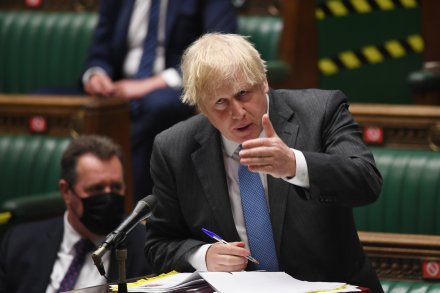
Boris Johnson did not have a good Prime Minister's Questions. It was never going to be a comfortable session, given the multiple rows about the funding of the Downing Street flat revamp and his reported comments about letting bodies 'pile up'. But the way the Prime Minister approached it ensured both that the story will keep running and that he betrayed quite how annoyed he is by it. It is little use trying, as Johnson repeatedly did, to argue that the British people are not interested in the line of questioning that Sir Keir Starmer was pursuing. For one thing, there is nothing like a politician claiming that something is 'boring' or a 'non-story' to make the media want to cover it all the more.