Isabel Hardman

Isabel Hardman

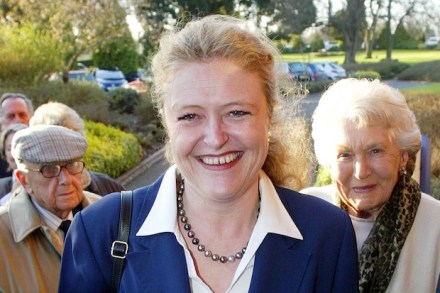
Isabel Hardman is assistant editor of The Spectator and author of Why We Get the Wrong Politicians. She also presents Radio 4’s Week in Westminster.

David Cameron: We are still a green government

From our UK edition

One of the most intriguing things about last week's Prime Minister's Questions was David Cameron's decision to say he suspected the recent severe weather in the United Kingdom was linked to climate change. It seemed to be an interesting restatement of where the Prime Minister personally stands on green issues - a position that his own Environment Secretary Owen Paterson refused to back the very next day. So today when David Cameron appeared before the Liaison Committee to talk about, among other things, green issues, its members were understandably keen to probe him on whether, after the Green Crap Removals Team had rolled up their sleeves and got to work on levies and taxes on energy bills this winter, this government is still green and committed to tackling climate change.

The mysterious absence of the Immigration Bill

From our UK edition

What has happened to the Immigration Bill? It was supposed to come before the House of Commons for report stage before the close of play in December, but was cleverly bumped to avoid a hoo-ha over Nigel Mills' amendment calling for transitional controls on Bulgarian and Romanian migrants. The problem is, this clever bit of manoeuvring by those in charge of Commons business didn't make a great deal of difference to the amendment's popularity: the latest publication from the Vote Office, released after the Bill was bumped into this year but before the end of the winter term, shows 74 signatures. Now the gossip in the party is that the legislation is going to have a little lie down in some longer grass for a while.

Miliband returns to the ‘promise of Britain’ with pitch to middle class

From our UK edition

Ed Miliband's cost of living crisis campaign has, so far, tended to focus more on those who are seriously struggling and turning to food banks or turning off their heating in cold weather. But today the Labour leader turns to the middle classes in a Telegraph op ed. His assessment is downbeat as you would expect: Miliband needs pessimism in order to succeed in 2015, while the Tories need an upbeat vision (but not, as most senior party figures accept, so upbeat an economy that voters think it safe to back Labour). It is interesting that Miliband sees the middle class as a group worth bidding for: he clearly feels there has been a sufficient gap left by the other parties for Labour to sneak into.

Iain Duncan Smith: People are shocked by ‘Benefits Street’ and Labour will thank us for welfare reform

From our UK edition

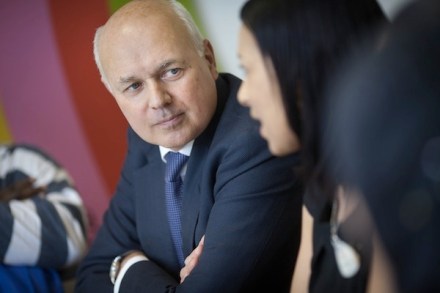
Channel 4 screens the second episode of its Benefits Street documentary tonight, as a petition calling for it to be taken off the air has gained over 30,000 signatures. Labour MPs are trying to use it as an example of the way the media, and by extension the Conservatives, stigmatise benefit claimants. So perhaps it was only natural that a Conservative MP would do the same and use the programme to make a political point during Work and Pensions Questions in the Commons this afternoon. Philip Davies asked Iain Duncan Smith whether he too had been struck by 'the number of people on there who manage to combine complaining about welfare reforms whilst being able to afford to buy copious amounts of cigarettes, have lots of tattoos done and watch Sky TV on the obligatory widescreen television?

What the minimum wage debate tells us about the Tory Right

From our UK edition

The Conservative debate about the minimum wage continues today, with campaign group Renewal pushing for an increase, at least in line with inflation. Renewal is launching an interesting agenda today aimed at making capitalism work for groups who currently feel it fails them, such as the low paid and those living in deindustrialised towns in northern England. The group's work, 'Renewing Capitalism', is supported by Robert Halfon, the Tory MP who is always trying to work out ways of broadening the Conservative appeal. He says: 'It was a big mistake for the Conservative party to oppose the minimum wage. We must right that wrong by at least increasing it in line with inflation. We should not make the same mistake.

Fracking incentives ‘pathetic’ and ‘insulting’, Tory MP warns

From our UK edition

Many plaudits this morning for ministers such as Michael Fallon who have catalysed the government's push ahead with fracking. The only question, though, is whether enthusiasm in Whitehall will translate into enthusiasm in local communities. Ministers are pointing to a change in the incentives for communities which means they can now keep 100 per cent of business rates from extraction sites. But it certainly hasn't impressed Ben Wallace, the Tory MP for Wyre and Preston North, who is a vocal spokesman for the group of MPs whose constituencies sit on the Bowland Shale. Wallace tells me: 'What they are offering us today - an extra £850,000 of business rates is pathetic, insulting. The Treasury should take a little less and we could have a little bit more.

Nick Clegg: Tory benefit plan is ‘Chinese-style family policy’

From our UK edition

Did Nick Clegg recite his entire Andrew Marr interview from memory? The Deputy Prime Minister managed to cram so many soundbites into his answers that anyone wondering what the months in the run-up to the 2015 generation election will be like will have sunk into a pit of misery at how dull and formulaic it is all going to be. Thank goodness for those trouble-making Tory MPs with their letters who are at least trying to make things a bit more unpredictable, eh?

Former Liam Fox aide to advise Cameron on Nato summit

From our UK edition

Number 10 has appointed Tobias Ellwood has the Prime Minister's parliamentary adviser on this year's Nato summit, Coffee House has learned. Ellwood, who is currently PPS to Jeremy Hunt, will work as a link between MPs, peers and the Prime Minister. The summit will take place in Newport, Wales, on 4 and 5 September 2014. This is interesting, not just because Number 10 is still making strenuous efforts to improve the Prime Minister's relations with the rest of his party (although in my Telegraph column today I examine whether one such effort, the Number 10 policy board, is really all it's cracked up to be). Ellwood was PPS to Liam Fox when he was Defence Secretary until Fox resigned from his job in October 2011.

Will peers decide to #LetBritainDecide?

From our UK edition

The first week back in January is always a miserable one. Commuters stare miserably out of rain-streaked train windows contemplating the end of the festive season. More couples turn to divorce or relationship counselling than at any other time of the year. George Osborne did try his best to cheer us all up on Monday by merrily announcing that he'll need to cut a further £25bn from public spending in the next parliament, but we need something more than that in the worst week of the year. Which is why it is so cheering that #LetBritainDecide is back in Parliament today. Yes, now it's the chance of peers to discuss that wonderful Wharton Bill, the private members' bill for an EU referendum in 2017.

Ed Miliband’s immigration nightmare

From our UK edition

[audioplayer src="http://traffic.libsyn.com/spectator/TheViewFrom22_9_January_2014_v4.mp3" title="David Goodhart and Tim Finch on Labour's immigration woes"] Listen [/audioplayer]Victor Spirescu came to Britain last week looking for work washing cars, but seems to have landed himself with a career in broadcasting. The Romanian, who arrived on the first flight into London after restrictions on workers from Bulgaria and Romania ended on 1 January, has now spent the days since touring studios and newspaper offices, obliging those who wish to talk to him about his new life. Those who bump into him as he weaves his way across television studios have the impression that he wishes he’d caught a slightly later flight.

What will 2015’s broken promises be?

From our UK edition

Ed Balls' softer language about Nick Clegg might be an inevitable repositioning of the Labour party in the run-up to another hung parliament in 2015, or it might be the shadow chancellor trying to get ahead of the game after the end to his 2013 was rather bruising. But it is worth mulling the sorts of things that, aside from personalities, the two parties could struggle with. One is the language that those at the top have used about Labour wrecking the recovery. At the 2013 Lib Dem autumn conference, Nick Clegg said: 'Labour would wreck the recovery. The Conservatives would give us the wrong kind of recovery.' Some Labour figures such as Lord Adonis felt this was unfair on Labour: wrecking the recovery is far worse than swerving off balance, surely?

The question on immigration that Labour must answer before 2015

From our UK edition

We don't quite know what Ed Miliband would really do about a lot of things just yet: this is the year when he plans (and desperately needs) to set that out so Labour isn't just an Opposition that complains about things being expensive but a party that voters can imagine governing. But it's significant that one of the policy areas where Miliband has felt it is important to get a lot of detail out pretty early is immigration. He, and everyone around him, is acutely aware that though their personal instincts might be to argue for the benefits of mass immigration to this country, the voters, rightly or wrongly, aren't quite so keen. I look at the party's new tough stance on immigration for the politics column in this week's Spectator.

George Osborne: Minimum wage rise must not cost jobs

From our UK edition

Amid continuing confusion on what on earth the Tories do think about raising the minimum wage, George Osborne has had a go at clarifying things. He has just told Sky News: 'Well look, I think everyone wants to see an increase in the minimum wage. I'd like to see an increase in the minimum wage, but it has to be done in a way that doesn't cost people their jobs, because that would be self-defeating and we have the Low Pay Commission as a body that exists to make exactly that judgement, and what we've got to do as a country is get that balance right between supporting business, growing our economy and making sure it's a recovery for all and that is what our long term plan is all about delivering.

Sombre PMQs sees David Cameron test his new line on welfare

From our UK edition

PMQs was a rightly sombre affair, coming as it did only a few hours after the death of Labour MP Paul Goggins was announced. It has been striking to hear many MPs of all political persuasions pay tribute to Goggins as a 'decent' and 'kind' man, and those tributes were echoed in the Chamber. These two qualities are rarely trumpeted in politics and yet when someone does possess them, they have a profound impact on those around them. Ed Miliband split his questions between flooding and fixed-odds betting terminals (FOBTs). His first tranche, on flooding, was still rather sombre and the Labour leader and the Prime Minister both sought consensus.

Coalition starts 2014 with exhausting round of bickering

From our UK edition

If George Osborne and David Cameron did fire the starting gun for the 2015 election campaign over the weekend and yesterday, then what will that campaign look like? Labour wants to say it will be a nasty campaign because this means they can talk about heir favourite bogeyman Lynton Crosby and Ed Miliband's own emphasis on personal decency. And privately Tories in the know accept that it is going to be a rough and dirty campaign on all sides. But in the past two days we've also seen a glimpse of what it is going to be like between the two coalition parties, and frankly, it all looks rather exhausting. George Osborne pledges to cut welfare further. An hour later Nick Clegg describes it as unbalanced. This morning we've got Vince Cable muttering about the Tories' net migration target.

Osborne sets clear welfare challenge to Labour – and his coalition partners

From our UK edition

We already knew that the Chancellor would focus on welfare as a field ripe for further cuts in his speech in Birmingham today. When he delivered that speech, George Osborne announced that the Treasury's current forecasts suggest that £12 billion of further welfare cuts are needed in the first two years of the next Parliament, and framed this as a challenge to all parties not to let voters down by refusing to cut benefits. He said: 'So when you see people on the telly who say that welfare can't be cut anymore - or, even worse, promising they will reverse the changes we've already made and increase housing benefit - ask yourself this: way public services would they cut instead? What taxes they would put up in their place?

2014: the year of ‘hard truths’ that are easy for George Osborne to say

From our UK edition

George Osborne has a funny way of saying 'happy new year'. In his speech in Birmingham this morning, the Chancellor will describe 2014 as the year of 'hard truths' about how much more spending needs to be cut in order to close the deficit. So why is the Chancellor kicking off what most commentators are billing as an extremely long general election campaign with a bleak message about more cuts to come? In 2010, the three main parties did everything they could do avoid talking about the detail of the challenge on public spending.

David Cameron dodges questions on pensioner benefits

From our UK edition

One of the most significant things about David Cameron's Sunday Times interview today was something he didn't say. The Prime Minister made maintaining the triple lock for pensions for the next Parliament 'the first plank of the next general election manifesto', but he didn't make any 'read-my-lips' promises about anything else related to those of pensionable age. Why not? Did this mean the Conservatives are going to drop their support for universal pensioner benefits such as the winter fuel payment and free bus passes? His interview on Marr suggested that this could well happen.

What François Hollande’s latest crisis means for Westminster politics

From our UK edition

Beyond the slew of amusing 'No man's hand' photos of the beleaguered François Hollande trying and failing to find support from other European leaders, there are a number of implications for the British political scene of the beleaguered French leader's latest crisis, in which he has been forced to admit that taxes have been too heavy while watching his country's manufacturing sector fall behind that of Greece and borrowing costs rise. The first is that David Cameron has a perfect case study of what happens when you stick your fingers in your ears and repeatedly say there is an alternative.