Harry Mount

Harry Mount is a barrister, editor of The Oldie and author of How England Made the English (Penguin) and Et Tu, Brute? The Best Latin Lines Ever (Bloomsbury).

England, their England

From our UK edition

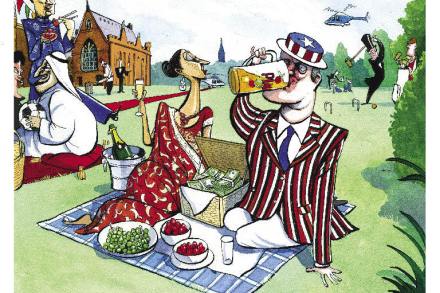
Ian Fleming understood the attractions of an English summer. At the end of Dr No, James Bond is in Jamaica, his arch enemy dead, his knockout girlfriend, Honey Rider, about to leap into their double sleeping bag. And yet, despite being in paradise, Bond longs for ‘the douce weather of England — the soft airs, the “heat” waves, the cold spells — the only country where you can take a walk every day of the year.’ It used to be just eccentric Englishmen who acquired this peculiar taste for the changeable English summer. But no longer. Quietly, but decisively, the English summer and social calendar have been globalised and commercialised.

Royal treasures

From our UK edition

Some schoolboys used to know about Alexander the Great (356–323BC), how he extended the Macedonian Empire from Greece to India, cut the Gordian knot, and wept when there were no more worlds to conquer. Fewer schoolboys — or grown-ups — will know how skilled, and moving, the art of the Macedonian court was. Now they can, thanks to an exhibition at the Ashmolean, Heracles to Alexander the Great (until 29 August). Some schoolboys used to know about Alexander the Great (356–323BC), how he extended the Macedonian Empire from Greece to India, cut the Gordian knot, and wept when there were no more worlds to conquer. Fewer schoolboys — or grown-ups — will know how skilled, and moving, the art of the Macedonian court was.

Speak to me

From our UK edition

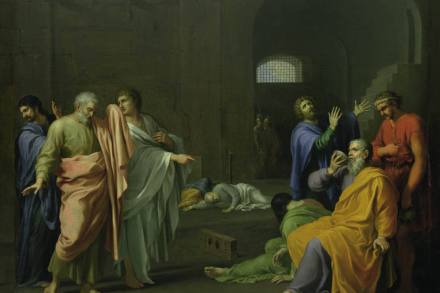
Critics have been predicting the death of the public lecture ever since Johannes Gutenberg got his printing press going in 1450. Why bother negotiating the market-day crowds in downtown Mainz to hear someone read from the Bible, when you can sit by the fire in your parlour and read your own copy? The same argument was made ad nauseum about the internet when it first kicked off: who on earth will bother trotting off to an expensive talk when you can see and hear the best lecturers in the world on your computer for free? TED, an American website, offers you hours of fun from David Cameron, Tim Berners-Lee, inventor of the internet, and the Amazon founder Jeff Bezos. It can even resurrect the dead — Douglas Adams is on their books.

Turkish time travel

From our UK edition

Harry Mount looks across the Dardanelles and sees yesterday’s weather today In Canakkale — the biggest town on the Dardanelles, where more than 130,000 British, Australians, New Zealanders and Turks were slaughtered in the 1915 campaign — Mark Wallinger, the 2007 Turner Prize winner, has dreamt up a clever little work about memory. On the Asian quayside, looking across to the Gallipoli killing fields on the European side of the straits, is an old shipping container, tricked out like a 1950s picture house; think Cinema Paradiso, and you get the idea. Using a 1950s-style sign, Wallinger has named it ‘Sinema Amnesia’ (Sinema is Turkish for cinema).

Piling Pelion on Ossa

From our UK edition

Bettany Hughes is the Nigella Lawson of the classical world — all tumbling raven curls and smoky-voiced seduction, as she takes telly viewers through the greatest hits of the olden days; recent programmes have covered the Spartans, Athens and the Bible. Bettany Hughes is the Nigella Lawson of the classical world — all tumbling raven curls and smoky-voiced seduction, as she takes telly viewers through the greatest hits of the olden days; recent programmes have covered the Spartans, Athens and the Bible. She’s just been on Radio 4 talking about Britain under the Romans. She’s no slouch on the academic side, either: a scholar at Oxford and a research fellow at King’s College, London, she got rave reviews for her first book on Helen of Troy.

Left out

From our UK edition

New Labour Islington is no more – it is now an area for Tory-voting bankers When I grew up in Islington in the 1980s and 90s, there was a reliable election ritual: the bigger the Georgian villa, the more likely the resident barrister was to put up a Labour poster in his sash window. If they weren’t barristers, they were senior Labour politicians. Some were both. The poster in the window in the rambling terraced house in Canonbury belonged to Charlie Falconer, later lord chancellor. Nearby was Malvern Terrace, home to Brenda Dean, later Lady Dean, former general secretary of the print union Sogat. Next door was Margaret Hodge. A few doors down, at 1 Richmond Crescent, was the spiritual king of fashionable Islington, Tony Blair.

Post-racial America? Forget it

From our UK edition

The United States is almost as segregated under Obama as it was in the time of Martin Luther King As I arrived in New Orleans this summer, there was a juicy racism row blazing across the airwaves and the blogosphere. Like lots of the juiciest rows, it was over a little thing. The question was, do black people use the social networking site Twitter differently from white people? According to Farhad Manjoo, Slate magazine’s technology correspondent, the answer is yes. He’d noticed that a group of black Twitter users in America were much more likely to react to particular topics. Some of them were race-based, such as ‘If Santa was black …’; answers included ‘He wouldn’t say ho-ho-ho, he would say yo-yo-yo’.

Don’t police the beach

From our UK edition

You might not have been to Freshwater West, on the remote western shores of Pembrokeshire, but you’ve probably seen it before — on the big screen. Because the bay is so untouched by man, it can stand in for pretty much any period in history. It’s just starred as the medieval beach in Russell Crowe’s Robin Hood, and as the seaside home to the shell house in the latest Harry Potter film. These days, it couldn’t stand in for much, except perhaps a Welsh version of Baywatch — Boyowatch, perhaps? Because, as of this year, between 26 June and 5 September, the beach has been destroyed by the Royal National Lifeboat Institution. Every day this summer, the RNLI has erected a beach hut — the only man-made structure on the beach. Every day, between 10 a.m.

Fourth Estate skulduggery

From our UK edition

Tim Waterstone is the man who set up the bookshop chain in 1982, so you might expect him to have read a few books, and be OK at writing them. In fact, he’s more a businessman than a writer. He began life as a broker in Calcutta, before becoming marketing manager for Allied Breweries and W. H. Smith. But it turns out that Waterstone is rather a skilled thriller writer; his publicity people are doing him a disservice in their promotional literature by comparing him to Jeffrey Archer (the novel’s gallumphing Archeresque title apart). He has wisely chosen two worlds he knows about to set his thriller in — business and publishing. It’s a thinly disguised milieu he’s dealing with, too. What might the big bookselling chain, Waterwell’s, be based on?

Dressing down

From our UK edition

Mad dogs and Englishmen go out in the continental midday sun. But at least the mad dogs don’t dress in vests, belly-hugging T-shirts or those cut-off trousers that make short men shorter and fat men fatter. Why do they do it? How has it happened that you can spot Holidaymakerus britannicus in an instant, from the other side of the piazza — from the far end of the tapas bar? The romantic legend that the British provide a model of good dress still lingers on. The British invented the modern suit, so the myth goes, Savile Row stands for the best tailoring in the world, so those sartorial standards must be written into our dressing DNA. Well, it just goes to show how difficult it is to dislodge a national stereotype.

Classic treasure

From our UK edition

The Greek and Roman Collections Sculpture Promenade 2010 Fitzwilliam Museum, Cambridge, until 28 January 2011 Virgil was wrong — don’t be afraid of Greeks bearing gifts, particularly if you’re a British regional museum. While our government has cut its grant to the Fitzwilliam by two per cent, Greek zillionaires have stepped admirably into the breach to subsidise the renovation of Cambridge’s heart-stopping Greek and Roman gallery, untouched since the Sixties. The Greek Ministry of Culture has chipped in, too; it may want the Elgin Marbles back but it’s happy to pay for Cambridge’s classical treasures to stay put, even while the Greek economy is on the skids. Its prized euros have been well spent.

Barking mad — a day out with the BNP

From our UK edition

Harry Mount watches Nick Griffin try to win round the disgruntled former Labour voters of Dagenham and Barking — if he wasn’t so ridiculous, he might be dangerous As always, P.G. Wodehouse got it right. Far-right groups are unlikely to take off in Britain because, for all their nastiness, they always come across as just a little too ridiculous. That’s certainly the impression I got after spending last Saturday in Barking, east London, at the BNP campaign launch. In The Code of the Woosters (1938), Wodehouse neatly took care of Sir Oswald Mosley and his Blackshirts, by casting him as Sir Roderick Spode in his black shorts; by the time Spode had set up his fascist group, there were no shirts left, according to Gussie Fink-Nottle.

‘I went into the war as a student and came out as an artist’

From our UK edition

Ronald Searle, who turned 90 this month, talks to Harry Mount about being captured by the Japanese, chronicling the 1950s and inventing both St Trinian’s and Molesworth High in the mountains of Provence, in a low-ceilinged studio at the top of his teetering tower house, Ronald Searle is showing me the simple child’s pen he uses. As he draws the pen down the page, the ink thickens and swerves; a few sideways strokes, a little cross-hatching, and suddenly the famous Searle line comes to life: part Gothic, part anarchic, part comic. The girls of St Trinian’s, Nigel Molesworth, Adolf Eichmann, thousands of Punch caricatures, the Goya-like pictures of dying prisoners of war... all utterly different, all enclosed by that distinctive Ronald Searle line.

Confessions of a middle-class anarchist

From our UK edition

If Gordon Brown really wants to start appealing to the middle-class vote, he could start by picking up my rubbish. The bin bags outside my flat in Kentish Town, north London, weren’t collected for four weeks over Christmas because of the snow. When the foxes started to rip them apart and left a trail of chicken carcasses and half-chewed bread across my front garden, I cracked. Patching up the most damaged bag and strapping it to my handlebars, I pedalled along the snowy roads — if my bike could negotiate the streets, so could a rubbish truck, by the way — to my local park. There, I poured the rubbish into a large, metal-mesh bin.

The death of ‘shabby chic’

From our UK edition

After more than 200 years, a uniquely British taste is on the way out. Shabby chic has been vacuumed, whitewashed and dry-cleaned out of existence. Frayed shirt collars, egg yolk on the tie, soup stain on the crotch, roses rambling out of control over the crumbling terrace flagstones, walls cluttered with pictures, tables covered with teetering piles of books. The quintessentially British air of decayed gentility has been destroyed by a combination of minimalism, modernism and nihilism. For the first time in history we live in a civilisation where, the richer you are, the fewer things you have, and the newer, cleaner and more stripped-down those things must be. Shabby chic meant the opposite.

The ominous creep of Baby Chic

From our UK edition

How can we expect our children to grow up, asks Harry Mount, when British culture is becoming increasingly babyish — full of primary colours and little letters It first struck me how babyish modern Britain has become when I got a flyer through my door about a new doctors’ surgery in Kentish Town, my patch of north London. I’d bicycled past it as it was being built — it’s your usual faceless ziggurat of undecorated, angular white concrete, with spindly, metal-framed windows half-blocked by lime-green steel grilles. No worse than the usual publicly funded horrors dumped on London’s pretty terraced streets; no better.

Wales and the Welsh are no longer a dismal joke

From our UK edition

In the hall at Aberglasney — a fine, classical country house, built in 1720, 20 miles north-west of Swansea — high up by the cornice, an elaborate chunk of plasterwork is missing. To give the full catalogue entry, it is a rococo console, carved with twirling honeysuckles, a motif dear to the ancient Greeks. I know, to my deep and lasting shame, where to find it. In fact I can see it now, on a mahogany stand next to my desk. Its protuberant plaster leaves provide a nice perch for my keys where I don’t forget them. For all its usefulness as a key perch, the console would look better glued back to the cornice in Aberglasney’s drawing room. And so I am returning it.

I half expected to see Welles run towards me

From our UK edition

Harry Mount celebrates the 60th anniversary of Carol Reed’s masterly film The Third Man with a tour of Harry Lime’s postwar Vienna — the true star of the movie Vienna Six times a week, the Burg Kino cinema in Vienna shows The Third Man in its small Studio Theatre. ‘It’s best that you book,’ said the polite young man behind the counter in perfect English, when I came along in the morning to see if there were any tickets for the 10.45 p.m. show on Friday night. ‘We sometimes get tour parties and the place is packed out.’ I needn’t have booked after all.

Finding Pooter’s house

From our UK edition

These days, Charles Pooter, the City clerk and narrator of George and Weedon Grossmith’s The Diary of a Nobody (1892) — the enduring comedy of hum-drum middle-class, late-19th-century life — could never afford to rent (or buy) his six-bedroom house, The Laurels, in Brickfield Terrace, Holloway. The Pooters of this world fled north London a long time ago, driven to the commuter belt by soaring property prices. However big the collapse of the housing market, the Pooters could not possibly buy their way back to those comfortable years of meat teas, live-in maids, and champagne from Jackson Frères at three and six a bottle.

State education has outlawed difficulty

From our UK edition

But private schools, private tutors and bestselling books are filling the vacuum, says Harry Mount. Larkin was right: there is a hunger in us all ‘to be more serious’ The decline of the British education system has been my gain, I’m only partly ashamed to confess. As somebody who has published a jokey book about a highbrow subject, I have profited from the proceeds of writing for a market that simply didn’t exist half a century ago. In 1958, the sort of people who are buying books about Latin today were learning Latin in school. I’ve lost count of the people in their forties who’ve told me, ‘I never learnt Latin, but my parents did. I wish my children did, too.