A letter to George Steiner
George Steiner was easier to admire than to love
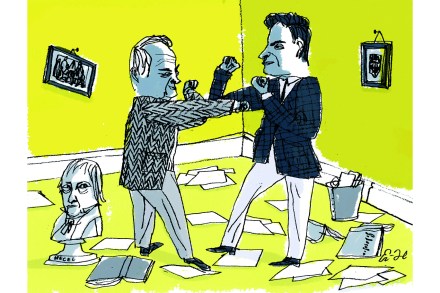
George Steiner was easier to admire than to love
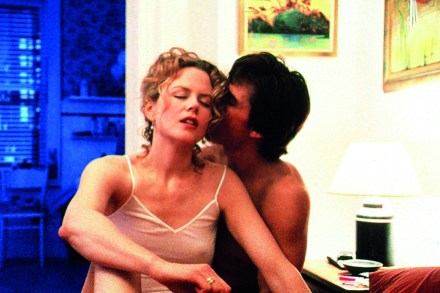
Frederic Raphael wrote the script for Stanley Kubrick’s Eyes Wide Shut. Now he writes a personal letter to the director’s shade
From our UK edition
Aimez-vous Heidegger? According to his admirers, he was the most significant and influential philosopher of the 20th century. For Hannah Arendt, despite her claims eventually to have found the perfect husband in Heinrich Blucher, Heidegger was the love of her life. She was his precocious teenage pupil when he lectured on Plato’s Sophist at Marburg
From our UK edition
The long war between France and the US has its liveliest consequence in the world of film: Hollywood does movies, the French do cinema. In terms of equipment, the Yanks were the pioneers, but France’s Charles Pathé was the first tycoon and — more importantly — George Méliès was the inventor, by accident, of the

From our UK edition
The emperor Augustus was the original god/father. Julius Caesar was often referred to as ‘the divine Julius’, but his nephew (and adopted son) was the first Roman to have temples dedicated to him in his lifetime. If uncle Julius had died a natural death, or in some brave battle, the Roman upper class would never

From our UK edition
The Great Depression of the 1930s has passed into myth as essentially American, not global. The Wall Street crash ended the Good Times and led, apparently inevitably, to the crisis of Capitalism. Europe suffered from the effects, but had the glum fun of watching the dollar lose its almightiness. America’s internal response was dramatic and,
From our UK edition
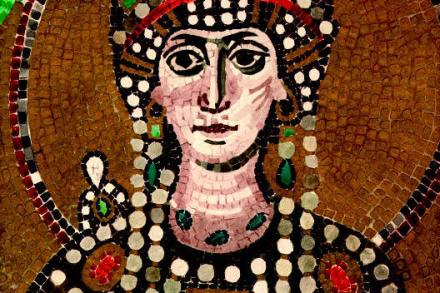
The Fall of the West: The Death of the Roman Superpower, by Adrian Goldsworthy The Ruin of the Roman Empire, by James O’Donnell These two fat, well-sourced books about the decline of ancient Rome run, until they limp, in relay. Adrian Goldsworthy begins his leg from the end of the second century AD, the term
From our UK edition
Mary Lefkowitz is a distinguished (i.e. no longer young) classicist who taught for over 30 years at Wellesley College. She has been particularly bold and articulate in promoting the role of women in antiquity. Married to Hugh Lloyd-Jones, a famously rigorous ex-Regius Professor of Greek, she can be presumed not to advance lazy arguments or
From our UK edition
The subtitle of this account of the genesis and fate of the five movies in competition for the title Best Film at the 1967 Academy Awards is ‘the birth of the New Hollywood’. Hyperbole being the most reliable trope known to publicity, we are promised that 1967 was ‘the year that changed film’ and that
From our UK edition
How should ancient Roman history be written? Gibbon larded his account with ironic elegance. Echoing Tacitus’ epigrammatic sarcasm, he made ponderously light of the vanities and savagery of imperial rule. Yet the Latinate charm of his prose implied wry nostalgia, not only for the age of the Antonines, but also for the whole myth of
From our UK edition
Tenn — as friends and sycophants called him — Williams was one more of those American writers whose lives have spectacular first acts, but dwindle away, more or less slowly, into repetition, sterility and self-pity eased (and exacerbated) by sex, alcohol and drugs (‘Way to go’, some might say). Williams was born in 1911, in
From our UK edition
The classical scholar T. P. Wiseman decided that, once he had passed his 42nd birthday, his middle-aged hands were no longer apt for writing about the erotic Catullus. In his 90th year, Leo Abse manifests no such squeamishness in this psychoanalytic study of Daniel Defoe. Neither embarrassed nor embarrassing, he sees no reason to abate
From our UK edition
Audrey Ruston was born in Brussels in May 1929, of a Dutch baroness, Ella van Heemstra, and an English father, Joseph Ruston, some kind of toff, among whose distant ancestors was James Hepburn, Earl of Bothwell, the third husband of Mary Queen of Scots. Ruston soon abandoned his wife and daughter for a long lifetime
From our UK edition
Listing page content here Vae victis, the Roman warning to the defeated, was probably more threatening than sympathetic. Ever after they themselves had been subjugated — forced, literally, to bow their heads under the Samnite yoke — they made a habit of ruthless winning. The defeated could expect slavery and pillage. After June 1940, both
From our UK edition
Dr Johnson talks somewhere of a Reverend Dr Campbell whom he calls the ‘richest man ever to graze the pasture of literature’. If his riches derived from his books, he was surely outgrossed by John Fowles, whose novel The French Lieutenant’s Woman topped all the bestseller lists, and remained on the New York Times list
From our UK edition
This is a slim two-in-one offer of a pair of previously undisclosed ‘novellas’ (actually film treatments) by Graham Greene. In 1949, when they were written, The Third Man had just been a prodigious hit for the author, Carol Reed and Orson Welles. No Man’s Land — the sole complete piece on parade here — was
From our UK edition
‘Everyone with a bellyful of the classics,’ Henry Miller said, ‘is an enemy of mankind.’ Was the Brooklyn bronco serious in claiming that indoctrination with ancient literature generated monsters? As readers of The Colossus of Maroussi well know, Miller himself fell under the Greek spell. So, earlier, had the Romantics (with unromantic Periclean Athens), Victorian
From our UK edition
In the first century bc, the wrestler Nicophon of Miletus was said to have a physique which would have made Zeus himself tremble. He literally outstripped his rivals at the Olympic Games. Nicophon’s mere name, Victory Voice, announced a champion, just as that of Schwarzenegger did in the Mr Universe — and, more recently, in
From our UK edition
It’s no surprise that one of Alain de Botton’s favoured sources, in a text well-sprigged with neat citations, should be Matthew Arnold: sweetness and enlightenment are their common contributions to a culture in which anarchy is the liveliest art form. What can Arnold have been complaining about in Victorian England, as compared with what we
From our UK edition
THE WEST AND THE RESTby Roger ScrutonContinuum, £12.99, pp. 196, ISBN 0826464963 Two reincarnations of the Old Oligarch – alike in deploring The Way We Live Now, different in emphasis and style – jostle for the moral high ground. Gore Vidal’s diagnosis of global schism centres on the US and its (mal)administration. Like a liberal,