Fraser Nelson

Fraser Nelson

Fraser Nelson is a Times columnist and a former editor of The Spectator.

Wanted: online news editor for The Spectator

The Spectator is creating a new position, fusing together the work of print, digital and broadcast journalism. We’re looking for someone who can write, loves language and loves intelligent debate – but the emphasis, for this job, will be on audio and video. It's a great time to join Britain's  most influential magazine. We recently celebrated the highest sales in our 185-year history; both print and digital are rising, our website is now read by two million people a month. But the staff team is small; there are only about a dozen of us.

France bombs Islamic State bases in Raqqa. But will it make much difference?

Yesterday, Francois Hollande promised "merciless" retribution against the Islamic State. This evening, armed with American intelligence, the French Air Force dropped 20 bombs on two Isil positions in Raqqa – in what tomorrow’s newspapers will almost certainly portray as a swift and dramatic act of vengeance. But in fact, it won’t be much different to what the French have been doing in the last few weeks as one of the United States’ partners in what has been a year-long bombing campaign (along with the Saudis, Turks and Aussies). It's a campaign that doesn’t seem to have been too effective in holding back the Islamic State. The French targeted an Isil command centre, an arms depot, a recruiting post and a training camp.

Paris massacre: ten developments, as of Sunday morning

Barack Obama flies into Turkey for a G20 conference now likely to have the Islamic State as its theme. Here are ten developments. The death toll has risen to 129, with 352 others wounded, 100 critically. Five Britons are feared dead, and another five injured. A passport found near the body of one attacker was that of a 25-year-old Syrian migrant, according to French investigators. The Greek government said he had been registeredat the Aegean island of Leros on 3 October. Another attacker has been identified as a 29-year-old Frenchman who had been on a jihadi watch list. His father and brother are being held by police for questioning Another jihadi had a ticket for the France vs Germany football game, but was intercepted by security guards in Stade de France.

“The first of the storm” – translation of Islamic State statement after Paris attacks

This morning, the Islamic State claimed responsibility for the Paris attacks - the first time it has laid claim to any attacks in Europe. It released a rambling statement in French, referring to a music concert as a "profligate prostitution party". It also seemed to reference Charlie Hebdo. Here is an English translation:- In the name of Allah, the All Merciful, the Very Merciful. The Very High All Said: “It is He who expelled the ones who disbelieved among the People of the Scripture from their homes at the first gathering.

The shocking rise of anti-refugee attacks in Sweden

Sweden, perhaps the most open country in the world, is on course to take almost 200,000 asylum seekers this year. Adjust for population size and that's like the UK taking a refugee city the size of Birmingham. It can't cope. Yet political refusal to admit this is incubating concern - sending voters towards the anti-immigrant Sweden Democrat parties. But most shockingly, a trend is emerging of attacks on immigrants. I look at this in my Daily Telegraph column today. [datawrapper chart="http://static.spectator.co.uk/qjCco/index.html"] Sweden's government and opposition parties both dislike talking about immigration; they are too quick to dismiss concerns as xenophobia.

If Iain Duncan Smith resigns over Osborne’s strivers tax, he’ll endanger his own legacy

Yesterday, the Daily Telegraph disclosed that George Osborne was planning to open a second front in his rather bizarre confrontation of the working poor by raiding Universal Credit, the government's new welfare-to-work scheme. Today, the Times reports that Iain Duncan Smith might resign if this goes ahead. Friends of Mr Duncan Smith escalated the row, saying that he would quit rather than carry out cuts he believes would wreck universal credit. “The Treasury have come after UC [universal credit] at every fiscal event and Iain has made clear every time that this is a red-line issue for him. That is the case now as it has been in the past,” one said.

Does George Osborne really want to make himself the scourge of the strivers?

Without George Osborne, we’d probably be living under Prime Minister Ed Miliband right now. His value to the government goes far beyond his brief as Chancellor; he is across most departments most of the time. But as Chancellor, he is judged by the success (or otherwise) of his Budgets – which is why he is now in a moment of great danger. His love of complexity has come to threaten not just his own reputation, but that of the Conservative Party too. Sometimes, Osborne is so clever that he can be downright stupid: This is one of these times. In my Telegraph column today, I say that Osborne is currently planning to soften – but not abandon – his tax credit cuts programme.

Spectator Parliamentarian of the Year 2015: the winners

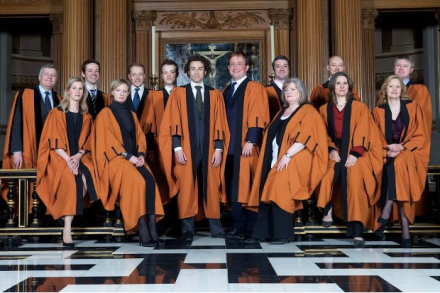
The Spectator’s 32nd Parliamentarian of the Year awards, sponsored by Benenden, took place at the Savoy Hotel this afternoon. Here are the winners – and a few extracts from my speech. The awards were presented by Alex Salmond. The winners' speeches, and my spiel, are below: 1. Speech of the year – Johnny Mercer Our winner is a former serviceman – and, briefly, a male model – whose maiden speech was theatrical, magisterial and moving. 'A great stain falls upon our nation,' he said, 'when more soldiers take their own lives than die in action.' Our winner completed three tours of Afghanistan, now serving his first tour of duty for the Tories. 2.

Osborne’s ‘living wage’ will help richer households the most

Last week’s tax credit debacle has highlighted how even well-informed people believe that the £9 minimum wage (misleadingly dubbed 'living wage' by the government) is a progressive measure that will help the poorest the most. The low-paid are being hit by tax credit cuts, it's argued, but don't worry, soon they'll get a £9 minimum wage! In fact, the minimum wage only affects the lowest 4pc of workers, and a surprising number of them are second earners in wealthier households. So the biggest cash gains will go to the richest households.

Going to war with the Lords over tax credits would retoxify the Conservatives

With a gossamer Tory majority in the Commons and no majority at all in the Lords, confrontation between the two chambers was always inevitable. Tonight's defeat over tax credits will be the first of many. But it would be a great error for the Conservative government to choose this as the issue over which to go to war with the Lords. For a start, their Lordships are right: taking tax credits away from low-paid workers, rather than phasing them out, is cruel and and unnecessary. Next, this was not in the Tory manifesto: the party said they would cut £12 billion but didn't say how — and had hinted that they would not do it by tax credits. But also, crucially, this battle threatens to retoxify the Conservatives. What does it say about Tory values?

Exclusive: tax credit reform leaves low-paid facing tax rates of up to 93%

As the House of Lords prepares to debate the tax credit cuts, a significant new piece of information has come to light. The government initially suggested that, in the vast majority of cases, its minimum wage increase and higher tax allowance would compensate for tax credit removal. A bold claim based on not very much research. Coffee House can today reveal that the most authoritative analysis yet conducted—based on over 100,000 working-age households—shows the damage being far more extensive than the Treasury realises. Policy in Practice, Britain’s leading welfare-to-work consultancy, held a Chatham House symposium on the subject three weeks ago, attended by various figures in the world of welfare reform.

Mark Carney may have unwittingly strengthened the case for leaving the EU

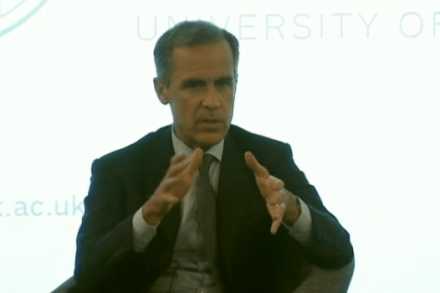
I suspect that Mark Carney set out to strengthen the case for Britain staying in the European Union with his remarks in Oxford tonight, but his intervention may end up having the reverse effect. First, the Bank of England governor did not talk about the advantages of staying inside the EU. He spoke about the advantages of Britain being part of a free trade block; as Boris Johnson argues in the new Spectator this is still likely even if we vote to leave. Here’s what he said:- ‘Broadly speaking, the evidence suggests that the UK has successfully harnessed the benefits of openness afforded by its EU membership while avoiding some of the drawbacks of reduced flexibility from which some continental European economies suffer.

The British public agrees: China is buying our foreign policy

A few weeks ago, the Dalai Lama gave an interview to The Spectator where he summed up what he regarded as David Cameron’s policy of not seeing him again, so as to not upset his new friends in Beijing. ‘Money, money, money,’ he said. ‘That’s what this is about. Where is morality?’ A powerful point – and one that we put on the cover of the magazine. Now YouGov has put his words to the public in an opinion poll, and asked if they are a fair reflection of Cameron’s policy on Tibet and China. The result: 69 per cent said he was right, and just 8 per cent said he was wrong. With President Xi signing deal after deal today, the Dalai Lama can now consider his verdict amply vindicated. [datawrapper chart="http://static.

Has Nicola Sturgeon found a verbal formula to disguise SNP’s failure of poor students?

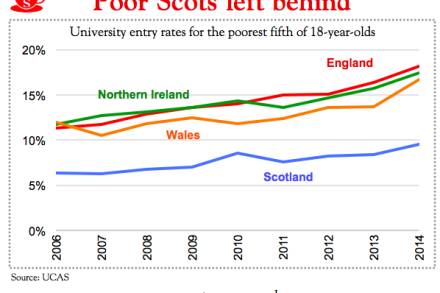
At the SNP conference the First Minister and her deputy, John Swinney, both had precisely the same thing to say about university. Here’s Swinney: “Students from a poorer background have never had a better chance of a place at university than under the SNP”. And Nicola Sturgeon: “More students from poorer backgrounds are now going to university”. More. That's the test they set: if more poor students are going to uni then the SNP is succeeding. They both talk about “university,” as distinct from other forms of further education. Yes, the ratio of poor kids at uni is rising in Scotland – but shamefully, it’s half the level of England. Worse, the gap is growing (see chart, above).

The jobs miracle continues: UK employment now at all-time high

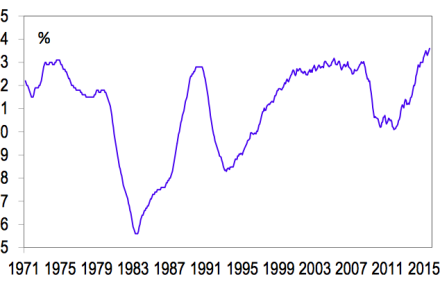
Another milestone has been reached in the recovery: 73.6pc of working-aged British people are now in employment (see above) - the highest in recorded history. And, needless to say, the highest of any country in Europe. What kind of jobs? Mainly full-time employees (up 2.1pc) not self-employment (down 0.6pc). The total number of hours worked is also up, and Britain is working almost a billion hours a week. Unemployment is down, and as Michael Saunders from Citi notes (pdf):- The drop has been concentrated in the long-term jobless rate (ie the share of the workforce who have been out of work for more than 12 months), which has dropped from 2.2% a year ago to 1.

The SNP bow out of the shambolic EU ‘in’ campaign

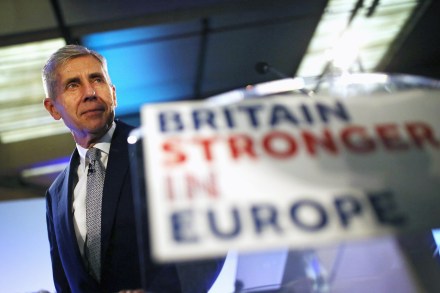
After the chaotic launch of the Britain Stronger in Europe campaign (didn’t they work out that having the acronym BSE is not a good idea?) the Scottish National Party has made its mind up: it’ll stay well clear of this. John Swinney, the SNP Deputy First Minister, has just been on BBC Radio Scotland laying out his reasons. Yes, he doesn’t like the idea of being part of a campaign that might involve the Conservative Party – but it’s about more than that. As the SNP can see, the ‘in’ campaign is turning out to be a rebadged version of ‘Project Fear’, the campaign that almost destroyed the union in last year’s Scottish independence referendum. It has the same people, even the same selebs (June Sarpong, for example).

Yes, Tories can be progressive (if they’re doing conservatism right)

Can a Conservative be ‘progressive’? In my Telegraph column last week, I argued that David Cameron is halfway to being one of the most progressive Prime Ministers in recent British history – and published a few graphs to make my case. This went down pretty badly with some CoffeeHousers, who said that I was applauding Cameron for being left-wing – if they wanted a bleating leftie, they’d have voted Labour. I take the point: the word ‘progressive’ is synonymous with ‘left-wing’ in America, as is the word ‘liberal’. But that’s the Americans’ problem. Granting the left ownership of the words ‘liberal’ and ‘progressive’ disguises two basic points.

The SNP is failing Scotland’s poor, and Nicola Sturgeon is struggling to deny it

Would Scotland be better if government was run from Edinburgh rather than London? This is the SNP’s central proposition, but it’s not hypothetical. For 16 years now, public services have been run from Edinburgh – and so, if Nicola Sturgeon’s premise is correct, Scotland’s schools and hospitals should be pulling ahead of England’s under superior localised management. In fact, the reverse is true. Scotland on Sunday today has a powerful editorial about the problems of NHS Scotland but this morning, Andrew Marr interviewed Nicola Sturgeon to ask her about education – specifically the way in which the poorest are suffering most under the SNP. He started by asking her why the poorest are twice as likely to go to university in England than in Scotland.

Six ways in which the Conservatives became Britain’s true progressives

'Britain and Twitter are not the same thing' said David Cameron this week – eight words that summed up the difference between the two parties. One has disappeared down a rabbit hole of social media, convinced that Britain is becoming more unequal and that the poorest have been suffering the most. The other, the Tories, are hard at work making Britain not just more prosperous but fairer too. If David Cameron actually follows up on his conference speech (he has a habit of not doing so) then a great prize awaits him: he could be Britain’s most socially progressive Prime Minister. I look at this in my Daily Telegraph column today. 1. Under Cameron, the poorest have done best and the richest worst.

Theresa May lambasts her own record on immigration. Why?

What on earth is Theresa May playing at? As Home Secretary she vowed to cut net immigration down to the ‘tens of thousands,’ only to see it increase to a record high of 330,000. A bit embarrassing: the slogans that used to adorn Tory conferences boasting ‘immigration down’ have been quietly removed, and replied by the fictional achievement ‘deficit eliminated’. If I were her, I'd just drop the whole thing. Instead, she chooses this conference to inform us that the immigration she has presided over is bad for Britain, bad for our social cohesion. In her words: 'When immigration is too high, when the pace of change is too fast, it’s impossible to build a cohesive society.