Fraser Nelson

Fraser Nelson

Fraser Nelson is a Times columnist and a former editor of The Spectator.

Brown is trying to deflect blame onto the bankers

From our UK edition

Why won’t the banks pass on the rate cut? Because there isn’t anything to pass on. And for the life of me, I can’t work out why they don’t point this out. The Bank of England base rate simply doesn’t mean the Bank of England is lending to banks at 2 percent. The plumping doesn’t work that way, not no more. British banks aren’t hoarding anything. They have no net assets. They have to borrow every penny they lend. Once they borrowed from the wholesale market, which has seized up. What cash is available comes at a hefty price. By means of illustration, the banks had to pay 12 percent to for the latest injection of government cash. Barclays went to the Arabs instead and paid 14 percent. Until banks can borrow cheaply, they can’t lend cheaply.

Taking a pounding

From our UK edition

How much should we worry about a falling pound? Since Monday sterling is off 5 percent against the Euro, 6.5 percent against the dollar, 9 percent against the Yen and 3.4 percent against the Hungarian forint: Hungary, of course, had to be bailed out by the IMF. This is worrying for the government as its survival plan for the next five years involves borrowing untold billions from the Arabs, Chinese or whoever has cash – who may not relish the thought of pumping billions into IOU notes in our rapidly devaluing currency. Of course it’s true that a weaker currency is good for the economy overall, as will help exports. It’s a reminder how lucky we are not to be in the Euro. But talk about a manufacturing-led recovery next year is dangerously optimistic.

Turning Japanese? I really think so

From our UK edition

After the rate cut, one question presents itself: is the British economy turning Japanese? Now rates are at 2%, it makes you wonder how low they can go and whether we are approaching a zero-rate like Japan after its economy blew up in 1990, leading to the “lost decade”? To answer it, let’s get a doctor to take a picture so we can look at the UK economy from the inside as well (*) The market expects rates to bottom at 0.75% next spring and then rise slowly. So those lucky few on a variable mortgage will be in the money for the foreseeable future – like Japan, where rates never quite picked up. The Brown bust had the same characteristics of Japan’s: a debt-fuelled asset boom followed by painful recession and demand slumping so low that we get deflation.

The Speaker passes the buck

From our UK edition

So it was all Jill Pay’s fault. That was Michael Martin’s verdict. He didn’t know. The Serjeant At Arms should have asked for a warrant and she didn’t. Nor did he shrink from dumping on her. He’ll grant a debate on Monday and set up a committee of grandees (just as he did with the expenses furore).  Here are the key points from the Speaker's statement. --“Parliamentary privilege has never prevented the operation of criminal law” – except when they’re dodging expenses fraud, or voting to exempt themselves from their own FOI laws. -- “On Wednesday last, the Met informed the Serjeant at Arms that an arrest was contemplated.

MPs should ask what they have done to preserve Parliament’s stature

From our UK edition

I do feel for Her Majesty. This ordeal should be foisted on her only after an election. Having to read out the New Labour newspeak was bad enough, but the Brownian argot is dreadful. I do love the way she did it without any feeling - with a wearisome look in her eye - and the way Prince Philip was caught on camera apparently joking about throwing the speech in the bin. It was a pretty bald speech: just 13 pieces of legislation versus 21 in last year’s. After years of worsening child poverty, even by Brown’s narrow measures, he now legislates to “abolish” it by 2020 – as if that will achieve anything. Put that alongside some of the legislation announced for the banks, and it adds up to a whole load of gesture politics.

The case for Scottish fiscal autonomy

From our UK edition

Those of us in favour of “fiscal autonomy” for Scotland have been sent homewards to think again by the Calman Commission (pdf, here), which looks at the asymmetrical mess which calls itself devolution. But it’s not all bad news. It had been expected to dump on the idea, but is fairly clear about the need to abolish the Barnett Formula which is even denounced by its author, Lord Barnett. This is what the commission has to say: “With no substantive tax raising power, the Scottish Parliament is funded by a block grant, needed to address a near total vertical fiscal imbalance. Voters are not exposed to tax and spending decisions at the margin, meaning that a degree of political accountability for the taxation which supports spending decisions is missing.

Profiting from profit-making

From our UK edition

School reform is by some margin the best Conservative policy, but could it be better still? The Independent today runs a piece in which Michael Gove is told he’s making a “terrific mistake” by refusing to allow his proposed independent schools to make a profit. The comments come from Mikael Sandstrom, a state secretary (or spad, as we call them) but one of the world’s leading authorities on school reform. He is more than just an adviser and has written academic papers showing how much better the “free schools” (as they are called in Sweden) perform. Sweden has reams of data, thousands of students: it isn’t theoretical over there. It works.

What Gordon told Hugo

From our UK edition

I’ve just picked up The Hugo Young Papers – his notes from his meetings with the great and the good. It’s a lively read, if you skip the bits about Europe (well, the bit where Ed Balls stresses his impeccable Europhile credentials is fun), and you see a fascinating glimpse of what Brown says in private conversation. And not all of it is bad. Some extracts, with my comments:- BRITISH COLLECTIVISM 12 Dec 00 HY says he “had written a piece for The Spectator about how Hague might start to recover. GB obviously thought I had been trying to help Hague... did I believe, he (Brown) asked, in the cyclical shape of politics? That there were individualist phases followed by collectivist phases? This was the rhythm he himself plainly believed in.

The system overreach must come to an end

From our UK edition

You don’t need a cat-stroking authoritarian to damage democracy and erode liberties. You just need to sit back and talk as if the system is a law unto itself. I believe Gordon Brown is being honest when he denies knowledge of the Damian Green arrest. No10 knows there will be an inquiry, and it will come out who knew what. But ignorance is no defence. System overreach is one of the gravest possible threats to democracy, and it is precisely by tolerating it that we lose the open society which a couple of generations ago so many died to defend. In my News of the World column today, I say the Green arrest is an allegory for what has happened to Britain.

Brown has played into the hands of the Tory Bullingdon Boys he loathes

From our UK edition

Conservative backbenchers were in  good voice on Monday, and by prearrangement. The whips had sent around the message that there was to be raucous heckling as Alistair Darling read out what used to be called the Autumn Statement. Duly, there were roars of indignation at the Chancellor’s claims that Britain was best-prepared for a downturn, howls of protest as he claimed to have reduced debt. But then this yielded to unexpected quiet as it slowly became clear that Mr Darling’s giveaways included something the Tories would never have dared dream of: the surrender of everything New Labour once stood for. David Cameron had been at George Osborne’s house the day before, nervously preparing for the surprise tax cut which they suspected was in store.

What stature does the House have now?

From our UK edition

Word is that Michael Martin has hit the roof today. He was informed about the Sergeant-At-Arms' (deplorable) decision to let anti-terror police forage through Damian Green's office (I gather they're still happily at work stripping his constituency office bare). As Speaker, he had to be informed but did not have to give his permission. The Sergeant-At-Arms did. I suspect Martin didn't take in the gravity of the situation until last night, and the full constitutional implications of this will now have dawned on him. Why were counter-terror police involved in a common law offence? We don't know. It does seem that neither Gordon Brown nor any minister was informed, which is in itself incredible.

A whistleblower’s view

From our UK edition

And Damian Green is suspected of what, exactly? I just spoke to Steve  Moxon, who was a whistleblower in the Home Office and sacked for leaking stories. As you can imagine, he knows more about the legalities of all this than most. When he was rumbled, he said, he was safe under the Public Interest Disclosure Act 1998. It protects whistleblowers who are doing it for the public interest (as opposed to for money, etc). Moxon lost his job, but kept his liberty – and wrote a rather good book about it all, The Great Immigration Scandal. Moxon told me he couldn’t begin to work out what was going on in this case.   I believe Gordon Brown when he says he had no prior knowledge of Green’s arrest, and also suspect he would have stopped the arrest if he could.

A scary use of police time

From our UK edition

So what did Damian Green leak that has warranted his arrest? From what I can gather, here are the three of the stories in this case. The links are not necessarily to the papers who broke the stories. The topics are not just immigration, as I had earlier thought. But they are all in the public interest. They all raise serious questions about the way government is conducted in Britain.

Tories angered by Green arrest

From our UK edition

We can now give you that Tory story. Damian Green, the shadow immigration minister, has for some time had a whistleblower in the Home Office, which resulted in four stories ending up in the newspapers. And for this, at 12.50 today he was arrested – but not charged. On suspicion of what, you might ask? “Suspicion of conspiring to commit misconduct in a public office, and aiding and abetting counselling or procuring misconduct in a public office.” In other words, using his contacts to bring the truth to the British public via the press. David Cameron is standing by him, and from what we know so far this sounds perfectly correct.

Brown’s worst nightmare

From our UK edition

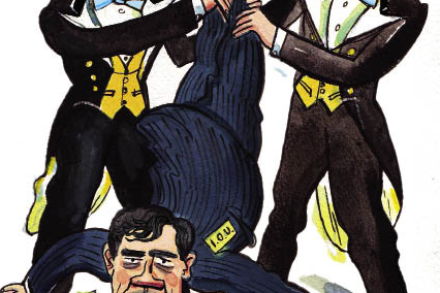
When Gordon Brown has nightmares, what does he see? I suspect it’s something pretty close to Ken Cox’s brilliant cartoon to accompany my cover piece in this week’s Spectator.  It shows Cameron and Osborne in their Bullingdon Club outfits jostling Brown, taking a leg each, until borrowed cash is falling out of his pockets. Like all confidence tricksters, Brown will live in fear of being rumbled, having gotten away with so much for so long so far. And I think that – after an agonising period of faffing about – Cameron and Osborne are finally on his case .  There are five reasons why the PBR plays into Tory hands. Here they are: 1. Brown's so-called splurge is a more of a squirt.

Merkel rejects the Brown approach

From our UK edition

Can someone please tell Angela Merkel that the world is behind Gordon Brown in a great consensus? Because the German Chancellor seems to have forgotten. After rejecting Brown’s casino approach to public finance (borrow like mad, and encourage the public to do the same, then hail yourself as an economic genius), Germany has two things Britain woefully lacks: a balanced budget and a trade surplus. Germans have always been nervous about the debt-fuelled growth which Brown relied on. They recognise the danger in asset bubbles. The Bundesbank was always mindful of this, and its DNA is in the ECB which has handled this better than the Bank of England.

In Brown’s debt

From our UK edition

Can David Cameron make national debt into a campaign issue? He tried in PMQs today asking if Brown can confirm he's doubled the debt to £1 trillion. Problem is: few knew "trillion" was a real word until recently. When Brown decided not to have a payback plan he figured no one would really care. It's like his pension fund raid: it's such a little-understood area that people don't know they're being diddled. This video is how we see debt, it's adapted from a MoveOn.org ad in 2004. How do CoffeeHousers think Cameron could bring this issue to life on the doorsteps?

This is who will pay for Brown’s debt binge

From our UK edition

Gordon Brown is hoping that the sheer size of the borrowing numbers that Alistair Darling announced on Monday will stop people from comprehending them. But we hope that this video—adapted from the brilliant one that won MoveOn’s competition to design an ad against Bush in 2004— will bring home the consequences of this debt. On Monday, Brown decided to saddle each British household with a £40,000 debt by 2013 with interest payments collected through the tax system for decades. This will be Brown’s legacy to Britain.

Why squeezing the rich doesn’t produce much juice

From our UK edition

A devastating blow against Brown's "tax the rich" plan from the Institue of Fiscal Studies today. How much will the new 45 percent tax rate for those over £170,000 raise? "Approximately nothing" says the IFS and adds that "HM Treasury would raise more with, eg, a 44 percent rate". This reminds us why most developed countries have cut their top marginal rate: it discourages risk-taking. After the briefing, I asked why a higher tax could fail to collect more revenue. Mike Brewer from the IFS replied: "People will contribute more to their private pensions. Convert more income into capital gains. Emigrate. Work less." I asked him if, then, Brown's 45 percent tax rate could be described as "futile" and he just smiled.

Digging down

From our UK edition

The IFS post budget briefing is becoming as anticipated by the media as the budget itself, and I'm sitting at the back with the crowds. The IFS spotted the 5 million losers from the abolition of the 10p tax band which Brown claims to have only noticed afterwards. So what do they see this time? My notes...  1. The Treasury forecasts that a chunk of the City that once generated four percent of GDP is never coming back. That accounts for £22bn of the projected deficit, the splurge is just £9.3bn. To me this acknowledges that debt-financed boom was just that, not stability as Brown assumed. 2. The £5bn efficiency cut in 2010-11 is actually a departmental spending cut, ergo real and bankable. 3.