Fraser Nelson

Fraser Nelson

Fraser Nelson is a Times columnist and a former editor of The Spectator.

Osborne’s speech contained not a whiff of radicalism

I’m afraid I did not detect a “new economic model” in George Osborne’s speech. He has said he will “eliminate “a large part” of the deficit (ie, the amount that debt goes up by) over the next parliament. In questions, he kept repeating this phrase: “a large part” - and which is woolier than Labour’s plan to halve it. When asked about this he said that he would do more than half it – but gave no indication by how much. It could be a lot, or a negligible amount. We still don’t know. Osborne said he will stick to what was, in my view, the root error of the recession: the 2 percent CPI target. Inflation was fine in the boom years – it was asset price inflation that pointed to the debt bubble.

The single best reason to vote Tory

There can be fewer more powerful untapped resources in Britain than the desire of parents to place their children in a good school. Every Sunday, pews of school-sponsoring churches are filled with atheist mothers and their kids. You read stories of parents giving up their kids to live with their aunt and uncle just to get a better school.   The single best reason to vote Tory is that they will set up a new system to harness this power, and allow anyone to set up a state school (by themselves or, more likely, in collaboration with the many companies offering to run new schools).  The Times today says that 350 requests have been made through the New Schools Network - an organisation dedicated to explaining the system. You can bet this is just the start.

Because of Blair, Britain will now be shaped by the world

It's striking how Tony Blair, the most successful election winner in Labour party history, is now so despised in the country that gave him three landslides. This matters politically, because he has - I fear - poisoned the cause of liberal interventionism. I look at this in my News of the World column today. Blair's Chicago speech of 1999 laid out what I regarded as a bold and coherent foreign policy case. It was time to stop letting genocides happen because they take place within the borders of sovereign states protected by the UN Security Council. I agreed with him when he said that, if the Rwandan genocide happened again, we would have a moral duty to act there. But if it happens again, what are the chances of Britain joining a multi-national coalition? Pretty close to zero.

The return of IDS

What to do with Iain Duncan Smith? The Sunday Telegraph tomorrow says  he will be given a Department for Children and Social Justice - an idea that has been in the pipeline for a while now. At first, I was against IDS returning to the front bench given what amazing influence he has had as a backbencher. I fancied him as a Frank Field/Wilberforce type - someone used his public platform to advance radical ideas. But that changed when Theresa May was promoted to welfare reform, something which did more to damage my confidence in the Cameron project than anything else since 2007. It seemed to suggest to me that Cameron was not serious about welfare reform (given May's track  record of achieving squat, in any field).

A tale of two FTs

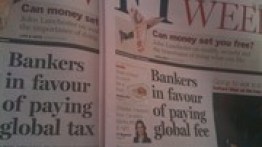
The Spectator isn't in favour of many taxes, but we are calling for a mandatory insurance premium for banks. Depending on which version of the FT you picked up today, it seems the banks are agreeing to this too. But are they agreeing to a tax, or a fee? Even the FT isn't sure - and has two different versions in two editions (pictured).  "Some of the world's most prominent bankers have come out in favour of a global tax on banks," says the first edition with a report from Patrick Jenkins in Davos. But later editions changed this to "a global bank wind-down fund" (ie, voluntary) and in the headline "global tax" is replaced with "global fee". So what's up?

I bear a charmed life, which must not yield to one of woman born

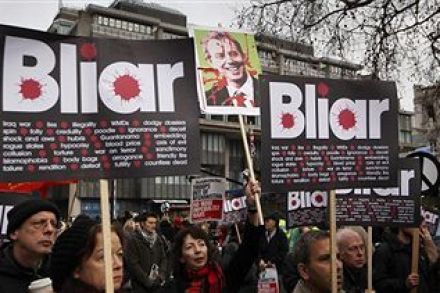
If Tony Blair were to go to the newsagents to day to see how his performance is being reported on the front pages,  he'd be in for a pleasant surprise. He does not feature - certainly not in the biggest sellers. The extra-curricular activities of John Terry make the the lead story on the Mail, the Sun, the Daily Telegraph and the Daily Mirror. Blair himself is relegated to the inside pages on most.  Of all today's press coverage, The Times is probably the most damaging. "Tony Blair was branded a murderer and a liar last night,". But even Blair-hating papers like the Daily Mail find it hard to compete with the John Terry story, which journalists have known about for days but been unable to report (I gather that there are more explosive revelations to come).

As Basra slid towards hell, Blair looked the other way

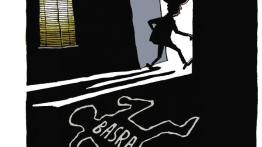
It’s a mistake to focus on the dodgy dossier, says Fraser Nelson. Blair’s real crime was to invade Iraq with no strategy, no understanding of the Islamist factions and no qualms about leaving Iraqis to the mercy of death squads There has always been a faction of the Labour party that wanted Tony Blair in the dock for the Iraq war — no matter how pointless it would be. This was the sole purpose of the Chilcot inquiry. Gordon Brown agreed to it simply to assuage his backbenchers, and the whole exercise was intended to be more a mischievous distraction than an inquisition. But almost by accident, the inquiry has exposed the real scandal of Iraq: the appalling mismanagement of the war and the defeat of the British army, which left the people of Basra to the death squads.

Blair wants to tell Iranian tales

Iran. That’s the news story which poor Mr Blair is trying to spin to the panel – but they don’t pick up on his hints. It would have all been all right in Basra – he’d like to say - if it hadn't been for those pesky Iranians. As Prime Minister, if he blamed Iran in public then that would have had implications. He’d have had to follow up on it. But now he wants to tell us, or he would if those chaps on the panel would kindly probe him on it. When he was talking to Baroness Prashar he tried to start: “If what you’d ended up having was an indigenous violence or insurgency, or criminality and looting and so on…” She wasn’t interested “We’ll come to that later…” and handed over to Chilcot.

A composed and calculated Blair takes round one

So, what do we make of round one? Blair looks younger, in a strange way. A shorter haircut. But all those thespian mannerisms that I had forgotten about are still there - and are being used to full effect. A complete mastery of his facial expressions – which, for Blair, do the communicating. He can torn on anxiety, bemusement etc on tap.The quizzical look, the mock concern. The pause, as he thinks about something (or pretends to). It wouldn’t surprise me if he was faking the slight shaking of the hands which Joey Jones at Sky has just picked up.   We have seen the usual Blair lawyerly hair-splitting habit: “regime change” is not the same as wanting to “remove” Saddam – etc. Blair will, today, throw up something for a headline.

Blair’s real crime

As Tony Blair prepares to sit in the dock tomorrow, I suspect he knows he’ll walk it. The focus is on the case for war and how it was spun – which will be his Mastermind specialist subject. Nor will anything new be uncovered. As one of the journalists whose summer holiday was eaten up by the Hutton Inquiry, I have been getting a sense of deja lu throuhout the Chilcot Inquiry – and Hutton was more informative because he exposed emails written at the time. They had more meaning and impact that the hazy recollections we hear now. The real story is one that Chilcot has unearthed almost accidentally: the betrayal of Basra.

An election victory is only the start of the battle for Cameron

The News of the World has done its poll of marginal seats today (story here, Anthony Wells here) – a hugely expensive operation, but worthwhile because British elections are decided in marginal seats. National polling, while interesting, can be a misleading indicator of outcome. The result is that the Tories have a safe lead of 13 points (take a bow, Lord Ashcroft), but would still end up with just a 38-seat majority due to Westminster’s unfair voting system. As I say in my column, this is nowhere near a ‘safe’ majority, because it means the government can be defeated by 20 rebels.

Rompuy wants the EU to slither onto the world stage

Well hello there, Rompuy. We haven’t heard much from the new EU president so far – he was upstaged by Barroso at the Copenhagen conference, showing that the EU stage only has room for one super-ego*. But with the Lisbon Treaty ratified, in defiance of public opinion in Britain (and Labour’s manifesto pledge), he now has powers to advance the EU project further. His idea today: the possible development of a "humanitarian rapid reaction force" for the EU. This rung a bell with me. When I did my tour of duty in the Scottish Parliament, this was a goal of the SNP. They want to creep on to the world stage, without asking permission. One step is to send “observers” to various committees. But aid is the softest target.

Osborne looks to Sweden, but let’s not turn Japanese

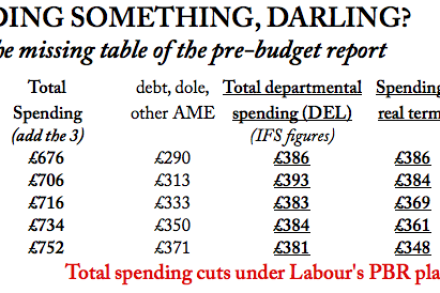
The Tories have said plenty to dismay me in the last few weeks, so I was delighted to pick up the FT today to see George Osborne talking sense – and boldness. Given that we have to increase taxes, it’s an obvious one to raise. The “too big to fail” principle means that the state now provides de facto insurance to banks – so it’s reasonable that they pay for that insurance. The whole tone of Osborne’s interview is reassuring, especially as he indictates he is studing the aggressive Swedish reponse to the fiscal crisis. He indicates Tories are looking at plugging the deficit with 80 percent cuts and 20percent tax rises – even more radical than the 70:30 split which (as James told us back in October the Tories were then thinking about.

Surprise, suprise, inflation’s on the rise

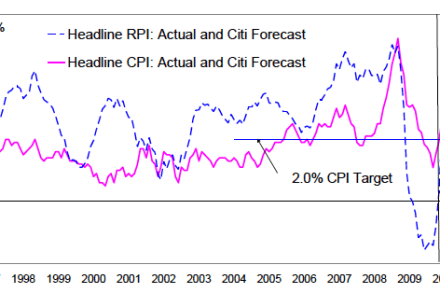
Oops! Britain's inflation is heading back to 4 per cent territory ­ as you'd expect with the Bank of England printing money and using the debt to finance government spending. If you create more money, you reduce the value of the money. Citi has done another brilliant research note, which it is putting online, laying out the implications. The punters are facing pay freezes, or settlements below 2 per cent. The cost of living is soaring. Result: misery. Here are the two graphs from Citi that spell it out. First, inflation (much affected by the VAT hike ­ in the same way that it was artificially reduced by the VAT cut. The resulting inflation was, of course, a great excuse to print money to finance Brown¹s fiscal debauchery.

The cost of saving the Army

We have led the magazine this week on coming Tory defence cuts, with a brilliant piece by Max Hastings. Look closely at the cover image (our second by Christian Adams) and you can see the guillotine blade will hit he RAF and Navy guys before the Army. This, Hastings argues, will be the effect of the Tory Strategic Defence Review. And even this will leave cuts of up to 20 per cent across the defence budget under the Tories. How could Cameron justify that, in this dangerous world of ours? David Cameron prepares the ground today with an important speech in Chatham House promising “one of the most radical departures in security policy we’ve seen in decades”. He goes on to say that “We need to do much better at stopping wars from ever starting.

Both sides of the divide

Sky has again given the BBC a lesson in how to produce documentaries. Ross Kemp in Israel last night was superb: not just grippingly produced, but actually balanced. Yesterday’s episode opened with Kemp on a tour with an Israeli taxi driver, who talks about the Palestinian terror attacks, the effects it has on his community and not least to him (they killed his 17-year-old daughter). Then to a man who lives 300 yards from the Gaza border who lost his 22-year-old daughter to a Hamas rocket – but who wants forgiveness, and a two-state solution. The issue of illegal Israeli settlements was brilliantly covered.

Cameron has the positioning right – but fiscal questions remain<br />

Here, CoffeeHousers, is my take on this morning's Cameron interview: 1. General demeanor: excellent, articulate, confident. The complete opposite from Brown. It does make you think that he should wipe the floor with Brown in the TV debates. 2. “Last week we saw William Hague and George Osborne going to Afghanistan together. First shadow Chancellor, the man who is going to be in charge of the money, on the frontline seeing what is going on in Afghanistan”. Indeed, but the NHS pledge and deficit cut pledge imply deep cuts to the military. To govern is to choose, and Cameron has made his choice: NHS spending before the military.

Inside the Brown operation: the loathing, the cluelessness and the sulks

Remember Peter Watt? No one in Team Brown did either –and that, it now turns out, was a big mistake. As general secretary of the Labour Party when the Blair-Brown handover happened (and cash-for-honours was in the air) he was in a brilliant position to know what went on. And, after being abandoned by all of them, he has a motive to tell. His revelations are pretty explosive, but this jumps out at me the most - from Douglas Alexander, the man everyone thought was Brown’s little Mowgli raised by a fellow son-of-the-manse in the jungle of politics. This is what Alexander (the would-be co-ordinator in the election that never was) had to say to Watt in 2007: "The truth is, Peter, we have spent ten years working with this guy, and we don’t actually like him.

A message to subscribers

One of the joys of living in Britain is watching the country fall apart when some snow falls. Trucks laden with your copies of The Spectator are, alas, no exception to this ­ and we gather that many of our readers could face delays before receiving their magazines. So we have decided to put the whole magazine online this week (7 January - 14 January)  ­making it free to everyone, not just our subscribers. It's no substitute for the whole thing, I know, and can only apologise as our trucks and postmen battle through the snow.

What’s it all about, Dave?

This morning, I drove past one of the Cameron adverts - “I’ll cut the deficit, not the NHS” - and that Bacacharch & David song came into my head: "What’s it all about, Alfie?" It’s been in my head, in fact, ever since his Oxford speech last weekend. Just what is the Big Idea? We seek to answer the question in this week’s magazine with four pieces. James Forsyth says that any hunt for Cameron’s ideology will be in vain, because he doesn’t really have one. He doesn’t like –isms and there will never be a Cameronism. David Selbourne, one of Britain’s leading political philosophers, has written a scathing piece. (“I’m afraid this is merited” he said in the email, when his sent his piece).