Fraser Nelson

Fraser Nelson

Fraser Nelson is a Times columnist and a former editor of The Spectator.

Where the Mail’s cover story came from

From our UK edition

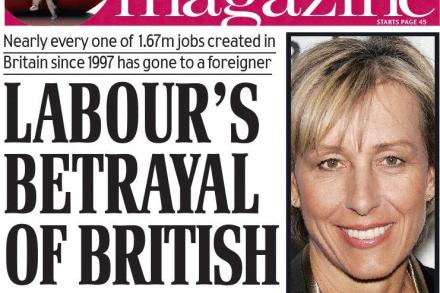
It's always gratifying to see Coffee House posts followed up in the newspapers, and I almost admire the way the Daily Mail has just splashed the newspaper on one of our posts without mentioning the source. CoffeeHousers will recognise the story on the Mail's front page (left) - some 99 percent of jobs created since 1997 are accounted for by immigration. But the reader is left wondering where this figure came from. Was it released by the ONS? Erm, no. The only source for these figures is an email I was kindly sent by the ONS after specifically requesting the data. I used it in a line from The Spectator's editorial endorsement of the Conservatives, which we flagged up in a CoffeeHouse post at 11am yesterday. The Tories spotted it, and Damian Green raised it in PMQs at 12.28pm.

British jobs for British workers…

From our UK edition

Did you know that there are fewer British-born workers in the private sector than there were in 1997? I'd be surprised if so: these official figures are not released. The Spectator managed to get them, on request from the Office of National Statistics. We use the figures in tomorrow's magazine, but I thought they deserves a little more prominence here. See the graph above, which shines a new light on the boasts Gordon Brown has been making. He said his Glasgow speech last month that: "If we had said twelve years ago there would be, even after a global recession, 2.5 million more jobs than in 1997 nobody would have believed us.

The true cost of Brown’s debt binge

From our UK edition

When Alistair Daring admitted last week that there would indeed be job losses arising from the proposed National Insurance hike, it would have struck Gordon Brown and Ed Balls like root canal surgery. This blows wide open the main part of Brown's election deceit: asking the public to look at the advantages of the borrowing, and not contemplate the flip side to the debt coin. Not to ask where the repayments will come from, or the impact of those repayments on the jobs of the future. No wonder Darling is today being made to claim the opposite. The grim truth is that every job "protected" now, due to debt, will be more than balanced out by money taken away from the economy in the form of the interest needed to serve that debt.

Brown helps Cameron to define his Big Idea

From our UK edition

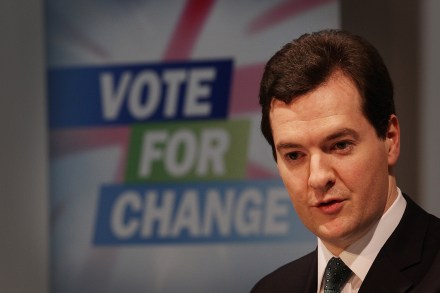
Gordon Brown has walked straight into George Osborne’s trap. After bleating that the national insurance tax cut is unaffordable, he has decided to make this a massive election dividing line – claiming that this teeny (1 percent of state spending) tax cut somehow poses a mortal danger to an economic recovery.  Please, God, let him keep on this message through the campaign. “The Tories are proposing to cut your taxes and make you better off – stop this lunacy, and vote Labour”. But Alastair Darling has taken it further, with a significant piece of language on the radio this morning. The Tory tax cut, he says, is “taking money out of the economy” at a vulnerable time. As he said at 7.

Why the Tory lead is growing

From our UK edition

With the Tories back up to a ten-point lead in the YouGov/Sunday Times poll, it seems that – as James put it yesterday – the ‘big mo’ is with them. David Cameron is about to survive his third political near-death experience: the first being his leadership campaign and the second the election-that-never-was in 2007. This demonstrates Cameron’s extraordinary recovery capacity – but also an unfortunate habit of blowing opinion poll leads. It’s a habit that I hope he has now kicked: the elastic on his political bungee may snap if he tries another dive before the election. So it’s time to ask: what went wrong? And what went right?   Both should be painfully clear by now. I say in my News of the World column today, “Detect a trend yet?

Why we shouldn’t confuse poverty with inequality

From our UK edition

The power of ideas is vastly underrated in British politics. It has become fashionable to dismiss them as "ideology" and declare oneself in favour of "what works".  But the idea of what works is, of course, driven by concepts. As Keynes put it: "Practical men, who believe themselves to be quite exempt from any intellectual influence, are usually the slave of some defunct economist."   I write this because ConHome has just run a piece by Max Wind-Cowie saying, "Equality should not be a dirty word for the Conservatives". I do admire the way Demos, seeing Labour on the way out, is trying to inject as much of its agenda as possible into the Conservative party. But "equality" is, alas, a trap.

The joke’s on Brown

From our UK edition

It took a while, but I spotted Labour’s April Fool trick: an attack document on the Tory economic agenda. It looks real at first, but when you go through it the con becomes transparent. APRIL FOOL ONE: “The Conservative Party wants to face two ways at this election, promising extra tax cuts and spending commitments while at the same time claiming they would reduce the deficit further and faster than Labour’s plan to halve it in four years.” REALITY: Labour pretends to be unaware of the basic economic concept that if you have a lower tax rate, business grows faster – generating more revenues. There is such a thing as a self-financing tax cut, which is why the top rate of tax has fallen around the world over the years.

Highlights from the latest Spectator | 1 April 2010

From our UK edition

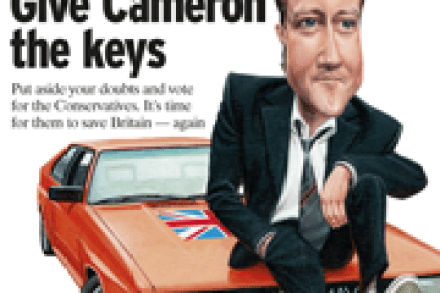
The latest issue of the Spectator is out today. Here are my top five features: 1. Can Catholicism save British Christianity? It's our Easter issue this holiday weekend, so we're trying out a new artist on the cover (left). And in the magazine is one of the very best pieces we've run since I've been in the editor's chair. It's by Matthew Parris, and is a denouncement of the Catholic Church - but on the grounds that it defies what Jesus stood for. Now, I disagree with his argument - but when he made it, during our debate on Catholicism last month, I was blown away by its power and force. It reads just as well as it sounds. If Jesus of Nazareth did not live, he says, the Catholic Church would not have invented him.

A new Brownie Buster

From our UK edition

Michael Scholar: hero. The newish head of the UK statistics authority is finally coming to the aid of the statistics nerds who have been protesting that Gordon Brown makes things up. Normally, the ONS do not censure Mr Brown when he misrepresents their data: that's not their job. But as head of the Statistics Authority, Sir Michael has - wonderfully, inspirationally - written an open letter to the Prime Minister telling him not to lie. Well, not quite in so few words, but this is the plain implication. What is significant is that Sir Michael is using his job to protect  the integrity of statistics in Britain. One of my favourite ever facts is that "65 percent of the UK population do not believe statistics".

Why Blair’s return is good news for the Tories

From our UK edition

Blair's return will be worth a good 2-3 points to the Tory lead. Like Mandelson, he can dazzle journalists who admire his tradecraft. Like Mandelson, he is loathed by the public who see a snake oil salesman. Blair mis-sold the country a project in 1997, and delivered none of what he promised (and it was with those broken 1997 problems in mind that the News of the World backed the Conservatives last weekend). He is not very popular now. When he gave evidence to the Chilcott Inquiry, the crowds came from near and far to denounce him. One placard, which I found outside my office, said "Blair is a war criminal" then someone had taped below it "and a w****r" but without the asterisks.

Osborne’s silent victory

From our UK edition

I think Osborne’s main victory tonight would be to reassure those who thought him a clueless idiot. The left demonise him, and it’s easy for the right to despair at him too (yes, guilty). But the figure we saw tonight was calm, collected and assured – and I reckon this was his achievement. He allayed fears. Expectations of his performance would have been rock bottom, and he’d have surpassed them easily. He was playing it safe. Vince Cable did his after-dinner speaking comedy act (I met William Hague in the ‘spin room’ afterwards, who swears that some of Cables lines were nicked from his repertoire), and the studio audience loved him for it. But Cable is not going to be Chancellor, he can afford to take risks.

Back to his Tory best

From our UK edition

George Osborne has just set the scene for tonight's Chancellors' debate by announcing something neither Darling or Cable will be able to match: a tax cut. It's a real one, it will benefit some 20m workers and (best of all) it will be paid for by spending cuts. While the amount is not huge - everyone on under £43,000 will be £150 better off - it indicates the route the Conservatives would go down in government.   Trusting people with their own money, and stoking the recovery by cutting the tax on jobs. Here are the main points: 1) Osborne would raise National Insurance threshold in Apr11. One of the many booby traps Brown laid for the country after the next election is a national insurance hike of 1 percent, for both employer and employee.

Explaining the NotW endorsement

From our UK edition

The News of the World's endorsement of the Conservatives today is worth reading. It has taken some time and much soul-searching for the paper to make this decision. Papers, even under the same proprietor, have different readerships with different outlooks on life. The Sun came out for the Tories on the last day of the Labour conference last September, but its stablemate has taken far longer. It has been firm in its denunciation of Brown's failings but – like many voters – it has looked long and hard at just how a Tory government would correct them. The reason for its endorsement now is laid out in the leading article. It started with the reasons for why it backed New Labour in 1997 – what would it change?

Highlights from the latest Spectator | 26 March 2010

From our UK edition

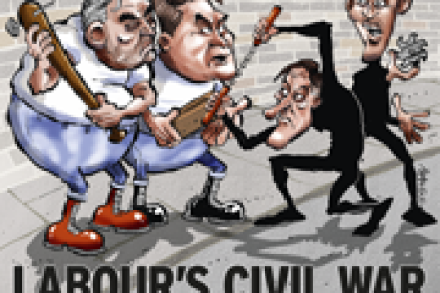
The new issue of The Spectator leads on the next big story in British politics: the not-so-cold war for the Labour leadership. The first sign of a brutal civil war is mass evacuation, and we’ve seen that with Milburn, John Reid, Purnell etc. James’s cover piece takes you through the other dynamics. The war the Brown-Whelan-Unite alliance is trying to rig the succession for Ed Balls, he says, and has started to think of which new MPs to select. So when Purnell goes up to Tom Watson and describes him as being a “cancer at the heart of the Labour Party” this is what he’s referring to: an attempt by Watson to rig the succession in his soon-to-be-vacated constituency in favour of a candidate who could be relied upon to vote Balls.

Labour’s spending cuts exposed

From our UK edition

Darling has now exposed as false the Brown/Balls dividing line of "investment vs cuts". If Labour were to win, he said, the cuts would be worse than anything seen under Thatcher in the 1980s. This is Darling's problem: he's a dreadful liar. The IFS today laid out the scale of the cuts that would happen whoever wins the election, and the below graph is worth reprinting. Overall spending falls 12 percent (once dole and debt interest are taken into account). So when Darling says this is worse than anything in the 1980s, he is simply stating a fact. You'd never catch Balls or Brown doing that, by the way, and I hope that, when either pop up for interview, they will be asked if they agree with their Chancellor's assessment.

Osborne’s weak response

From our UK edition

I was all set up to Fisk the post-Budget analysis which Darling normally gives to the Today programme after the Budget - but he wasn’t there. The Treasury refused to have him debate with Osborne which is what Today (unusually) seems to have assumed. Well, we’d best get used to hearing Osborne post-Budget day. At first, I thought it was a coup for the Tories - but as Evan Davis sharpened his claws, it soon appeared to have been a net negative. Osborne just didn’t sound confident. A series of exchanges left him looking unprepared. His line - that he will eliminate ‘the bulk’ of the annual overspend over the lifetime of the parliament - was challenged: what does it mean?

In defence of Alistair Darling

From our UK edition

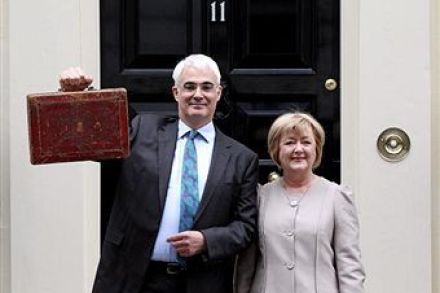
It's unusual for Chancellors to stand with their wives on the steps of the Treasury on budget day, and to see the Darlings together this morning gives an indication of what they have been through. Brown doubtless thought him an automaton when he appointed him to the job - but I was wrong to say that he would be "no more a Chancellor than Captain Scarlett was an actor". He has defied Brown, bringing moderation and much-needed dullness to the worst fiscal crisis in Britain's peacetime history. In James's political column last week he suggested that Darling calls his autobiography "the forces of hell" - that he would defy Brown like that takes some guts. It felt strange to praise Darling in the editorial of tomorrow's magazine, given that he has presided over this fiscal collapse.

A reassuringly dull budget

From our UK edition

This was a surprisingly subdued Budget, and for that Alistair Darling is to be commended. He must have resisted all manner of pressure from Brown to put in pre-election pyrotechnics. But the budget was what it should be: a punctuation mark on the sentence of the national economy. That sentence says "our finances are going to hell," and the Budget's high point is that we are doing so fractionally slower than we were expecting to last November. Personally, I forgive Darling all the partisan stuff in his speech - this is a pre-election Budget after all. There is no act of wanton vandalism, like the 50p tax. Stamp duty on properties over 1m is rising from 4 percent to 5 percent, but does anyone seriously think this would not have happened under the Tories?

Closing the gap between state and independent education

From our UK edition

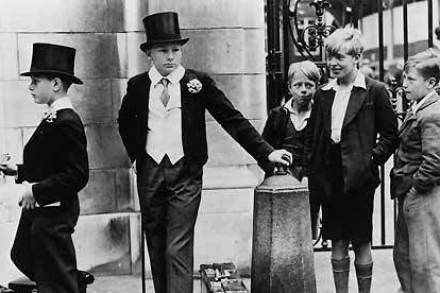
I do hope that Oxford will finally be free from government claims of snobbery soon. We learn today that the proportion of state school pupils it admits has fallen from 55.4 percent to 53.9 percent - but, as the university says, this is in line with the (appallingly low) proportion of state school pupils achieving three As. The problem lies with the schools, not the universities, and it helps no one to pretend otherwise. Here's one figure that you won't read in the ongoing "Oxford snobbery" story: in 1969, only 38 per cent of Oxford's places went to privately-educated children. Why? Because the private schools in those days were not places of educational excellence, but of social preference. The decline of state education, relative to private, is the problem here.

Introducing the Nelson tax

From our UK edition

In the News of the World today, I propose a new tax on the rich: specifically, on ex-ministers who go on to earn a crust advising companies how to avoid the regulations with which they have saddled the British economy. I proposed this before the news broke about Byers and Hewitt etc, but their appalling story makes it all the more pertinent. The Nelson tax should be above the top rate, and imposed on any activity such as giving speeches to the Chinese, lobbying, consultancy, etc. - anything which trades from contacts or reputation built up while serving the taxpayer. It would not be levied on activities which the ex-minister could plausibly claim he would have taken on anyway. So if Blair were to return to law, his earnings would be taxed at the normal rate.