Fraser Nelson

Fraser Nelson

Fraser Nelson is a Times columnist and a former editor of The Spectator.

King’s inflation nation

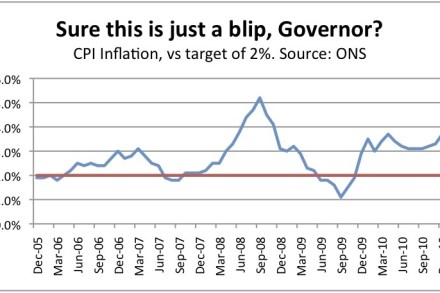
If Mervyn King and his team are trying to deal with Britain's debt crisis by letting inflation rip, I do wish they would just say so - rather than go through this monthly farce. Yet again, base rates have been left at an absurd 0.5 per cent, in an economy expected to grow by a full 2 percent this year but with inflation at 3.3 percent or 4.8 percent depending on how you measure it. Petrol prices are bad, but now they are matched with soaring prices elsewhere - from train travel to groceries. Here's a list of some price rises confronting shoppers:   Add Osborne's VAT rise to non-food items and we will see CPI inflation soon at 4 percent, twice the Bank of England's much ignored target. Here's what puzzles me.

Exclusive – Adonis: I back Gove

Is Michael Gove’s school reform a hideous distortion of the Labour Academies programme, as Ed Balls put it, or the fulfillment of that agenda? Until now Lord Adonis, the architect of the Academies programme, has kept silent on the issue. But he’s interviewed in The Spectator tomorrow by Matthew Smith, editor of Attain magazine. Here is a brief extract: 'Ed Balls has declared Gove’s plans for academies as ‘a total perversion of Labour’s policy, which was about turning round under-performing schools in disadvantaged areas’. Adonis’s response is rather different.  ‘Neither I nor Tony Blair believed that academies should be restricted to areas with failing schools.

The crash from an Austrian perspective

It’s not all politics at Westminster. There’s a pretty good think-tank scene too, with lectures on topics that you’re unlikely to read about in the newspapers. One took place today: the Adam Smith Institute hosted a lecture by Steven G. Horwitz, from St. Lawrence University, entitled “An Austrian perspective on the great recession of 2008-09”. As many CoffeeHousers will know, "Austrian" refers to von Mises, Hayek and the others whose analysis of bubbles and crises certainly seems to fit current events. My colleague Jonathan Jones was there, and took some notes – which I have moulded into a six-point briefing.  It’s not often we do a post based on a think-tank talk – we may do more, if CoffeeHousers find them useful.

Cameron sells the coalition’s economic policy

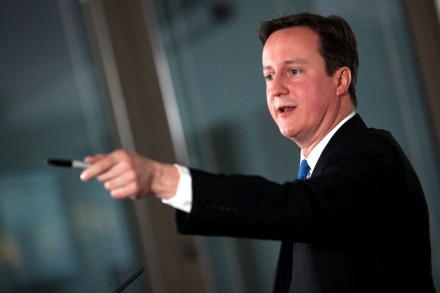
David Cameron was on Marr this morning (with yours truly doing the warm-up paper review), talking about the "tough and difficult year" ahead. Others have been through the interview for its general content. What interested me was its economic content: not the most sexy subject in the world, I know, but, as Alan Johnson unwittingly demonstrated on Sky this morning, the Labour Party looks unable to scrutinise the government's economic policy. Anyway, here are ten observations:   1) "Because of the budget last year, we are lifting 800,000 people out of income tax, we're raising income tax thresholds. That will help all people who are basic rate taxpayers." Thanks to the Lib Dems. But it's a great claim, and I'm glad Cameron is making it.

King’s ransom

How much bigger does Britain's inflation have to become before Mervyn King realises it’s a problem? The VAT rise should have lifted prices by 2.1 percent – but shopkeepers over Britain have been applying far larger rises. Why? Because one of the most important factors in economics – expectation of inflation – is back. People are bracing themselves for another year of rising heat, transport and staff costs – so retailers hike up prices in anticipation, and a vicious spiral of inflation begins. The Retail Price Index was up 4.8 percent last November, and Consumer Price Index 3.3 percent. The price of this failure of monetary policy is paid by ordinary taxpayers, whose wages stand no chance of keeping up with the rise in prices.

Gove’s school reforms approach a tipping point

Today marks something of a milestone for Michael Gove’s school reform agenda. Free schools – i.e. ‘Academies’ which are independently run, yet within the state sector – now account for more than 10 percent of British secondaries. This is what I have always thought of as a tipping point – where independent schools offer real competition to council schools (i.e. those run by their local authority). One hesitates to sound too confident, but the genie of choice seems to have been yanked out of the bottle, and a few facts are worth nothing: 1. There are now 407 Academies open, twice the amount in May 2010. The 400 mark was, for Tony Blair, totemic - a goal that he made Gordon Brown sign up to as a condition of the handover.

Is it a merger?

When a Conservative leader wishes the LibDems well in a three-way marginal by-election, then what is going on? Andrew Gilligan’s piece today shows that the Conservative campaign there is muted, and my colleague Melissa Kite reported earlier that Cameron personally called off  the hunt supporters, Vote OK, who were planning to boost the Tory campaign. Little wonder that Conservative MPs are beginning to smell a rat. They are being told this is the cohabitation of rival parties; in the Daily Telegraph tomorrow, I ask if this is actually a merger.   From the start of this coalition, I’ve been struck by the differences between the coalition in Westminster, and that I witnessed during my tour of duty in the Scottish Parliament.

A debt-filled New Year

The Spectator is out today, with a cover story that I would commend to CoffeeHousers. Failure to learn from history usually condemns a nation to repeating its mistakes. That's why we should be nervous that no one seems to have worked out what caused the crash. Little wonder: the guys doing the analysis are the same guys who failed to spot the crisis building up, so it suits everyone to blame the banks. "How was I to know," says everyone from Gordon Brown to Joe the Pundit, "that they were doing all these complex debt swap thingies? They deceived everyone, the bounders." There is another analysis – and it's our cover story, written by Johan Norberg.

A paean to the people

There's so much junk on the box at Christmas that yesterday I tweeted a link to a seven-minute video that I thought would be much more memorable: an American's film on England in Christmas 1940. The film is above, and speaks best for itself. The great thing about Twitter is the response: positive and negative. And while many people retweeted the link (one guy said he'd forced his kids to watch it), it provoked fury from one David Walker. His words: "@frasernels - this Tory dares extol this film - a paean of praise to the state and common sacrifice. What hypocrisy.

A sign of the Times

Yesterday, The Times produced its first Christmas Day edition for more than a century - since, that is, newsagents started taking that day off. The jewel in that edition was a wonderfully spirited piece from my Spectator colleague Matthew Parris about the importance of paywalls. I fervently believe in them, and regard them as the only hope for this sharply contracting industry. But over to Matthew: “‘Sorry, I can't read you anymore, but I refuse on principle to subscribe now that there's a paywall,’ these muppets whine. ‘On principle?’ I reply. ‘What principle?’ As they fumble for an argument, I interrupt: ‘Look, maybe the money is a bit tight at present: I quite understand that.

The coming war between the coalition and the councils

Cameron vs the councils may well be the most vicious political battle of 2011 – and one I preview in my News of the World column (£) today. It comes in four stages. First was last week, when the increasingly impressive Eric Pickles said he wanted a 27 percent cut in funding over four years. Grant Shapps weighed in behind him – saying that even 8.9 percent in a year (the maximum cut facing councils) was do-able without any cuts in frontline services. The councils, predictably, said it is not possible. And the threats have started. The strategy amounts to nothing less than a human shield strategy. "If you make us cut," they say, "then we'll turn off street lights, or sack lollipop men" (both real examples).

Access all areas | 18 December 2010

It is an exciting day for Liberty Osborne, the Chancellor’s daughter, to join him at work. The windows at HM Treasury are boarded up, workmen line the road replacing the bombproof (but not student-proof) glass. Graffiti defaces the walls, but although several politicians are named and shamed in spray paint (‘Why did Nick Clegg cross the road? Because he’d promised not to’) there is nothing unkind about the author of the cuts: George Osborne himself. When we meet the Chancellor at 10.30 a.m. in 11 Downing St, he does not look the slightest bit like a man under siege. Seven-year-old Liberty bounds out of his study, waving at us cheerfully. The Chancellor is no less upbeat.

The Spectator’s Christmas interview with George Osborne

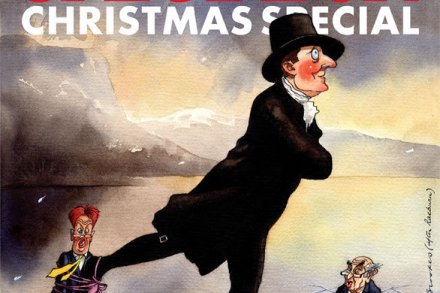
The Christmas Special of The Spectator is out today, and George Osborne kindly agreed to an interview. We have printed 1,500 words in the magazine, but James and I thought CoffeeHousers may like a fuller version, where he has more space to speak for himself.  We have gone into way more detail on tax policy here than in the magazine, for example, as Osborne is seldom pressed on this point and his thoughts are very interesting. We have divided it up by subject headings, so CoffeeHousers can skip the chunks they’re not interested in.   Liberty, paternity and Treasury It is an exciting day for Liberty Osborne, the Chancellor’s daughter, to join him at work.

Any Christmas reading suggestions?

Christmas is coming, and the bookshelf is getting thin - so, any suggestions for Christmas reading? We are putting our Christmas Special to bed today, so your baristas at Coffee House would be grateful for any tips. I don't need to say that we're not after politics books. Coffee House is not simply a home for political wonks, and the brilliant suggestions last time I asked pointed me to all manner of treasures, old and new. So all suggestions welcome.

Who are the government’s regulation busters?

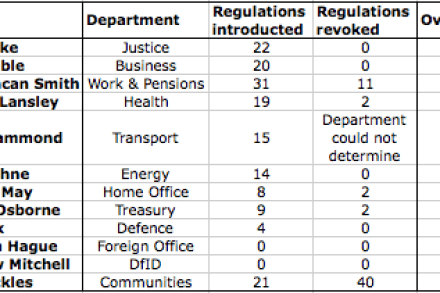
Each time politicians fight regulation, regulation normally wins. So far it seems like this coalition government is no different. John Redwood has been busy tabling parliamentary questions asking each department how many regulations have been introduced, and how many repealed. Rather than “one in, one out” in turns out that two regulations have been introduced for every one revoked. Eric Pickles emerges as the star, having revoked twice as many as he introduced. But the rest? Here’s the league table: I don’t think that the “guilty” ministers have been lax. It’s just that the system is out of control.

Cameron must head for the common ground

All the attention last week was on the Lib Dem split – but what about the division within the Conservatives? This is the greater threat to the coalition, and while there is not likely to be an earthquake soon, one can discern the outlines of the tectonic plates. Ladbrokes has odds of 5-2 of an election next year, and these don't seem so short when one considers the short life of coalitions in British peacetime history. So where might the tension lie? A while ago, I referred to the bulk of the party as "mainstream Conservatism," as a more useful phrase than the tautological "Tory right". Tim Montgomerie last week drew a distinction between this and what Ken Clarke calls "liberal Conservatism".

Sifting through the wreckage

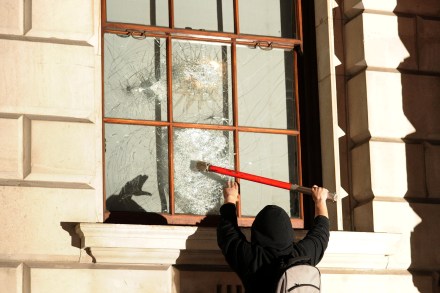
The revolution may not be televised, but protests certainly are – and the process magnifies the drama. Since last night, the news broadcasts have all had footage of two thugs trying to smash the windows of the Treasury and, in the process, familiarising themselves with the properties of bombproof glass. The attack on Charles and Camilla's royal limo is splashed across all this morning's front pages. The script is so well-rehearsed now that I hesitate to repeat it: the vast majority are peaceful protesters, infiltrated by vandals who soak up the attention. Many of the protesters yesterday looked like they’d get a cab straight back home to their Notting Hill trust-fund houses.

Christmas cheer, Spectator style

It was the Spectator’s Carol Concert last night, in the Fleet St church of St Bride’s – and one of my favourite nights of the year. The choir is amazing: if you’re a sucker for John Rutter-style choral arrangements (which I very much am), then it was heaven. The choir’s first piece was Harold Darke’s stunning arrangement of In The Bleak Midwinter, perhaps my second-favourite piece of Christmas music.* I was up for the first reading, Isaiah Ch9, predicting the birth of Christ. It was weirdly short, so I looked up the Good Book to see if I could beef it up a little – and it was one of those moments when you’re reminded just how brutal the Old Testament can be.

Why we must remember the lessons of the Anglo-Scottish Enlightenment

The Adam Smith Institute kindly asked me to speak at their Christmas reception last night, and yesterday I was mulling what to say. When at The Scotsman ten years ago, I would sometimes visit the great man's grave in Edinburgh, and be surprised to see only Chinese tourists paying tribute. It was a pretty good sign of how political power would play out. Edinburgh is, with Prague and Stockholm, among the most beautiful cities in Europe; itself a monument to the Enlightenment. And how tragic that students – even Scottish ones – are taught about the E word only in the context of the French Enlightenment. The likes of Rousseau, Voltaire, Diderot wrote of grandiose ambitions and recasting society using state power.

The Passion of Nick Clegg

You almost feel sorry for Nick Clegg this week, with the tuition fees vote in prospect. Being hated is difficult for LibDems because they didn’t expect it. Not so with the Tories. As a conservative, you usually realise early on that you're going to be a small fish swimming against the current of fashionable received wisdom – and that will involve various tribulations. Like having to persuade your non-political friends that you do not advocate slaughter of the firstborn, and that there is a difference between believing in empowering people, and wanting to let the devil take the hindmost. If you turn up to the Islington Conservative Carol Concert (as Eric Pickles is doing), then you brace yourself for protesters outside it (as there will be).