Fraser Nelson

Fraser Nelson

Fraser Nelson is a Times columnist and a former editor of The Spectator.

Poverty porn

British poverty is normally a subject for comedy, rather than documentary. Scotland gave the world Rab C. Nesbitt with his string vest and indecipherable accent. Channel 4 had Shameless, the capers of a family ruled by drink and drugs. The BBC has now brought us the real thing: The Scheme (BBC1, Tuesday), a fly-on-the-wall portrayal of the lives of six families in a welfare ghetto in East Ayrshire. It was a smash hit in Scotland, where it was aired last year, and the BBC is now trying it on the rest of the country (with subtitles, naturally). The characters look as if they were chosen for a Trainspotting sequel. We are introduced to Marvin, a recovering heroin addict who lives with his bull terrier, Bullet. Or did, until he was arrested and had to leave the dog with the new girlfriend.

Breaking strikes

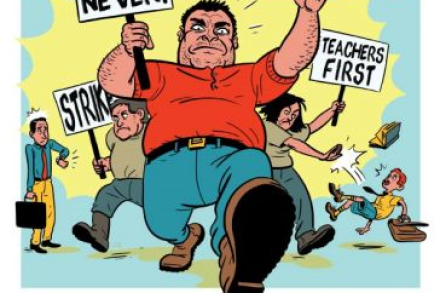
Shortly before Michael Gove organised a strike for journalists in Dundee, I crossed a school picket line with my mum, a teacher at my local school (Nairn Academy). She was a member of a teaching union, the PAT, that didn't believe in strikes, so when the school closed the two of us went in. It was a perfectly friendly affair: my teachers (and her colleagues) were at the gate, with no one else around. One of her colleagues handed her a leaflet and we went on inside. We never discussed politics at home, and I still have no idea what my mum thought about Thatcher (it was 1985). But then, she and thousands of teachers like her took the basic view that kids should not be dragged into disputes between adults.

Tax versus philanthropy 

I was on the panel of Any Questions last night in Saltaire, the most beautiful town I’ve seen outside of the Highlands. Jonathan Dimbleby always warms everyone up with a test question, which lets the panelists make their mistakes early. The first question was this: the town of Saltaire was founded by a philanthropist, Sir Titus Salt. What can be done to make today’s rich pay their fair share? Lucky for me that it was not recorded, because I went on for ages. Sir Titus was living in an era before the welfare state, where welfare was provided voluntarily, by people in the community. Had he been alive today, the government would be confiscating 52 per cent of what he earned – thanks to George Osborne’s recently increased tax.

The myth of cuts

Last week, Ed Balls warned against the effect of George Osborne’s vicious, front-loaded cuts. Today, we have an update in the form of monthly state spending figures. In cash terms, a new record has been set in state largesse. The UK government’s current spending was £51.7 billion in May, up from £50.6 billion in May last year (the last month of Gordon Brown). George Osborne has so far outspent Gordon Brown every month that he’s been in the Treasury. Even adjusted for the runaway inflation, the Chancellor has on average outspent Brown during his first 12 months:     To fund this extra spending, the Chancellor borrowed £27.4 billion from the public for April and May. Labour chirp today that this is more than the £25.

The limits of stigma

As James says, it’s been a day of high passions here at The Spectator. He feels strongly that many of the problems in Britain are societal, and require a cultural shift. Maybe so. I disagree with James when he says a Prime Minister's role is to “lead society". I disagree. We pay him to run the government, not offer his advice (or, worse, condemnation) on how society is running itself. Sure, society is shaped by government incentives. Cameron can fix these. But shaping society by exhortation is not what we expect of limited government. Fundamentally, it confuses what I see as the natural pecking order. In Britain, the people pass judgment on politicians. Not the other way around.   Tim Montgomerie is on James’ side, and chastised me yesterday.

Cameron takes on bad dads

It’s Fathers’ Day today — and David Cameron is marking it with an extraordinary attack on those dads who are AWOL. It comes in one paragaph of an otherwise excellent and moving piece for the Sunday Telegraph (albeit one that downplays the role of the taxman), in which he says that men leaving their family is "beyond the pale"; that such fathers should feel the "full force" of society; and goes as far as comparing them to drunk drivers. This is a brave move — in the Sir Humphry sense of the word — for three reasons. 1. Britain has more absent fathers than any country in the EU. That’s numerically: as a proportion, only in Estonia do single mothers compose a larger chunk of the electorate. Perhaps Cameron is appealing to single mothers here.

Hilton will probably ride it out

Not for the first time, a throwaway line in a Spectator article by James Forsyth has been picked up by Fleet St and set the hares running. It's about Steve Hilton, Cameron's best friend and chief strategist, and whether he'll quit. Hilton is a man in a hurry — rightly, in my view, as the Tories are not incapable of blowing the next election. So he wants things transformed, and — for all his faults — acutely feels the sense of urgency and tries to communicate it through government. The Whitehall machine (and, more specifically, the permanent secretary of No.10) does not share this urgency and waters down change. It poses a grave risk. Cameron's mission to change Britain could be over, before it begins.

Balls’ bloodlust gets the better of him

Ed Balls’ problem is his killer instinct. If he were a Twilight vampire, he’d be a Tracker: someone whose uncontrollable bloodlust takes him to places he should avoid. His position on the deficit is so extreme — more debt, more spending — that he’s pretty much isolated now. People are mocking him. John Lipsky, the acting IMF chief came two weeks ago and rubbished Balls’ alternative (as Tony Blair did) — so Balls, ever the fighter, has today given a long speech where he sinks his fangs into Lipsky and says (in effect) "I’ll take on the lot of you!" But Balls is brilliant. Often George Osborne seems not to bother arguing, and instead seeking approval from an alphabet soup of external agencies ("I must be right, the ABCD says so!

Inflation: cock-up, not conspiracy

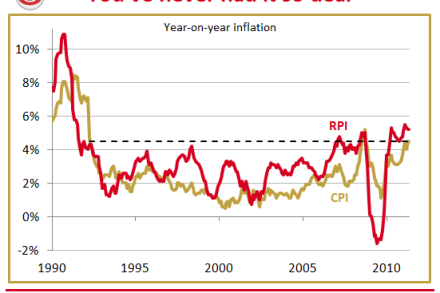
Britain has the worst inflation in Western Europe; this is today's story. CPI is 4.5 per cent and RPI is 5.2 per cent. This masks even worse rises which, as the IFS says today, hit the poor hardest. The price of a cauliflower is up 38 per cent to £1.26, potatoes are up 13 per cent to £1.54 a kilo. For millions, these are the most important metrics. Historically, it's pretty bad. You'd think a Bank of England legally mandated to keep CPI inflation at 2 per cent would be horrified at this, and start vowing to tame the cost of living. After all, this isn't just a statistic: it means everyone's savings and salary is worth 4.5 per cent less than it was a year ago. Inflation is, as Reagan said, as deadly as a hit man and as violent as a mugger.

Labour is working towards a decade of Opposition

Is Ed Miliband finished? That's the implication of many of the papers today — and David is portrayed as waiting in the wings, ready to claim his rightful inheritance. Dream on. Ed Miliband’s leadership of the Labour Party is hardly in crisis. If there was an election today, he’d win a Labour majority of 34. Dull men can win surprising victories, as John Major demonstrated in 1992. The Times’ notion that he has until party conference to save his leadership is just as fanciful. Labour Party Conferences are neverscenes of grassroots rebellion. The Tories are the ones who lay on fights, and some just turn up to Tory conference for the political violence. Tories can (and do) get rid of leaders to liven up a wet weekend.

How the coalition hopes to fix Britain’s economic dysfunction

The largest welfare-to-work programme on the planet is launched today by Chris Grayling and Iain Duncan Smith. It’s not much of an exaggeration to say that the future of this country — and, perhaps, David Cameron – depends on its success. The lead article of this week’s Spectator looks at it, and we used various metrics — some of which puzzled David Smith of the Sunday Times. He understandably challenged our claim that 81 per cent of the new jobs created are accounted for by immigration. We had a Twitter "conversation" about it earlier this morning, but some things you can’t explain in 140 characters. So here is my argument: complete with data, sources and assumptions.

Osborne’s “flexibility” explained

So what does George Osborne mean by "flexibility"? Do we hear the quiet sound of a gear change, prior to a u-turn? No, I'm told, it's Plan A all the way. And here are the details. The government's five-year departmental budgets (the so-called DEL limits) are set in stone. They won't change (in cash terms) until April 15, after which no figures have been set. If inflation continues to be high, then this will exacerbate the real effect of the cuts (Osborne has already seen trouble caused by with this as inflation has turned the tiny NHS budget increase into a tiny NHS budget decrease). The OBR reckons it may deepen them from 13 per cent to 19 per cent." What might change is the cost of debt and dole. This can't be budgeted for: you never know how many folk will claim.

The Lucifer Effect

Today’s papers are full of comment on the brilliant Panorama exposé of care home abuse. But none have mentioned what jumped out at me: the parallels between this and the Stanford Prison Experiment. The way that the tattooed Wayne treated his mentally ill patients is sickening — but, to me, this is not just a story about human evil. It’s a story about how institutionalisation brings out the evil in people, and that this evil is far closer to the surface than we like to admit. Philip Zimbardo, a psychology professor at Stanford, randomly divided 25 volunteers to play the roles of prisoners and guards in a poorly-regulated, mock prison.

The austerity hasn’t started yet

Another month, and another all-time record for state spending in Britain. The government splurged £1.8 billion a day in April — of which £332 million a day was borrowed. Up goes the national debt. All of which leaves us with the question: where is this austerity that George Osborne keeps talking about? He's been in No.11 a year now, and each month state spending has been — on average — 4.9 per cent higher than the same month under Gordon Brown. He seems to be taking the St Augustine approach to fiscal conservatism: Lord, give me spending restraint. But not yet. The below graph shows state spending, per month. The amount in red is how much the government had to bum from the City: This does not look so much different to Labour's plans.

Cutting through the BS

If the Big Society were a horse, it would be shot. The wounds are too deep, the contamination too great, its legs are broken. And, worse, the Big Society is giving a good idea a bad name. David Cameron tried manfully today, but we only ever hear about the BS (as most Tory MPs call it) when he’s trying to relaunch it. No agenda can be sustained with such thin support. It has become hopelessly confused as an issue. Myths have crept in that volunteering relies on heavy state spending, so Cameron is talking out of his hat. It ain’t so — Jonathan Jones did the digging — but people still believe it. Cameron gives multiple definitions of the BS, confusing the issue further. Does it mean families? Diversity of public service providers? More volunteering?

More thoughts on Cameron’s Cabinet of the undead

CoffeeHousers raised some very good points about my post on Cameron’s undead ministers. I thought I’d reply in a post, rather than the comments thread. 1. About the ‘undead’. Cameron leads a radical government of surprisingly competent people: the ambitious tasks of welfare and school reform are testimony to how far he is moving. Cameron’s policy is to delay a reshuffle for as long as he can. While Blair did reshuffle a lot, he tried his best not to do so to satisfy the media headlines. This is when the concept of undead ministers first arose. You’d have people like Geoff Hoon in defence and Stephen Byers in transport, who obviously had to go — but Blair would wait until the media stopped saying so.

Cameron should cleanse his Cabinet of the undead

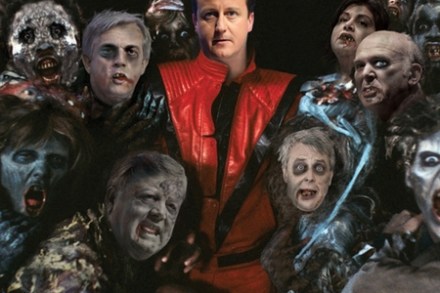
Chris Huhne "cannot be sure" whether he might, after all, have been driving his car that fateful night. Ken Clarke cannot be sure why he spoke about rape in that way. Andrew Lansley cannot be sure. All this we learn from the Sunday newspapers: three ministers are for the chop — it's just a matter of time. They will sit in the Cabinet death row alongside Caroline Spelman, unforgiven for her handling of the forests fiasco, and Vince Cable, caught on tape boasting about his “nuclear option” of resignation. This makes no fewer than five dead men walking — and that's before you think about the party chairmanship. As I say in the News of the World today, Cameron needs a clearout.

Hugh Grant and Low Life

I’ve always rather admired Hugh Grant, so it was almost a pleasure to be beaten up by him on Newsnight last Friday. He was attacking the celebrity-hunting media, whereas I set out to defend free press and self-regulation of the media. If you’re going to have sympathy with any Hollywood figure, you’d have sympathy with Hugh: he’s a single man who has never tried to moralise, and has cameras pointing at him everywhere he goes. Besides, he made an impassioned and powerful case against the intrusion of the paparazzi — while yours truly was left defending the Press Complaints Commission. But I didn’t know, until I met him that night, that Hugh is also a Spectator subscriber — and has been for years.

Debt as a security concern

Is Britain's growing national debt a matter of national security? In a speech this morning, Liam Fox said so. Sure, he said, you can protest at the defence cuts — but strength comes from having a strong economy and strong national accounts. "Those who are arguing for a fundamental reassessment of the Defence Review are really arguing for increased defence  pending. But they fail to spell out the  inevitable result — more borrowing, more tax rises, or more cuts elsewhere. The bottom line is that a strong economy is a national security requirement and an affordable Defence programme is the only responsible way to support our Armed Forces in the long term.

Salmond’s treasure map

Since oil was struck in the North Sea in 1970, it has fuelled dreams of Scottish independence. ‘Rich Scots, or poor Britons?’ ran the Scottish Nationalist Party’s slogan two years later. Alex Salmond has refined this slogan into a formal plan for separation which — he says — would make Scottish independence financially viable. For a country which has Swedish levels of state spending, this is quite some claim. British waters are already separated from Norwegian waters, and so are the oil and gas underneath. Salmond’s proposed division, drawn up by the British civil servants he commands, would claim 91 per cent of British North Sea revenue. This would have raised £11.7 billion in 2008/09.