Eleanor Myerson

Why must medieval mysticism be treated as a malady?

From our UK edition

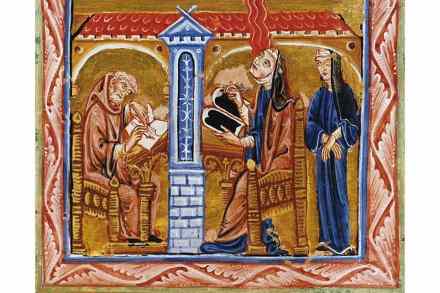
Medieval women – they were ‘just like us’. Except that they weren’t. Poet, Mystic, Widow, Wife is the first popular book by the academic and New Generation thinker Hetta Howes. It is a history of medieval women in relation to four celebrated figures – Marie de France (poet), Julian of Norwich (mystic), Christine de Pizan (widow) and Margery Kempe (wife) – whose lives have been retold recently in excellent studies by Anthony Bale, Marion Turner and Janina Ramirez. Howes’s book is highly readable and informative, placing the works of this quartet within a broad range of cultural documents – treatises, guidebooks, wills, court records and folklore. There are some great details, such as the theological debate about the Virgin Mary’s orgasm.
The rocky path to Christian dominance in Europe

From our UK edition

Mutilated, strangled, suffocated or beaten to death: these are just some of the methods used to get rid of popes in the early medieval period. An incredible 33 per cent of all anointed popes between 872 and 1012 died in suspicious circumstances. It’s safe to say that the path to Christian dominance in Europe was rocky at times. Peter Heather’s revisionist history of the rise of medieval Christendom directs attention to these moments. Though the subtitle is ‘The Triumph of a Religion’, his account is anything but triumphalist. In fact his argument gains momentum through the challenge it poses to simplistic accounts of Christian ascendency.

The forgotten heroines of the Middle Ages

From our UK edition

Isn’t it irritating when your ancestral manuscript collection gets in the way of your ping-pong tournament? That was Colonel Butler-Bowden’s predicament in the early 1930s. He was so peeved by the heap of rubbishy papers cluttering up his games cupboard that he declared his intention to burn the lot. Luckily, his ping-pong companion that day happened to be a curator at the V&A, so the colonel was dissuaded from book- burning and his manuscripts were shipped instead to the museum’s London archives. Among the collection was the unique edition of the Book of Margery Kempe, often described as the first autobiography in English, a sensational account of a woman’s mystical visions, travels and tribulations.