Douglas Murray

Douglas Murray

Douglas Murray is associate editor of The Spectator and author of The War on the West: How to Prevail in the Age of Unreason, among other books.

The questions nobody wants to ask about Asad Shah’s murder | 29 March 2016

From our UK edition

On Maundy Thursday a Muslim shopkeeper in Glasgow was brutally murdered. Forty-year-old Asad Shah was allegedly stabbed in the head with a kitchen knife and then stamped upon. Most of the UK press began by going big on this story and referring to it as an act of ‘religious hatred’, comfortably leaving readers with the distinct feeling that – post-Brussels – the Muslim shopkeeper must have been killed by an 'Islamophobe'. Had that been the case, by now the press would be crawling over every view the killer had ever held and every Facebook connection he had ever made. They would be asking why he had done it and investigating every one of his associates.

The questions nobody wants to ask about Asad Shah’s murder

From our UK edition

On Maundy Thursday a Muslim shopkeeper in Glasgow was brutally murdered.  Forty-year-old Asad Shah was allegedly stabbed in the head with a kitchen knife and then stamped upon.  Most of the UK press began by going big on this story and referring to it as an act of ‘religious hatred’, comfortably leaving readers with the distinct feeling that – post-Brussels – the Muslim shopkeeper must have been killed by an 'Islamophobe'.  Had that been the case, by now the press would be crawling over every view the killer had ever held and every Facebook connection he had ever made.  They would be asking why he had done it and investigating every one of his associates.

A terrorist attack has happened in Europe. Let the standard response begin…

From our UK edition

Well at least we all know the form by now.  This morning Islamist suicide-bombers struck one of the few European capitals they haven't previously hit in a mass-casualty terrorist attack. The standard response now goes as follows.  First the body parts of innocent people are flung across airport check-ins or underground trains.  Briefly there is some shock.  On social media the sentimentalists await the arrival of this atrocity’s cutesy hashtag or motif and hope it will tide them over until the piano man arrives at the scene of the attack to sing 'Imagine there's no countries’.  Meantime someone will hopefully have said something which a lot of people can condemn as ‘inappropriate’.

Finally: proof that the ‘Clarkson’ persona was all just an act

From our UK edition

To the extent I have ever thought about him, I have always viewed Jeremy Clarkson as a slight irritant. This is largely because he personifies what a type of lazy leftist believes right-wingers to be like (uninterested in culture, cultivatedly thick, casually racist). But this weekend we learnt what some of us had long-suspected: that rather than being a scourge of our dishonest, molly-coddled, excuse-ridden culture, Clarkson may be one of its happiest and most comfortable creatures. Saturday’s Times carried a long interview with him. It is worth reading not because of Clarkson, but because of what it says about our culture.

Prime suspect for Paris attacks arrested in Molenbeek, terror capital of Europe

From our UK edition

The prime suspect for the Paris terrorist attacks has just been captured in a police raid in (you guessed it) Brussels. Salah Abdeslam has been shot in the leg by police commandos, we're told, and has been taken for questioning. Where did they find him? In Molenbeek, the district that has quickly become known as the terrorist hub of Europe. "We got him," the Belgian Justice minister has declared. But what he should worry about is how Belgium came to get so many Islamic hardliners in the first place. For months, now, Molenbeek has been under intense scrutiny. Investigators believe that at least two of the terrorists who carried out the Bataclan attacks had been living there.

Cameron’s support for Turkey’s EU membership should worry us all

From our UK edition

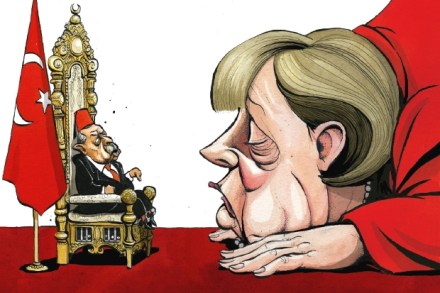
David Cameron this morning claimed that people who wish to leave the EU are 'taking a risk with people's jobs, taking a risk with families' finances.' Well then let us consider an even bigger risk that David Cameron is taking. In a visit to Turkey in 2010 our own Prime Minister announced that he would do everything he could to ensure Turkey entered the EU. Speaking as a guest of the country's Islamist Prime Minister, Recep Tayyip Erdogan, our own PM said, 'Turkey deserves its place at the top table of European politics - and that is what I will fight for.' Since then he has indeed been fighting to get Turkey into the EU.  This is despite Turkey doing everything it can to demonstrate that it has no place in the EU.

A civilisation under siege

From our UK edition

[audioplayer src="http://rss.acast.com/viewfrom22/thedeportationgame/media.mp3" title="Douglas Murray and Don Flynn from the Migrants' Rights Network discuss deportation"] Listen [/audioplayer]There are two great deportation games. One is the carousel which Rod Liddle describes — but even this, for all its madness, pales alongside the border-security catastrophe unfolding on the continent. Thanks to geography and a few sensible decisions by our government, Britain has so far been spared the worst of the migrant crisis. But we should pity most of the other European countries, because they are losing control not just of their borders but of their civilisation and culture — the whole caboodle.

Receiving online abuse has now become a badge of honour

From our UK edition

On Monday night I took part in a discussion on free speech in London for the think-tank Policy Exchange. The other speakers were ‘feminist comedienne’ Kate Smurthwaite, a student called Kitty Parker Brooks and the wonderful Munira Mirza.  Jess Phillips MP failed to show up, which was a shame because I wanted to decide for myself whether she is the free-thinking future-leader acclaimed by Julie Burchill or the PC-party-line clutz who recently compared New Year’s Eve in Cologne to any night in Birmingham. Anyhow, the argument I made was that two things are putting huge pressure on free speech and giving enormous impetus to the censors on campuses and elsewhere.  These are social media and mass migration.

Why are Amnesty keeping the details of their plan to bring in more migrants secret?

From our UK edition

The head of Amnesty, Kate Allen, was busily talking the most terrible balls on the radio this morning. In an interview on the Today programme she reminded everyone of how bad the situation in Syria is and indulged in the usual Conservative-bashing by arguing that Britain wasn’t doing enough to alleviate the refugee situation. Despite spending more than almost any other country on regional solutions to the humanitarian catastrophe and a commitment to take in 20,000 refugees over 5 years, Ms Allen particularly lamented that we were ‘not joining with the rest of Europe.’ Seemingly unaware that most of the ‘refugees’ flooding into Europe are not Syrians and not refugees, she insisted that Britain should nevertheless bring in far more of them.

Does Ken Livingstone really get his advice on Islamic theology from The Sun?

From our UK edition

As some light relief from all this EU discussion, I thought readers might like to hear about Isis. Or at least what to do about Isis. The week before last I teamed up in London with General John Allen to argue that Western boots may be needed on the ground in Syria and Iraq to destroy Isis. We were opposed in the Intelligence Squared debate by Ken Livingstone and the journalist Rula Jebreal. A video of the event went out over the weekend on BBC World and is now available to view here. I should add a note to say that in order to fit the schedules the BBC edit has to lose about half of the debate. It's a fine art, and the final edit keeps in most of the main points.

The EU ‘deal’ is a political stitch-up

From our UK edition

Almost everything about the EU debate so far has been a fraud.  The ‘Remain’ campaign has lied to the public about what David Cameron achieved in his ‘renegotiation’.  They have lied about the consequences of leaving the EU, in the hope of terrifying us into staying.  And now they are rushing us towards a referendum because the later they leave it the less likely it is that they will get the answer they want.  An innocent might rub their eyes in disbelief that a Conservative Prime Minister with the connivance of nearly the entire political class could be trying to bounce us into such a decision. But there it is.

Tim Montgomerie has put his country before his party. Will others do the same?

From our UK edition

In the wasteland of principles that is Westminster, Tim Montgomerie has always been an exception.  The area is filled with ambitious, bland careerists whose idea of taking a stand (as with most of the commentariat) consists of trying to locate two ‘extremes’ before comfortably wedging themselves equidistant between them.  But in resigning from a lifetime’s membership of the Conservative party, Tim Montgomerie has demonstrated that there is still room for principles in politics. Because nothing has so highlighted Westminster’s prevalence of careerism over principle than the aftermath of the great EU renegotiation charade.  In private absolutely nobody thinks that David Cameron achieved anything real with his ‘renegotiation’.

Leaving the EU isn’t an ‘unknown’; it’s a return to the known

From our UK edition

I see that Hilary Benn has been doing his bit for 'Project Fear'. According to Mr Benn one of the best reasons for staying in the EU is that 'President Putin would shed no tears if Britain left the European Union.' So what? Caliph al-Baghdadi may laugh like a drain if we stay in.  Anyone can play that game. According to Mr Benn, 'the weakness of European solidarity' caused by Brexit would be particularly damaging at this time, 'just when strength needs to be shown in the continent.' To which one might ask, how did that 'solidarity' and 'strength' go vis-a-vis Crimea and Ukraine? It is true that the EU was 'united' - it united in doing nothing.

Is it really wise for David Cameron to threaten us with migrants?

From our UK edition

Is it really wise for David Cameron to threaten us with migrants? That is what he has done today with his warning that if we ‘leave’ the EU then the migrant camp in Calais could have to be moved to Folkestone, Dover, or our own back gardens. Not only is the claim wrong (our Calais arrangements are with France, not with the EU) it neatly shines a light on the biggest failure of his time in office. The ‘jungle’ in Calais is currently home to around 5,000 people. They are there because the EU does almost nothing to control its external borders and made a principle of abolishing its internal borders (‘free movement of people’).

EU officials find that most of the ‘refugees’ are not refugees. What a mess

From our UK edition

Even EU officials are now finally admitting that a lot – or, rather, most – of the people we have been calling ‘refugees’ are not refugees. They are economic migrants with no more right to be called European citizens than anybody else in the world. Even Frans Timmermans, Vice President of the European Commission, made this point this week. In his accounting, at least 60pc of the people who are here are economic migrants who should not be here -  are from North African states such as Morocco and Tunisia. As he told Dutch television:- "These are people that you can assume have no reason to apply for refugee status.

George Weidenfeld was one of the great advocates for high European culture

From our UK edition

I am far abroad at the moment but have just learnt the sad news from home of the death of George (Lord) Weidenfeld, at the age of 96. As a publisher, philanthropist, convener, guru and friend he was one of the most extraordinary people in 20th and 21st-century Britain. Born in Vienna in 1919, he fled the Nazis and came to the UK in the 1930s where he was housed and looked after by a Christian family. Throughout the extraordinary life and career that followed he constantly acted on the gratitude he felt towards the country and people that had taken him in. Only last year he set up a fund to help save Christian children from the fighting in Syria.

An adult has finally intervened in the childish Cecil Rhodes debate

From our UK edition

I’ve never had much time for Chris Patten, generally disliking the Tory Europhile and late Roy Jenkins impersonator.  But the whirligig of time brings in strange revenges and none is odder than Chris Patten emerging as the only adult in the room.  In the great Cecil Rhodes debate at Oxford – a debate which like all such ‘safe-space’ debates has been crying out for the intervention of an adult – Chancellor of the University of Oxford Chris Patten has intervened. For anyone fortunate enough not to know about this embarrassing episode, it relates to a campaign by certain ‘Rhodes scholars’ at Oxford who will not rest until all memorials to the munificence of Cecil Rhodes are removed.

Cologne exposes a crisis in our continent, yet parliament is debating Donald Trump

From our UK edition

Europe is going through a period of radical change, but it is facing this with a process of radical self-distraction. Unwilling to face up to our problems we obsess over the responses to those problems. There have been some startling recent examples. As the whole world now knows, on New Year’s Eve in Cologne, dozens of German women were sexually assaulted, apparently by some of that country's more recent arrivals. For days the media across Europe declined to even report the story. It was only because of new media that the story began to get out at all.

The Isis executioner and me

From our UK edition

Even if Abu Rumaysah does turn out to be the new ‘Jihadi John’, shown on video this week presiding over the murder of five innocent men, I’m not sorry I encouraged him to go to Syria and join Isis. The last time I saw the 32-year-old Briton (born to a UK Hindu family as Siddhartha Dhar) was at a BBC studio in London. He was one of a group of people who had been central to the extremist group al-Muhajiroun and its offshoots for years. In 2009 they had, through a front organisation, lured me into a set-up with more than a hundred Islamists which soon became violent and from which I was extracted by the police. It was unpleasant, but it did lead to the then Labour home secretary finally proscribing al-Muhajiroun.

The Middle East’s 30 Years’ War just took a turn for the worse

From our UK edition

In January 2014, Douglas Murray explained in The Spectator how relations in the Middle East were becoming increasingly tense. With Saudi Arabia having now cut diplomatic relations with Iran, Douglas's insight seems prescient. Syria has fallen apart. Major cities in Iraq have fallen to al-Qa’eda. Egypt may have stabilised slightly after a counter-coup. But Lebanon is starting once again to fragment. Beneath all these facts — beneath all the explosions, exhortations and blood — certain themes are emerging. Some years ago, before the Arab ‘Spring’ ever sprung, I remember asking one top security official about the region. What, I wondered, was their single biggest fear? The answer was striking and precise: ‘That the region will clarify.