Douglas Murray

Douglas Murray

Douglas Murray is associate editor of The Spectator and author of The War on the West: How to Prevail in the Age of Unreason, among other books.

The latest Guardian attack on Nigel Farage is desperate stuff

From our UK edition

Some years ago I was approached by someone from a platform called ‘Cameo’. Not all Spectator readers will have heard of this platform, and I hadn’t either. As a result I listened to their pitch with the same amount of scepticism I might reserve for an email addressed to me as ‘Dear Beloved’, revealing that a distant relative had left me a share in a Nigerian diamond mine, and that if only I sent a quick cash deposit the diamonds would start flowing in my direction. I was informed that Cameo was a platform where I could make ‘easy money’. Being part-Scottish, I do not believe that there is any such thing. In fact I find the whole idea of easy money a contradiction in terms.

Why is the ‘gay press’ so cowardly on Iran?

Sometimes the obvious is so obvious that people forget to state it. So let me observe one small footnote among recent obvious things. Earlier this month, Donald Trump killed the Ayatollah Ali Khamenei and most of the senior leadership of the Islamic Revolutionary government in Iran. There are many things to be said against the Ayatollah and his friends. Since 1979 they have repressed the population of Iran and hurtled one of the great civilisations backwards by a millennium. From the start of the revolution they have murdered their domestic opponents by the thousands. They have shot students in the head when they came out on to the streets in protest. They have massacred, raped and tortured prisoners. They have exported terror around the world.

If only Britain was as important as Iran thinks we are

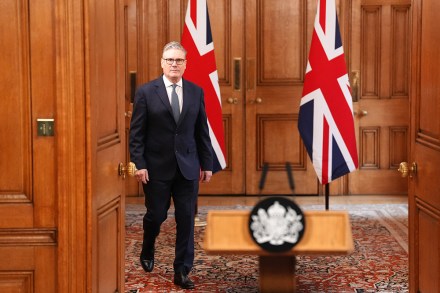
I am becoming rather fond of Prime Minister Starmer’s major foreign policy announcements. In early January, after US forces swooped into Venezuela and took President Maduro to New York to face trial, Keir Starmer was keen to get straight out in front of the cameras. There he said that he wanted to stress that ‘the UK was not involved in any way in this operation’. As though the whole world had been expecting to hear that the British armed forces were indeed central in snatching the narco-terrorist from Caracas. This week it was again Starmer’s turn to stand behind a podium, British flags behind him, and deliver another statement that absolutely no one thought necessary. Speaking about the US-led strikes on Iran, he announced solemnly: ‘I want to set out our response.

Do we really want our politicians to be uneducated?

From our UK edition

The interesting thing about political pendulums is that they always over-swing. In the campaign for this week’s Gorton and Denton by-election, one of the main lines of attack on the Reform candidate is that he used to be an academic and is therefore ill-suited to being the area’s parliamentary representative. The candidate who has suffered these attacks – Matt Goodwin – has countered that he is the first person in his family to have gone to university. He has also stressed that he was brought up in a one-parent household. That hasn’t cut it with the class-warriors of his rivals like the Green party’s Hannah Spencer. In one of her campaign videos, Ms Spencer has gone so far as to do a speech to camera while preparing some plaster for a wall.

Britain’s right is falling into the same trap as the left

From our UK edition

As I have suggested here before, there are few joys in life equal to that of watching the left fall out among itself. Whatever your political views, the whole Judean People’s Front vibe of the parties to the left of the Labour party brings a special type of comedy. If anybody remembers the recent Your Party conference they will know what I am talking about. In fact if anybody still remembers Your Party, they deserve a box of chocolates. But something similar now seems to be happening on the political right. And the Gorton and Denton by-election has brought it into a clearer light.

British politics has become a Devil’s Wheel

From our UK edition

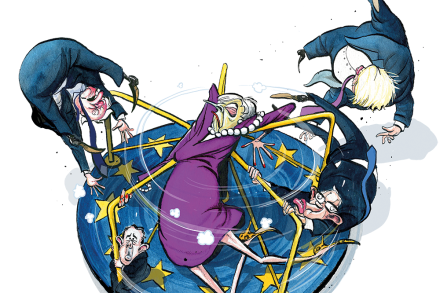
There is a moment in Evelyn Waugh’s Decline and Fall which has been much on my mind lately. It is the bit towards the very end of the novel when our hero, Paul Pennyfeather, re-encounters the sinister modernist architect Professor Otto Silenus. By this point Pennyfeather has undergone all manner of travails. He has been debagged and sent down from Oxford, accused of human-trafficking and sent to prison. But, as the pair sit outside the Corfu villa in which Pennyfeather is staying, the professor suddenly offers to reveal his theory about the meaning of life. How many people in politics have been picked up and flung off this great revolving fairground ride? Silenus describes a particular fairground attraction, the Devil’s Wheel (‘the big wheel at Luna Park’).

The British should have their holy places

From our UK edition

I think by now most of us can spot a double standard when we see one. So let me try two out on you. In what situation is it acceptable to denounce an MP or parliamentary candidate as ‘not very British’ or even someone who ‘doesn’t get our values, our culture, or our history’. When it is said by a Reform candidate about an MP from an ethnic minority? Or when Jeevun Sandher MP says it about Matt Goodwin, the Reform party candidate for Gorton and Denton? Doubtless you have already guessed the correct answer. The above phrase was used this week by Labour’s Sandher to denounce Goodwin, and as a result it has passed without any serious comment.

Britain’s guilty men, Labour’s reset & do people care about ICE more than Iran?

From our UK edition

43 min listen

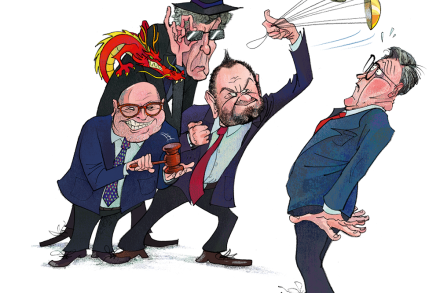
Who really runs Britain: the government, foreign courts or international lawyers? This question is at the heart of Michael Gove’s cover piece for the Spectator this week, analysing the role of those at the centre of Labour’s foreign policy. Attorney general Lord Hermer, national security adviser Jonathan Powell and internationally renowned barrister Philippe Sands may seek to uphold international law but is this approach outdated as we enter an era of hard power? For Gove, they are the three ‘guilty men’ who are undermining Britain’s national interest at the expense of a liberal international law that never really existed.

The censors are winning

They say you should never meet your heroes, a rule that is not always correct. But I did have a salutary session some years ago when a friend in New York asked me if I wanted to meet a comedian I really do admire. I had been looking forward to the meeting, but unfortunately it took place during the summer of 2020. If you remember those far-distant days, this was a time when America was obsessing over the story of alleged disproportionate police violence against black Americans. One of the cases was that of a woman named Breonna Taylor. Although the case for the police’s actions and the victim’s innocence revolved around a number of issues, the main one was whether officers should have shot when they did.

Am I a libertarian after all?

From our UK edition

I have never been the greatest fan of libertarianism as a political ideology. Libertarians seem to me to be the bisexuals of politics – they want a bit of everything. But even I felt a slight twinge of libertarian sentiment this week when I read some remarks by our Home Secretary, Shabana Mahmood. The Labour minister had told MPs that artificial intelligence is an ‘incredibly powerful tool that can and should be used by our police forces’, though she added that it must be regulated in a way that is ‘always accurate’. I have never before read the words ‘police’ and ‘always accurate’ in the same sentence, so the novelty grabbed my attention.

Mickey Down, Charlie Gammell, Sean Thomas & Douglas Murray

From our UK edition

32 min listen

On this week’s Spectator Out Loud: Mickey Down, co-creator of Industry, reads his diary for the week; Charlie Gammell argues that US intervention could push Iran into civil war and terrorism – warning that there are more possibilities than just revolution or regime survival; false dichotomy at the heart of; Sean Thomas bemoans the bittersweet liberation from his libido; and, Douglas Murray believes Britain has a growing obsession with race. Produced and presented by Patrick Gibbons.

Reform’s real race problem

I think it was Zadie Smith who I first heard point out that race is in America what class is in Britain: the conversation underneath every conversation. When I first heard that remark I slightly baulked. Not least because one had rather hoped that class would be less of a thing in Britain in the 21st century. I suppose it is, although you do still meet people who treat the English language as though it is a minefield in which one incorrect vowel will suddenly take them out. But if the class stuff still lingers in Britain, the good news is that we now have the American race obsession too. For anyone who hasn’t lived in America, it is hard to describe just how permeated race is into every conversation in the culture.

The young women hypnotised by Polanski

From our UK edition

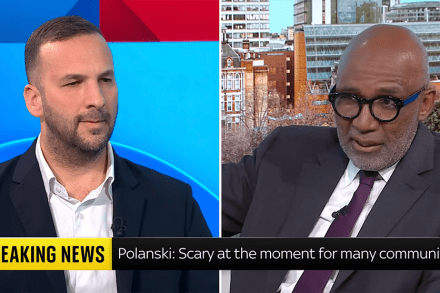
A friend mentioned to me last week that a third of young women in the UK are planning to vote for the Green party under its wonderful new leader, Zack Polanski. Bad as I tend to expect things to be, even I thought that surely things can’t be that bad. However I dutifully entered the terms ‘Polanski’ and ‘young women’ into Google, and promptly fell down a different rabbit hole. Defining my search terms a little more clearly, it turned out that my informant was correct. So badly deranged are the youngest cohort of female voters in this country that a third of them really do believe that they have found their saviour in a man who until recently promised that he had a technique to inflate women’s breasts through hypnotism but who also thinks that J.K. Rowling is a crank.

Alaa Abd el-Fattah and our misplaced priorities

From our UK edition

What would you like the priorities of His Majesty’s government to be? I have quite a long list. Sorting out the economy would certainly be up there, as would closing the border. But I imagine the government has had to put such things on the backburner because it turns out that one of its actual top priorities has been ensuring that Alaa Abd el-Fattah can come to the UK. Who, I hear you ask? El-Fattah turns out to be an Egyptian ‘activist’ who has lately spent a certain amount of time in the prisons of General Sisi. In 2021 he gained British citizenship through his mother, who lives in the UK. I think that clears up any fears of the anti-integrationist movement in this country by the way.

The pleasure in not knowing

A few years ago, the podcaster Lex Fridman published a list of books that he was hoping to read in the year ahead. It included works by George Orwell, Fyodor Dostoyevsky, Hermann Hesse and others. If he had published this in the world of print media he might have got back some encouraging noises. But because he put the list online – worse, on the platform then still known as Twitter – he received mostly mockery. “Who hasn’t read Animal Farm?” was the general tenor of the blowback, as though a man who had been a researcher at MIT was next to being a Neanderthal.

douglas knowing

The pleasure of not knowing

From our UK edition

A few years ago the podcaster Lex Fridman published a list of books that he was hoping to read in the year ahead. It included works by George Orwell, Fyodor Dostoyevsky, Hermann Hesse and others. If he had published this in the world of print media he might have got back some encouraging noises. But because he put the list online – worse, on the platform then still known as Twitter – he received mostly mockery. ‘Who hasn’t read Animal Farm?’ was the general tenor of the blowback, as though a man who had been a researcher at MIT was next to being a neanderthal.

Where was my invitation to Your Party?

From our UK edition

For perhaps the first time in my life I have experienced ‘fomo’ – fear of missing out. It is strange to feel this teenage sentiment now I am safely in my forties, and even odder that it should occur in relation to a party political conference in Liverpool. Yet as I sat watching videos from Your Party’s first conference this week, there was no way to avoid the feeling that I had missed out on something big – a feeling only intensified by the likelihood that Your Party’s first conference will also be its last.

Sir Tom Stoppard: ‘I aspire to write for posterity’

From our UK edition

Sir Tom Stoppard, the British playwright, died at his home in Dorset yesterday aged 88. In 2019, he gave a rare in-depth interview to Douglas Murray. Sir Tom Stoppard is Britain’s – perhaps the world’s – leading playwright. Born Tomas Straussler in Zlin, Czechoslovakia, in 1937, his family left as the German army moved in. The Strausslers were Jewish. In adulthood he learned that all four of his grandparents were killed by the Nazis. His father was killed by the Japanese on a boat out of Singapore as he tried to rejoin his wife and two sons. In India his mother married again, to an English Army man who gave his stepchildren his surname. Stoppard has lifted the lid on his early life only once before, in a piece for Talk magazine in 1999.

The theatre isn’t a thinktank

From our UK edition

Readers tend not to approve of rows between columnists, but I must take issue with something Lloyd Evans wrote in ‘No life’ last week. Our theatre critic claimed that his companionship ‘is very low calibre’, that he ‘can’t match anyone in conversation’ and that he ‘can barely recall making a witty or worthwhile comment’ in his life. I should like to disagree. Some time ago at a party in The Spectator’s garden I got talking with Lloyd and he said one of the most interesting things I’d heard in years. I had gone over to congratulate him on summing up the general awfulness of most of George Bernard Shaw’s plays in just a few paragraphs in a recent column, and then began commiserating with him. My sentiments went something along the lines of: how do you do it?

Trump’s Epstein gamble

It is always interesting to see who the American left claims are the leaders of the American right. There was a time during President Trump’s first term when Steve Bannon fitted the role – and relished playing it. Back then most days brought another media profile of the dark genius of the MAGA movement. The Guardian, New York Times and others were obsessed. Vanity Fair would send reporters to follow Bannon as he conquered America and, er, Europe. Documentary crews were perennially in tow. Indeed one documentary following Bannon around included a scene in which they followed him to the showing of another documentary about him from a crew who had similarly followed him around. At which point you felt that we might fall into some kind of vortex.