Dominic Selwood

Ozzy Osbourne, the accidental rock star

From our UK edition

To conjure an image of England on Thursday 16 October 1969 you could do worse than compressing all of Withnail and I into one day. The country was crippled by strikes. The bubble-gum pop track ‘Sugar Sugar’ was number one. And the first episode of Monty Python’s Flying Circus had just aired.  At Regent Sounds Studios in London’s Denmark Street four musicians from Birmingham recorded seven songs in 12 straight hours then went to the pub. Their name had been Earth, and before that The Polka Tulk Blues Band. When the album hit the streets the following year, on Friday 13 February, they were Black Sabbath. On the microphone was 20-year-old John ‘Ozzy’ Osbourne.

The surprising history of England’s three lions

From our UK edition

English lions went extinct 12,000 to 14,000 years ago. So why will eleven Danish men – each dutifully sporting the ‘DBU’ roundel of the Danish Football Association – be facing tonight 33 embroidered images of panthera leo on the shirts of the England team? The answer has nothing to do with football, or any other sport in which the men and women of England’s national teams bear the three lions. It is, in fact, a throwback to the medieval battlefield, and the system of identification that allowed heralds to walk among the dead once the frenzy was over and catalogue the fallen. King Richard clearly liked lions far more than he did England, which he barely visited Military insignia are ancient.

The Plantagenet we always forget

From our UK edition

Watching Heston Blumenthal arrange the infernal horror that is a lamprey’s head on a plate is one thing; seeing an enthusiastic dinner guest suck the raw, bloody meat out of it is quite another — something you will never, in fact, unsee. But finding the YouTube link to this spectacle in the chatty preface to an academic book on Henry III is quite the best indicator that you are in for a colourful ride.David Carpenter has chosen his subject thoughtfully. The history of English kings and queens is a well-trodden path, yet even aficionados struggle to list three things Henry did well and three areas in which he needed to improve.

The Cold War is over – and the Grey War has begun

From our UK edition

Antonio Guterres, UN Secretary General, announced on Friday that the Cold War is “back with a vengeance”. Although the US and Russia are squaring off militarily in a way that has not been seen for decades, Guterres is wrong. This is not a return to the Cold War. This is something new. His error is partly a challenge of vocabulary. It may appear pedantic in the context of rapidly escalating geopolitical tensions, but naming a phenomenon is intimately linked to our ability to understand it, and to recognise it as a reality. When Tolstoy came up with the title Voyna i Mir, War and Peace, for his vast 1869 Napoleonic and Tsarist epic, he – like his contemporaries – worked on the assumption that the two words, together, are all-encompassing.

Lemmy was a national treasure – a unique collision of swing and amphetamines

From our UK edition

Lemmy is what happens when a small slice of 1960s counterculture just keeps on going, oblivious to the changing world. He was a national treasure: a Methuselah of the British music scene, and one of its more thoughtful members. His driving forces remained a unique collision of baby boomer passions: jitterbug, skiffle, swing, rock’n’roll, and a lot of amphetamines. He was playing chirpy Mersey Beat numbers in a suit, a tie, and a smile with the Rocking Vicars when most televisions were still black and white. When the world changed, so did he. In the late 1960s he roadied for Jimi Hendrix, and later even had the patience to show Sid Vicious of the Sex Pistols how to play the bass.

In praise of charming but pointless laws – like the Magna Carta

From our UK edition

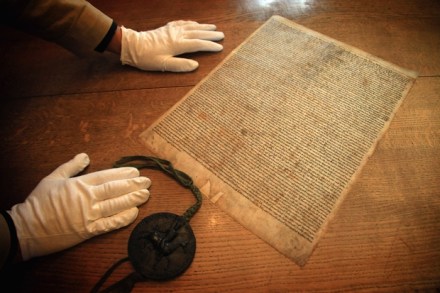
If you peer deep into the statute book, you will see that it is still an offence to enter parliament wearing armour. Even more amazing, it has been a crime since 1313. I mention this because the moment has again come for parliament to clear some of the redundant legislative noise off its books. This is a time-honoured process, and one that is becoming increasingly complex thanks to the sheer volume of modern legislation. A cursory wander through a suitable library will reveal that the statutes passed during the reigns of our medieval monarchs are neatly grouped together in a handful of surprisingly slim volumes. Back then, good rule was not measured by the legislative yard. But shuttle forward to today, and libraries need several shelves for every year of parliament’s output.

If the Turin Shroud is the work of a medieval artist, it’s one of the greatest artworks ever created

From our UK edition

Last week something rather unusual happened in the quiet Italian city of Turin. Inside the 15-century cathedral, an ancient, stained, and burned piece of medieval linen was removed from its airtight, bulletproof case and put on display. The exhibition will last 67 days. Last time the intensely controversial textile was brought out, in 2010, over 2.5 million people poured into the cathedral to see it. Or, more precisely, to see the images on the ivory-coloured fabric, which seem to depict faint life-size brown impressions of the front and back of a man.