Dominic Green

Dominic Green

The 2018 Oscars were indulgent, overlong, and weirdly amateurish — again

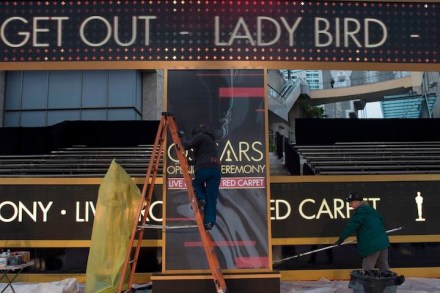
It was always going to be difficult for this year’s Oscars to balance politics and entertainment, the sweeping declaration with the plunging cleavage. The host, Jimmy Kimmel, got through his opening routine well enough, and without showing his cleavage either, but the strain was already showing. The décor and the script were like a moral split-screen. We were told to celebrate ninety years of the Oscars, while disapproving of nine decades of exploitation and sleaze, some of it practised by people sitting in the audience at the Dolby Theater. What we got was easy jokes about Harvey Weinstein and Donald Trump, and pompous announcements that it was time to send the casting couch back to the props’ store. Considering the political mood, this was weak stuff.

Oscars 2018: and the winners are…

Tomorrow night, TV viewers will take to their couches for a night of Hollywood glamour, razzmatazz and gross hypocrisy. A bunch of vain halfwits who make millions waving guns around or taking off their clothes will preach to us about gun control and sexual morality. Yes, it’s the 493rd annual Oscar Awards. I have the envelope in my hand, ladies and gentlemen, and there’s enough coke in it to see us through the after-party after the after-party. And the Oscar goes to… Best Picture: ‘Harvey’s Fall’. Harvey is a piggish producer who hangs out with the Clintons and assaults women in hotel rooms. Suddenly, he vanishes. Ben Affleck plays his son, an alcoholic gambler, who tours the rehab facilities of Arizona looking for clues.

Bruce on Broadway – and out of touch

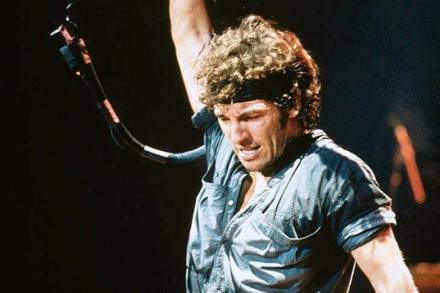
Bruce Springsteen promised that he was 'Born To Run', and now, like Judy Garland and Ethel Merman before him, he is running on Broadway—and running, and running. From last October to early February, the workingman’s tribune performed five nights a week at the Walter Kerr Theatre, his tools a piano, an acoustic guitar, and a harmonica in a daft neck brace. Today, he unpacks his faux-garagiste stage wear for another sixteen-week run. 'I’ve had a long writing life,' Springsteen ruminated in the New York Times, 'and over those years I’ve set out a certain set of values. And the best you could do at the particular moment was just to find a show that expressed those things as best I could.

The eternal visionary

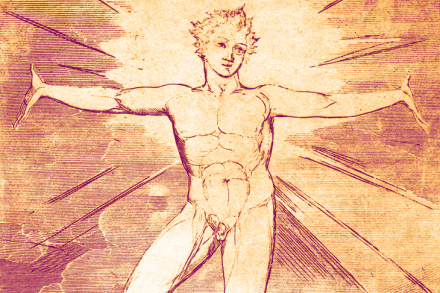
On 3 September 1968, Allen Ginsberg appeared on William F. Buckley’s Firing Line. Buckley exposed Ginsberg’s politics as fatuous — the blarney, stoned — but Ginsberg stole the aesthetic victory by reading ‘Wales Visitation’, a homage to William Blake. ‘White fog lifting and falling on mountain brow,’ Ginsberg intones, ‘…teeming ferns/ exquisitely swayed/ along a green crag/ glimpsed through mullioned glass in valley rain.’ ‘Nice,’ Buckley nods. He lets Ginsberg read the whole poem.

Wool, wheat and wet weather

From our UK edition

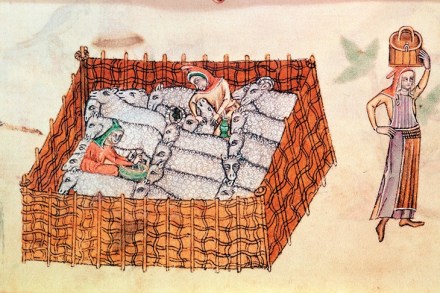
Englishness is big business in the nation of shopkeepers, and not just in politics and tourism. In literature, the gypsy scholars of Clan Macfarlane range freely across the hills and lexicons in search of old England, the dying and undead. This paperchase confirms that a change in the self-image of the English is afoot too. For centuries, the English poured into their cities. Now, they are trickling back out to the countryside. London excites precisely because it is another country, from a future that at least 54.8 per cent of the English prefer not to live in. But what does the returnee know of England who only London knows? In 1997, Little, Brown published Clive Aslet’s Anyone for England? as ‘A Search for English Identity’.

Taking the rough with the smooth

From our UK edition

In The Ambassadors, Henry James sends Lewis Lambert Strether from Boston to Paris to retrieve Chad Newsome, the wayward heir to a factory at Woollett, Massachusetts. Strether never names the ‘small, trivial rather ridiculous object of the commonest domestic use’ that has enriched the Newsomes, though he does say that it is not clothes pins, baking soda or shoe polish. In Aspects of the Novel, E.M. Forster identifies this ambiguity with James’s ‘uninvolved’ style, then suggests a button hook. Possible resolutions of the ‘Woollett Question’ also include safety matches, alarm clocks, toothpicks and, in a David Lodge campus satire, a chamber pot.

Vice guys

From our UK edition

In 1981, an FBI team visited Donald Trump to discuss his plans for a casino in Atlantic City. Trump admitted to having ‘read in the press’ and ‘heard from acquaintances’ that the Mob ran Atlantic City. At the time, Trump’s acquaintances included his lawyer Roy Cohn, whose other clients included those charming New York businessmen Antony ‘Fat Tony’ Salerno and Paul ‘Big Paul’ Castellano. ‘I’ve known some tough cookies over the years,’ Trump boasted in 2016. ‘I’ve known the people that make the politicians you and I deal with every day look like little babies.’ No one minded too much. Organised crime is a tapeworm in the gut of American commerce, lodged since Prohibition.

America’s other civil war

From our UK edition

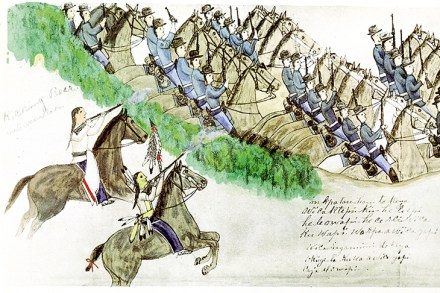
‘What makes the Red Man red?’ the Lost Boys asked in Disney’s Peter Pan (1953). According to Sammy Cahn’s lyric, it was embarrassment: ‘The very first Injun prince/ He kissed a maid and start to blush.’ Redness is everywhere in The Earth is Weeping — in the anger of the Indians, harried and starved into fatal resistance; in the shame of the whites, with their fork-tongued treaties and heavy weapons; and in the blood, Indian and white, that flows on almost every page of Peter Cozzens’s sweeping, expert and appalling account of the murder of America’s Indians. Every nation has its founding sin. America, the land of plenty, has two.

A hellish paradise

From our UK edition

‘Short of writing a thesis in many volumes,’ Patrick Leigh Fermor wrote in his preface to The Traveller’s Tree, ‘only a haphazard, almost a picaresque, approach can suggest the peculiar mood and tempo of the Caribbean and the turbulent past from which they spring.’ Island People, Joshua Jelly-Schapiro’s first book, is an academic picaresque. This unlikely hybrid might be the ideal vehicle for a trip around the ‘American lake’; the Caribbean’s cultures and peoples are also hybrids, legacies of unlikely crossings. The masters, slaves, indentured labourers and merchant middlemen of the Caribbean were the first truly modern societies, drawn and dragged to a hellish paradise solely to serve a global economy.

Knight’s tale

From our UK edition

In The Cousins’ War (1999), the Republican political strategist Kevin Phillips argued that three ‘civil wars’ had defined politics in the English-speaking world: the English Civil War, the American Revolution and the American Civil War. The ideological battle lines of 1641 recurred in 1776 and 1865, and not just because the Sons of Liberty and the Yankee industrialists were frequently descended from English Puritans. Broadly, all three revolts pitted Protestants against Catholics, reform against tradition, and yeomen against landowners. Civil war cuts across geography as well as families: Phillips compared pre-revolutionary America to the Balkans.

Towards the best of all possible worlds

From our UK edition

The flour is what matters, and not the mill, Georg Christoph Lichtenberg wrote in his notebook in 1799. ‘When we ask what time it is, we don’t want to know how watches are constructed.’ A telling assertion, considering Lichtenberg’s place and time. For nearly two centuries, the ‘mechanical philosophy’ had ground down tradition and metaphysics into reason and material processes. Enlightenment metaphors were mechanical: God as the divine watchmaker; or, in Leibniz’s image, the Cartesian mind and body as two clocks, synchronised but separate. As an experimental physicist, Lichtenberg practised the Enlightenment method, experiment and induction. But his frustration with matter and reason was Romantic.

Godly swingers

From our UK edition

There were two communist manifestos of 1848. One had no influence whatsoever on the revolutions of that year, but now symbolises the struggle against bourgeois capitalism. The other secured a small readership, and is almost forgotten today, but it also laid the foundations of a business that catered to bourgeois propriety. The gestation of Marx’s and Engels’s Communist Manifesto is fascinating — notably their attempts to peel socialism away from its roots in Christianity and the ‘utopian’ theories of Saint-Simon and Fourier. The gestation of John Humphrey Noyes’s Bible Communism is astounding. And gestation is the word.

Britannia rued the waves

From our UK edition

Military history is more popular than respected. It is not hard to see why. It is masculine history, a trifecta of logistical planning, technical detail and violent death. It shows the value of hierarchy and duty, sacrifice and patriotism — disgraceful notions which the young and impressionable might be inspired to emulate. And,with its sudden twists from tedium to danger and its tidily destructive conclusions, it has tight plots. One way to make civilian history as exciting is, as Eric Hobsbawm showed, to turn it into a false kind of fiction, true neither to the facts nor the life. Another, as N.A.M. Rodger did in The Wooden World, his ‘anatomy’ of the Georgian navy, is to integrate military history with political and social history.

Samuel Palmer: from long-haired mystic to High Church Tory

From our UK edition

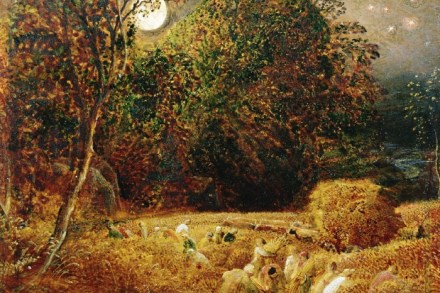
In his youth, Samuel Palmer (1805–1881) painted like a Romantic poet. The moonlit field of ‘The Harvest Moon’ (1831–32) glows with uncanny significance; for Palmer, as for Tolstoy’s Lieven, the bowed forms of the peasants at the harvest are shadows of divinity. Palmer aged like a Romantic poet too. The long-haired mystic became a High Church Tory: like Coleridge, but without the drinking. ‘The Past for Poets, the Present for Pigs,’ was Palmer’s opinion of England after the Reform Act. But did the poetry of Palmer’s seven-year sojourn in the ‘Valley of Vision’ at Shoreham, Kent also decline into prosaic commerce and pastoral nostalgia?

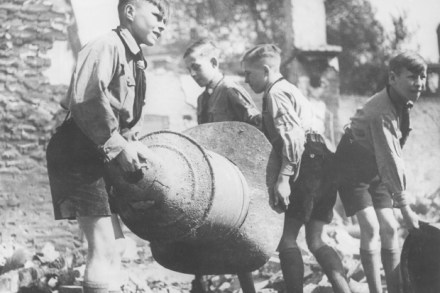
The swastika was always in plain sight

From our UK edition

In 1940, when Stephen Spender heard a German bomber diving down towards London, he calmed himself by imagining that there were no houses, and that the bomber was ‘gyring and diving over an empty plain covered in darkness’. The image consoled Spender with his ‘smallness as a target, compared with the immensity of London’. But it also exposed the ‘submission of human beings to the mechanical forces that they had called into being’. It seemed to Spender that entire nations were gripped by the ‘magnetic force of power’. People ‘no longer had wills of their own’. As Tolstoy complained in the second epilogue to War and Peace, this sort of thinking is tautological.

The real theatre of war

From our UK edition

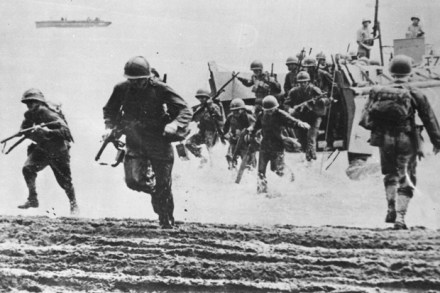
The history of ‘great events’, Voltaire wrote, is ‘hardly more than the history of crimes’. Physically, the war in Asia was the second world war’s greatest event. The Asian theatre, much of it water, was seven times larger than the European theatre. America’s mobilisation was the most complex in history, Japan’s crimes among the most sadistic. Metaphysically, the atomic consummation altered our relationship to our habitat. Yet only three comprehensive, single-volume accounts of the war in Asia have appeared — until now the most recent being Ronald Spector’s Eagle Against the Sun in 1985.

Licence to kill

From our UK edition

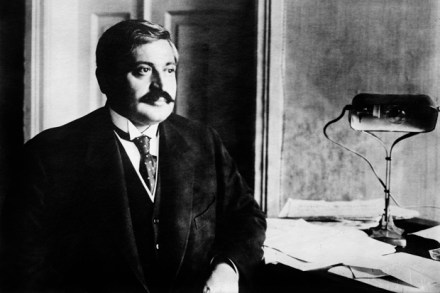
One morning in March 1921 a large man in an overcoat left his house in Charlottenburg, Berlin, to take a walk in the Tiergarten. A young man crossed his path, drew a pistol and shot him in the neck. Emitting a groan ‘like a branch falling off a tree’, he fell dead. The assassin ran, but was arrested by the crowd. ‘What do you want?’ he asked. ‘I am Armenian, he is Turkish. What is it to you?’ The victim was Talat Pasha, erstwhile interior minister of the Ottoman empire and convicted war criminal. His nemesis was Soghoman Tehlirian, engineering student and agent of the Armenian Revolutionary Federation. Talat topped the ARF’s list of targets: revenge for the genocide of some 1.5 million Armenians between 1915 and 1917.

The turbulent reign of King Cotton: the dark history of one of the world’s most important commodities

From our UK edition

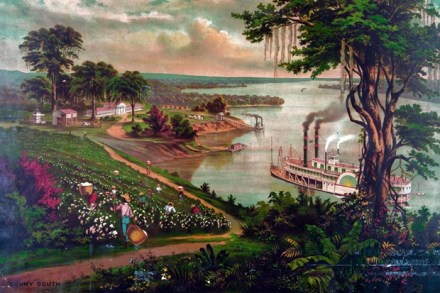
If not for cotton, we would still be wearing wool. To equal current cotton production, we would need seven billion sheep, and a field 1.6 times the area of the EU. Capitalism has spared us this itching, bleating nightmare. But capitalism, Sven Beckert writes in his hair-shirted history, Empire of Cotton, has wrought other horrors. For medieval Europeans, cotton was a luxury import. Prices fell as Europe’s maritime empires bypassed the Ottoman middleman. They fell further after the 1780s, when the East India Company increased its imports, and British inventors developed water-powered spinning machines.