Dominic Green

Dominic Green

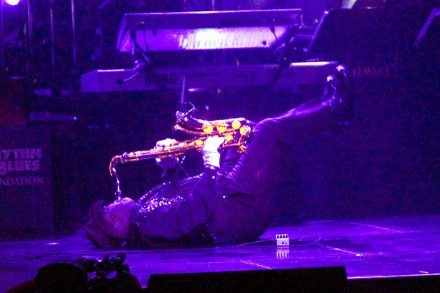
Big Jay McNeely brought joy to millions with his music

If I had to define rock’n’roll in one sentence, it would be: ‘The Blues from the Forties, played by Country musicians in the Fifties.’ Which is to say, black music played by white people. In the Sixties, and almost entirely at the prompting of the Beatles, the Rolling Stones and other white foreigners, white Americans allowed themselves to be persuaded of the merits of black American music. This created a small heritage industry, summarised in a 1991 album title by one of its beneficiaries, Screamin’ Jay Hawkins, as Black Music For White People. The black originators, ripped off once by R&B labels, and once again by the white impersonators, were granted the chance of being ripped off again by a new generation of promoters, selling their old hits to white audiences.
big jay mcneely

‘If you don’t want to taste the goat’s milk, at least watch the farmer in action’

From our UK edition

Did Ashraf Marwan jump, or was he pushed? Not his fall off the balcony of his luxury apartment in London in July 2007, which is how Marwan, an Egyptian diplomat turned billionaire, met his unexplained and highly suspicious death, but his tumble into the arms of the Mossad, into whose tender embraces he slipped in 1970. At the time, Marwan was also in the even more tender embraces of Mona Nasser, daughter of Egyptian dictator Gamal Abdel Nasser. After Nasser’s death in 1970, Marwan became a close aide to Anwar Sadat, and brokered military and diplomatic deals with the Saudis and Gaddafi’s Libya. All the while, Marwan was supplying top-grade intelligence to a Mossad contact in London, while dodging surveillance by Nasser’s old advisers.

Boris Johnson summons the spirit of Churchill in Washington DC

From our UK edition

Boris Johnson landed in Washington, DC on Thursday evening just ahead of Hurricane Florence, and leaving far behind the attentions of the British media, which over the last week have shown more interest in Johnson’s amicable divorce than his less than amicable campaign to replace Theresa May. In town to accept the Irving Kristol Award at the American Enterprise Institute’s annual black-tie dinner, Johnson gave a self-deprecating, self-asserting explanation of why a US-UK free trade agreement was an ‘opportunity’ for the United States.

Selling Europe’s new Muslim vote

Last weekend, while the world was watching the rise of the Sweden Democrats, Swedes were watching Uppdrag granskning (Investigative Assignment). The program’s title sounds like that of a Scandinavian noir thriller. This episode’s plot, set in the Stockholm immigrant suburb of Botkyrka, was murky too. But the criminal dealings in this Sveriges Television production weren’t fictional. Investigative Assignment exposed a scheme to sell thousands of Muslim votes in Sunday’s election, with implications that could have affected the national outcome. Botkyrka is one of Sweden’s largest municipalities, with 92,000 residents. It also has one of Sweden’s highest percentages of first- and -second-generation immigrants; in 2017, 58.

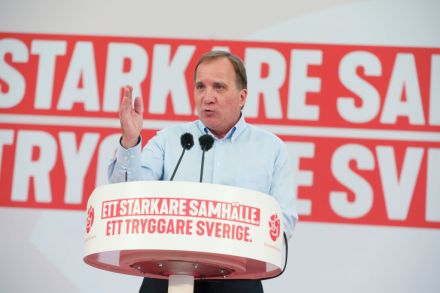
Stefan Lofven speaks during an election campaign meeting in Botkyrka

Julia Salazar’s identity politics

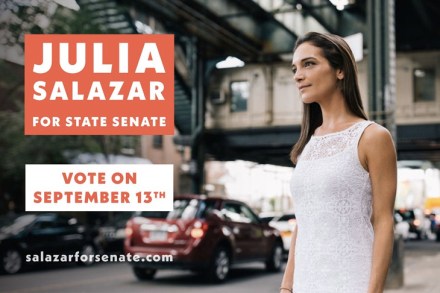
One rule of identity politics is that you get to choose your identity: ‘I identify as trans Latinx’. Another rule is that your identity is fated: ‘I was born trans Latinx’. The assumption of choice applies the logic of the market in a society of cheap credit and easy bankruptcy. The invoking of biological destiny is the crude mechanics of Victorian race theory. This is a pastiche of the ‘nature versus nurture’ debate. The purpose, though, isn’t the ‘identity’ part, solving the mystery of how we are made and become ourselves, but the ‘politics’ part. As in evolution, choice and heredity are complementary strategies, deployed for competitive advantage.

julia salazar

Review: Operation Finale

From our UK edition

They don’t make anti-Semites like they used to. Don’t get me wrong; I’m not complaining. But you’d think people who pride themselves on their metaphysical superiority would have more self-respect. Apart from the Nation of Islam, who remain true to the faith by dressing in the suit and bowtie of lower middle-class, small-town European Judenhass circa 1920, American anti-Semites are a sorry mess: a master race of of online mouth-breathers, hiding in their parents’ basements. The Islamists, given their numbers and technological arsenals, are underachieving too. Hassan Nasrallah, the flower of the resistance, is afraid to come out in case the Jews drop a bomb on his sweaty head.

Who’s afraid of Steve Bannon?

The New Yorker’s cancellation of Steve Bannon’s appearance at the New Yorker Ideas Festival shows that the New Yorker has no idea what it is doing. Not because it invited Bannon to be interviewed on stage by New Yorker editor David Remnick, but because Remnick reneged on the invitation only eight hours later, and because the reneging was so hasty that it cannot be presented as a thoughtful statement of journalistic principle. It looks more like the result of panic and fear, the emotions that Steve Bannon, by his own admission, exploited so successfully in 2016. https://twitter.com/JuddApatow/status/1036732535957422080 The New Yorker in turn attempted to exploit Bannon’s whiff of sulphur.

Any storm in a port: The Bookshop reviewed

Reports of the death of bookstores are fiction. In 1931, there were about 4,000 bookstores in the United States. Almost all of them were gift stores, selling a limited stock of paperbacks. Only about 500 of them were specialist bookstores, and almost all of them were in major cities. True, between 1995 and 2000, the number of independent bookstores collapsed by 40 per cent. Amazon opened for business in 1994, but two other factors were big-city gentrification, and the expansion of mediocre chains like Barnes & Noble and Borders, which went public in 1995. Now, the big chains are gone — and who, apart from a homeless person looking for a day bed, will miss them? — and independent bookstores are booming.

Life’n’Arts podcast: The Special Relationship in the age of Trump

From our UK edition

In this week’s Life’n’Arts podcast, I talk with Nell Breyer, Executive Director of the Association of Marshall Scholars, about the United States and Great Britain in the age of Donald Trump, and the Marshall Scholarships, an unsung element of the postwar architecture of Atlantic security. In 1953, the British government, led by Winston Churchill, created the Marshall Scholarships as a gesture of gratitude from Britain to the United States for its support during the War, and for the Marshall Plan, economic aid for the reconstruction of Europe between 1948 and 1953. Notable alumni include two current Supreme Court Justices, Stephen Breyer and Neil Gorsuch, and the late 2008 Nobel Prize winner, biochemist Roger Tsien.

Handling Pooh with kid gloves

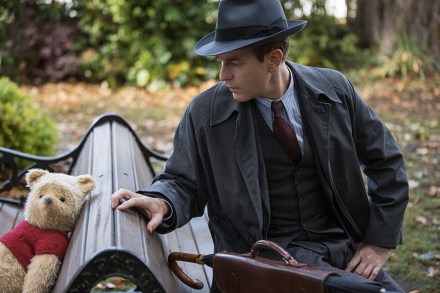
Is it good to contact your inner child — assuming, that is, you have one at all? And if you do, how far should you go—throwing tantrums, eating snot, wetting the bed? As an advocate of regression, Walt Disney was right up there with Arthur ‘Primal Scream’ Janov and R.D. ‘The Mad Aren’t Mad’ Laing. At least Yanov and Laing did their best to help troubled adults towards happiness. Disney did his wicked best to drive guilty parents into penury. Disney, the evil genius, realised that to really make money from children’s entertainment, you had to follow the money. Flatter the breadwinner, and he’ll spend bread on taking the kids to the movies, buying them stuffed toys, and even going to a Disney-themed resort.

christopher robin winnie the pooh

Life ‘n’ Arts podcast: celebrating American audacity with William Giraldi

The Spectator USA Life 'n' Arts podcast launches this week with fanfares, the popping of corks, and much coughing and wheezing into microphones. From now on, every week I’ll be casting a pod with artists, writers, thinkers, painters and even people who do something useful for a living too. First up is the novelist and essayist William Giraldi. Author of the novels Busy Monsters and Hold the Dark, and The Hero’s Body, a memoir of misspent youth as a bodybuilder, Giraldi is one of the few contemporary American critics worth reading. This month, he publishes his first collection of essays, American Audacity: In Defense of Literary Daring (Norton).

william giraldi podcast

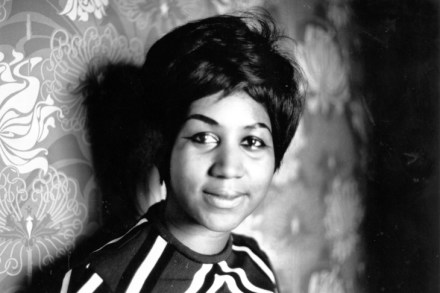
Aretha Franklin: The Queen of Soul is dead

Aretha Franklin, who died this morning at the age of 76, was called the Queen of Soul. But she did not inherit her crown, so much as create it. Nor, though she inspired plenty of oversold and over-souled pretenders, did she ever have a plausible heir. She wove that crown from the music of the black church, the blues and Broadway, from faith, pain and love. No one else could touch her, and she will meet her maker still wearing it. Aretha—the voice was so distinctive that her surname seemed superfluous—was simply the finest popular singer of her generation. Unlike every other pop star of the Sixties and Seventies, she would have been among the finest of the previous generations, too.

Twitter and the twilight of the philosophers

To ban or not to ban? The presence of Alex Jones on Twitter, and the decision on whether to un-presence Jones, has made a philosopher out of Jack Dorsey. A New York Times account of an emergency meeting of the Twitter “team” even described Dorsey as stroking his chin while ruminating on the delicate balance between truth and lies, not forgetting the balance between freedom of speech and Twitter’s share price. As a conduit for information, Alex Jones is about as reliable as a broken sewer. But Twitter is hardly fragrant.

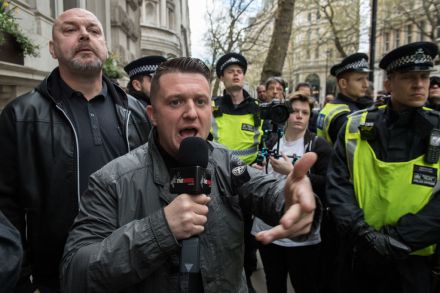
America, meet Tommy Robinson – if you must

There is a long tradition of British chancers making good in America, from the Mayflower to Piers Morgan. Imagine the golden age of Hollywood without those south Londoners Charlie Chaplin, Alfred Hitchcock, and Archie Leach, whose extended performance as Cary Grant established a lasting benchmark for masculine style. Unfortunately, the quality of the exports varies. As a British chancer, allow me to apologise unreservedly for Gerry & The Pacemakers, Freddie & The Dreamers and all the other chancers who caught a ride on the Beatles’ coat tails. And also for Piers Morgan. Should I apologise preemptively for Tommy Robinson? You may not know who he is but, the way things are going, you may well know soon. He has already turned up on Donald Trump Jr.

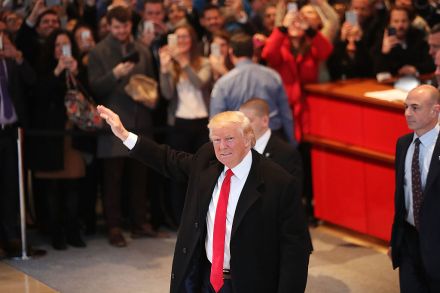
Frenemies of the people: Why Trump and the press deserve each other

Are Jeff Bezos, the world’s richest man and owner of the Washington Post, and Arthur Gregg Sulzberger, hereditary publisher of the New York Times, really ‘enemies of the people’, as Donald Trump has charged? Of course not. No more than their fellow plutocrat, the pussy-grabbing presidential populist. Trump and Sulzberger took off the gloves last week for a secret meeting, then came out swinging on Twitter. ‘The failing New York Times and the Amazon Post do nothing but write bad stories even on very positive achievements,’ Trump complained. ‘Freedom of the press also comes with a responsibility to report the news accurately.’ The lecture was a bit hard to swallow, given Trump’s well-documented habit of switching one set of facts for a more congenial set.

Ben Brantley isn’t transphobic – he’s pitiful

In yesterday’s Spectator USA, I described the experience of watching Mission Impossible: Fallout as akin to being sprayed in the face with hot diarrhea. This was inexcusably coarse and vulgar. So was my observation that the Fallout of this baggy mess of a film resembled an anal prolapse. It was not my intention to personally insult Tom Cruise, or to imply that he is a ridiculous fake, or to suggest that Paramount Pictures are peddling misogynistic smut. But if I did, so much the better. For that is what I believe to be true. What does Ben Brantley believe to be true? Anything you like, providing you shout loud enough. Since 2003, Mr. Brantley has held one of the toughest jobs in journalism.

A plot not so much paper-thin as soggy and smeary like used toilet paper

Spoilers for Mission Impossible: Fallout below. The jazz singer and Surrealist connoisseur George Melly once asked Mick Jagger how he had acquired those deep and sinister lines either side of his mouth. ‘Laughing’, Jagger replied. ‘No one laughs that much,’ said Melly. No one except Tom Cruise. It’s part of Cruise’s relentless and tedious professionalism, his insistence on being admired for his work rate. He is the Stakhanov of Hollywood. And he keeps going and going, his face uncannily smooth apart from his mouth, which seems to crumple inwards when he smiles, giving him the mien of an angry hedgehog. If Cruise made a deal with Satan or his agent, it would be of the Dorian Gray kind.

Film review: Netflix’s The Skin of the Wolf

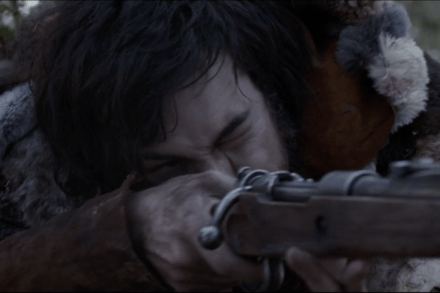
There are now more trees to hug in the Northeast than at any point since the eighteenth century. In the good old days, the trees were cut down for construction, firewood, and farming. Now, we build with concrete, burn old coffee grounds in decorative stoves, and convert old farmhouses into weekend rentals for skiers and hikers. This is good for the squirrels. Once, it was said that a squirrel could mount a tree on the coast of Maine or Massachusetts, and scuttle rattily through the canopy all the way to the Ohio River without putting one of his filthy little paws to the ground. But is it good for the humans? Samu Fuentes’ The Skin of the Wolf, newly released into the digital wild by Netflix, is about the dangers of re-wilding.

Two out of three ain’t bad: Jetlagged Trump’s European roadshow, reviewed

Remember William of Occam? He was the medieval English monk who invented the razor. Not the one that kept his tonsure bare and shiny, but the one that he applied to the confusion of evidence. Bearded philosophers still use Occam’s Razor, the principle that when all else fails, the simplest explanation is the likeliest explanation. Apply William’s logic-chopper to Donald Trump’s Helsinki performance, and you’re quickly down to two possibilities. One is that Trump, as John Brennan frothed on Twitter, is ‘treasonous’ and ‘wholly in the pocket of Putin’, presumably because of unspecified but urine-scented kompromat.

Meet Michiko Kakutani, the conservative

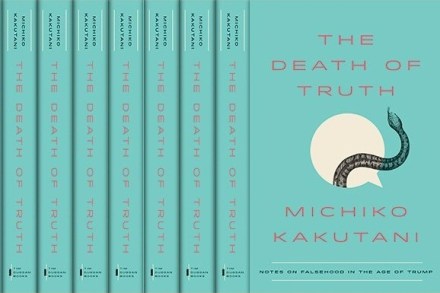
Michiko Kakutani used to be an important person in the world of people who cared about book reviews in the New York Times. This was not a world at all, so much as a small village whose borders could be seen from any tall building in Manhattan. Still, her opinion was considered important. Kakutani was notorious for actually reading the books she reviewed, and for not thinking of the reviewer’s desk as an outpost of the publisher’s press office. So, though book reviews are generally not worth reading, hers sometimes were. When Kakutani left the Times in 2017, it was rumored that she had jumped before being pushed by the downward-dumbing of the Times’ arts’ content.