David Blackburn

The people will make it happen

From our UK edition

Cameron’s speech might have lacked flair, but it was a brilliant rhetorical exercise. He cast himself into the distant future and reflected on his premiership. He saw a society that had paid its way back from the brink of collapse by rationing excess and embracing austerity. He saw a society that was flourishing, where the poorest attended the best schools, where people were empowered to work hard and were rewarded for doing so. Returning to the sombre present he said: “It will be a steep climb. But the view from the summit will be worth it.” But this rhetorical tour de force was inspired by a substantial philosophical argument. Cameron’s vision saw the State diminished to subservience.

Live blog – Cameron’s speech

From our UK edition

13:50 JF: I am in the conference hall which is already filling up. Word is that various candidates will be sitting behind Cameron. 14:02 JF: The backdrop for the speech is blue sky and fluffy clouds. Message: optimism. 14:04 DB: To emphasise an optimistic future, the Tories are playing ELO's Hello Mr Blue Sky. What a pity New Labour monopolised Things can only get better - a mantra that has never been more true. 14:12 JF: We have the text of the speech now and it looks like Cameron will set out his vision for Britain post recovery. One thing the speech does is make clear that Fox will be defence secretary. 14:18 JF: The theme is family, community, country and why big government is hurting all of them. 14:20 DB: The video has started.

Osborne is the key to Cameron’s success

From our UK edition

Initially, I thought George Osborne’s conference speech was unremarkable. Osborne, the second coming of Stafford Cripps, painted the grimmest picture since The Scream. He was relentless, remorseless. in fact, the argument that the Tories ‘relish cuts’ and are out of touch almost seemed plausible, as Osborne, the heir to an Anglo-Irish baronetcy with a flair for interior design, told the nation that “we’re all in this together”.  But in the wider tactical context of securing a Conservative victory, it was a brilliant speech. Writing in the Independent, Matthew Norman concludes: ‘Adorable he will never be, and as an orator he makes the Speaking Clock sound like Cicero, but undeniably he is extremely clever.

Oh dear | 7 October 2009

From our UK edition

Chris Grayling hopes that General Sir Richard Dannatt's prospective ministerial appointment is not a "political gimmick" designed to boost Gordon Brown's profile. He said: "I'm always suspicous of government's motives when it does things like this." The poor man hasn't grasped that it's David Cameron who is wooing General Dannatt as a potential minister. Grayling has since laughed off the gaffe, but really. The fact that Emily Maitliss started the interview with: "General Dannatt is lined up to be a junior Defence Minister in a future CONSERVATIVE government," ought to have alerted Grayling that this was not attack-dog territory. Quite how Maitliss didn't collapse with laughter defeats me. PS.

The Culture Secretary’s loaded gun is jammed

From our UK edition

Ben Bradshaw is in gladiatorial combat with the Beeb. Battling the BBC is an all consuming passion for BB and, like the Lone Ranger, he fights alone. With Twitter as his Tonto, he has already fired salvos of no more than 140 characters at the Corporation’s “disgracefully feeble” scrutiny of the Conservatives, and this morning he targeted the Today Programme. Outraged by Evan Davis’, I thought, appropriately pointed interrogation of George Osborne, Bradshaw tweeted: "Another wholly feeble and biased Today programme rounded off with a fawning interview with a Tory pundit!!

Cameron needs to tackle the expenses scandal head on

From our UK edition

The current consensus issue in British politics is not to discuss the expenses scandal. The so-called ‘New politics’ was a brief footnote in both Brown’s and Clegg’s conference speeches, but public anger remains palpable. Daniel Finkelstein points out that the Tories stand to lose the most from sidelining the issue: continuity undoes their claim that they stand for wholesale change. That is unquestionably true. Whilst the leadership prepare us for the age of austerity, visions of duck houses, moats and servants’ wings pervade the public consciousness, even though those responsible have been disciplined.

Aside from saving Gordon Brown, twice, what’s Peter Mandelson ever done for us?

From our UK edition

For such a Big Beast, Ken Clarke’s speech this afternoon was very pedestrian. Admittedly, the subject matter, cutting red tape for small businesses, was unlikely to inspire a carnival of Churchillian wit and verve. However, Clarke did provide activists with a whiff of red of meat: he trashed Mandelson’s come back. "Yes, I agree with him - responsibly and in the national interest - agree with him on the future of Royal Mail.  We agreed with him when he took his Bill through the House of Lords.  And what happened?  That weak and dithering Prime Minister – Gordon Brown - has stopped him bringing his Bill into the House of Commons.

Dannatt may be overstating his case, but the government is being disingenuous

From our UK edition

General Sir Richard Dannatt issues a vociferous condemnation of the government’s commitment to British efforts in Afghanistan in the print edition of today’s Sun. Dannatt asserts that Gordon Brown vetoed increasing the British deployment by 2,000 troops, against the advice of military chiefs. He told the paper: “The military advice has been for an uplift since the beginning of 2009. If the military says we need more troops and we can supply them, then frankly they should take that advice and deploy up to the level we recommend. “If it means finding more resources and putting more energy in, let’s do it. If you’re going to conduct an operation, you’re doing it for one reason – to succeed.

Further, stronger, faster

From our UK edition

Later today, George Osborne will elaborate on the Conservatives’ plan to raise the state pension age to 66. The rise will be enacted by 2016 at the earliest and will save an estimated £13bn per year. The Tories will review how they can accelerate the original planned pension age rise, dated for 2026, that would link the state pension with earnings. There’s much to elaborate upon, notably how the rise will affect female retirement age and exactly how much money would be saved overall. But essentially, this move should be welcomed. It is realistic and proves that there’s substance to the Conservatives’ cuts agenda beyond ‘trimming bureaucracy’ and burning quangos.

Dave, if you want Tracey to paint you, you’ll have to ditch the 50% tax rate

From our UK edition

At the end of Fraser’s interview with Cameron in this week's magazine, Dave confided that he would most like to be painted by the Maid of Margate, Tracey Emin. Cameron has been courting celebrity and popular culture, exactly as New Labour tried to align itself with ‘Cool Britannia’. Usually, the pursuit of photo-ops with celebs counts for nothing beyond the memory of the photograph, but yesterday Emin entered a contentious political debate. She said: “I’m very seriously considering leaving Britain; I’m simply not willing to pat tax at 50%.” For three months, the Spectator has been lodging Freedom of Information requests to view the working for the estimate that the 50% rate would increase yield by £1.13bn.

Book Club October book of the month

From our UK edition

Following a lively discussion and a member’s poll, the Spectator Book Club’s October book of the month is Bilton, by Andrew Martin. By all accounts it is an extremely funny satire of politics and the media in the late 90s, and it comes highly recommended by a number of Book Club members. You can buy a copy at a 10% discount, courtesy of Blackwells, if you register with the Spectator Book Club.

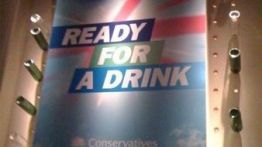
Labour isn’t working. Have a drink

From our UK edition

Thanks to Guido for snapping this arresting political slogan. The Conservatives will now sweep the country; of that I have now doubt. But as ever, there is a complication. In what is clearly an indication of the Tories’ target audience and political intent, lashings of Scotch and Newcastle Brown Ale are readily available, but Eric Pickles has banned Champagne. Is this the precursor of a hardening Eurosceptic line…?

The Tories look evasive on Europe, but now is not the time to clarify

From our UK edition

The phrase “we will not let matters rest” sounds slightly menacing, but it’s completely opaque. Is it time for the Tories to define what they mean by it? The leading article in the Times argues that perhaps it is. ‘Now that the Irish have ratified the Lisbon treaty at the second attempt, the Conservative Party needs to listen to Robert Peel. In 1834 Peel issued a manifesto in Tamworth in which he said the Conservative Party should now accept the Great Reform Act which it had vigorously opposed. Now that David Cameron finds himself struggling to clarify the circumstances in which he will offer the nation a referendum on the Lisbon treaty, he could do worse than echo Peel’s sentiment.

Cameron’s radicalism is best for Britain

From our UK edition

The Observer’s leading article asks the question: will David Cameron’s modernism serve Britain’s interests? The article’s conclusion is a firm ‘no’; its key is that the ‘Conservatives' apparent relish in tackling the budget deficit is not entirely economic in motivation. It expresses a broader ideological commitment to a smaller state.’ A smaller state is better for Britain. The consistent growth of the state over more than a decade has demolished Britain’s financial strength. In changed economic circumstances, its continued growth is unsustainable. July is a month that should produce a revenue surplus, as tax receipts outweigh borrowing. This year saw a £8.1bn deficit.

The European issue gets the Tory conference underway

From our UK edition

The Conservative conference is just hours old, but already Cameron faces a battle to hold the line over Europe and the Lisbon treaty.  He produced his standard response on the Andrew Marr show: that he wanted a referendum if the Czechs refuse to ratify the treaty. And he added: “I don’t want say anything or do anything that would undermine what was being decided and debated in other countries”. Meanwhile, rent-a-quote Europhiles and Eurosceptic Tories exchange blows in Manchester. Leon Brittan described a possible referendum on the Lisbon Treaty as “ludicrous” and Dan Hannan has just told Sky News: “This is not the Conservative party of the past. This is a 1990s story.

The politics of hope are dead. Cameron has everything to gain by being realistic

From our UK edition

Publicly at least, Labour MPs are jubilant that Gordon Brown has agreed to appear, in principle, in a televised election debate. They give the responses to the creed first spun by Blair: that Brown is an arch-realist and heavyweight who will undo the vacuous Tories in debate. Certainly, Mr Brown is blessed with talents. As proud wives like to do, Brown’s listed his the other day – intelligence, hard work, dutifulness, diligence and patriotism. All laudable attributes, but even from environs of the cosy Labour conference, Mrs Brown did not dare suggest that her husband was in any way a realist. Brown’s, and Labour’s, messy divorce from political reality was finalised this week when they launched a limp counter-attack based solely on crass anti-Tory slurs.

Brown agrees in principle to TV election debate

From our UK edition

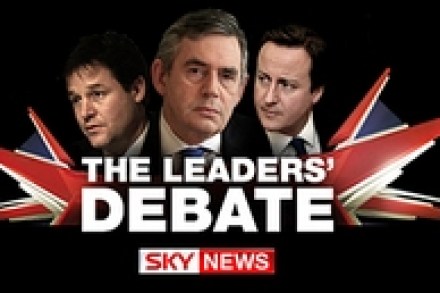
Despite trying to turn Adam Boulton to stone on Tuesday night, Gordon Brown has agreed in principle to appearing on the Sky election debate. It's long been suspected that he would agree to participate, today merely confirms the rumour. If the debate goes ahead, it would represent a huge change in British electoral procedure. Mr Brown deserves credit for contributing to that change. Why he did not choose to announce this positive move, illustrating that he's prepared to take the fight to Cameron and Clegg, in his conference speech defies belief and speaks volumes about his political courage and instincts.

A glimpse of Home Secretary Grayling?

From our UK edition

Chris Grayling’s reputation as a one-dimensional attack-dog was accentuated by his ill-judged comparison of Britain with Baltimore. The argument laid against Grayling is that he shouts about the government but provides no more than a whisper about policy. However, Grayling shows deep and nuanced consideration of policy when interviewed by Martin Bright in the Jewish Chronicle. Grayling’s subject is extremism and failing multi-culturalism. I apologise for its length, but here is the key section: ‘“I think the government has to make it absolutely clear that anyone in our country who espouses violence is not going to be able to do business with the government of the day and in many circumstances will be putting themselves in danger of prosecution.

The Hague Miliband Euro-feud hots up

From our UK edition

Much has been made of David Miliband’s vitriol against the Tories and their EU parliament grouping, and the intimation that Eric Pickles is Anti-Semitic. William Hague complained yesterday, and has now formalised that complaint by writing to the Foreign Secretary, highlighting the factual errors and misconceptions that dominated Miliband’s speech. Hague ends the letter by writing: ‘Democratic politics is at its best when it is a civilised and constructive debate between different points of view. It is deeply regrettable that you have listened to those who prefer the politics of slur and smear. Your duty as the country’s Foreign Secretary is to support our nation’s good relations with our allies.

How to form a government

From our UK edition

The change from being in opposition to being in government is almost impossible to gauge. How does a new prime Minister assume control of government? Peter Riddell gives David Cameron 10 tips that would ease the process. To emphasise the scale of Cameron’s impending problem, the only tip he can enact now is to ensure a smooth transfer from Shadow Cabinet to Cabinet. Riddell writes: ‘Do nothing that would make governing harder. When appointing Shadow spokesmen, think whether you want them to do the same job in office. In 1979 and 1997, two fifths of the new Cabinets had not held the same posts in opposition.