D.J. Taylor

D.J. Taylor is a critic, novelist and biographer of William Thackeray and George Orwell.

Hawkwind: a very British tale

From our UK edition

18 min listen

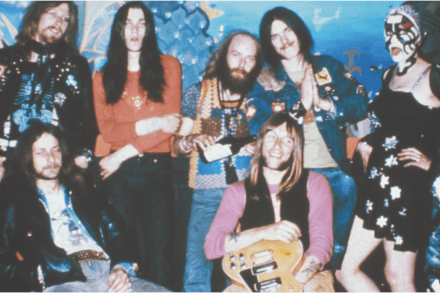
In this week’s edition of The Green Room, Deputy Editor of The Spectator’s world edition Dominic Green meets DJ Taylor, who writes in the June edition of Spectator World, about Hawkwind, unlikely champions of the British rock underground. Less a band, more a way of life, the fascinating story of Hawkwind veers from the radicalism

A complex creation myth: Alexandria, by Paul Kingsnorth, reviewed

From our UK edition

‘Challenging stuff,’ my wife remarked, having alighted on the page of Paul Kingsnorth’s new novel in which a character named el supplies several stream-of-consciousness paragraphs about a ritual dance featuring ‘big Birds runnin round Pole and fyr and mam and mother and all womyn and these big things all hummin’. Dystopian, or by the time

What would Orwell be without Nineteen Eighty-Four?

From our UK edition

43 min listen

In the first Book Club podcast of the year, we’re marking the moment that George Orwell comes out of copyright. I’m joined by two distinguished Orwellians — D. J. Taylor and Dorian Lynskey — to talk about how the left’s favourite Old Etonian speaks to us now, and how his reputation has weathered. Was he

The House of Eliot

From our UK edition

Like many a 20th-century publishing house, the fine old firm of Faber & Faber came about almost by accident. The inaugurating Faber — Geoffrey — was an All Souls don in search of a livelihood, who began his career in the post-Great War book trade by investing in the Scientific Press, publishers of the Nursing

His own worst enemy | 27 July 2017

From our UK edition

One fail-safe test of a writer’s reputation is to see how many times his or her books get taken out of the London Library. Here, alas, John Lodwick (1916–1959) scores particularly badly. If The Butterfly Net (‘filled with a lot of booksy talk and worldly philosophising,’ Angus Wilson pronounced in 1954) has run to all

Boats, goats and landslides

From our UK edition

J.L. Carr’s classic novel How Steeple Sinderby Wanderers Won the FA Cup (1975) contains a character named Arthur Fangfoss. Mr Fangfoss is a rural tyrant who, when standing for the local council, limits his election address to a pithy eight words: ‘If elected, I will keep down the rates.’ No such brevity, alas, attends the

Father, son and holy ghost

From our UK edition

No disrespect to any of the present incumbents, but Karl Miller (1931–2014) was a literary editor in an age when such jobs mattered. Between the late 1950s and the early 1970s he not only ran the books pages of two weekly magazines — The Spectator, and the Paul Johnson-era New Statesman — before moving on

A woman of some importance | 22 September 2016

From our UK edition

Searching for a 12-month stretch in the life of Elizabeth Jane Howard (1923–2013) that might illuminate the kind of person she was and the circumstances of her fraught and chaotic career, I settled on the year of 1955. Our heroine, then living in a maisonette flat in Little Venice and reading manuscripts for the publishing

Goodbye to all that | 12 May 2016

From our UK edition

Glimpsing the title of Lynsey Hanley’s absorbing new book as it fell out of the jiffy bag, I found myself thinking of my grandmother, Mrs Lilian Taylor. This lady, who died in 1957, spent the first part of her married life inhabiting a couple of furnished rooms on the western side of Norwich and the

Cold comfort for Gibbons fans

From our UK edition

One of the great fascinations of a ‘lost’ work by a famous name dredged up out of the vault after a lapse of several decades lies in establishing precisely when it was written. The jacket of Pure Juliet offers no clue, but parenthetic mention of Star Wars being on at the Odeon and an old

Spirits of the Blitz

From our UK edition

If the early Martin Amis is instantly recognisable by way of its idiosyncratic slang (‘rug-rethink’, ‘going tonto’ etc) then the later Pat Barker can be similarly identified by its finely wrought accounts of physical trauma. ‘Afterwards, it was the horses she remembered,’ runs a specimen sentence from the new novel, ‘galloping towards them out of

Cats, curates and cardigans

From our UK edition

Anyone who has ever listened to the thump of a rejected manuscript descending cheerlessly on to the mat can take comfort from the roller-coaster career of Barbara Pym. Between 1950 and 1961 Miss Pym (1913–1980) had published six modestly successful novels with the firm of Jonathan Cape. Then, on 24 March 1963 — ‘a sobering

George Gissing: the last great Victorian novelist?

From our UK edition

George Gissing’s The Whirlpool was originally published in 1897. In this shortened version of the foreword to the new Penguin Classics edition, D.J. Taylor argues that its author is ‘the last great Victorian novelist.’ In the early summer of 1896, hard at work on the manuscript of what was to become The Whirlpool, George Gissing struck up

Hilary Mantel’s fantasy about killing Thatcher is funny. Honest

From our UK edition

Heaven knows what the millions of purchasers of the Man Booker-winning Wolf Hall and Bring Up the Bodies will make of the ten stories collected here, for they return us to the landscape occupied by Hilary Mantel’s last great contemporary novel, Beyond Black (2005). This, for those of you unfamiliar with her pre- (or rather

The hooligan and the psychopath

From our UK edition

A Season with Verona (2002), Tim Parks’s account of a year on tour with the Italian football club Hellas Verona’s notorious travelling fans (motto ‘we have a dream in our heads, to burn the south’), contains a memorable scene in which Parks spots a teenage boy screaming abuse at some rival supporters before returning to