Cosmo Landesman

Do women really like porn?

I keep meeting women who claim they love porn as much as men do. The rise in the number of female porn consumers seems to confirm this is a trend. The popular internet porn site Pornhub reports that women make up nearly one-third of its audience, and that share is increasing. In 2019, Pornhub claimed that 32 percent of their visitors were female, a 3 percent increase from 2018. For many men the female embrace of porn is wonderful news. A porn-loving man loves porn-loving women because it legitimizes his love of porn. At a stroke, the stigma and shame surrounding his porn usage disappears. If a man’s girlfriend or wife enjoys porn, then it must be OK for him to enjoy porn too. Phew, he thinks, I’m no longer a misogynistic, sexist sleazebag! Thanks, babe.

pornography

The agony of watching friends succeed

From our UK edition

I’ve just had the first sign that things are going back to normal — and that I’m going back to normal, too. I was suddenly struck by a feeling I’ve not had since the first lockdown last March; a feeling writers and journalists know all too well. Literary envy. Whatever your profession, envy is something we all know. A colleague’s promotion or a friend’s pay increase prompts that inner voice of brattish resentment. Envy is the herpes of competitive capitalism — it disappears from view and just when you think it’s gone for good, up it pops. But envy hasn’t had much of a chance to surface during lockdown. Everyone’s career in the so-called creative industries has been put on hold.

Griff Rhys Jones, Toby Young and Cosmo Landesman

From our UK edition

17 min listen

On this week's episode of Spectator Out Loud, comedian Griff Rhys Jones complains about London's war on motorists (00:45); Toby Young on how he's become an English nationalist (08:55); and Cosmo Landesman on the joys of drinking alone (13:30).

The joy of drinking alone

From our UK edition

Thanks to a combination of night-time curfews, social-distancing rules, pubs closing, restaurants failing, the ‘rule of six’ and compulsory mask-wearing, that basic and necessary human need for people to meet for a drink has never been so difficult. Now, with the government’s new three-tier Covid strategy in place, anyone at any moment could find their local pub shut, their parties cancelled, and all forms of indoor mixing prohibited. Millions in the UK are already living under these restrictions. It’s a fair bet that millions more will soon join them. And if the government gives in to demands for a ‘circuit breaker’ — a short-term lockdown — it would in effect totally suspend social drinking as we know it.

In defence of the Covid snitch

From our UK edition

Nobody loves a bossy, busy-body. A curtain-twitching nosey-parker or that most despised creature of the popular imagination and the playground: the snitch. Once such people were the comic baddies found in Ealing Comedies and sitcoms like Dad’s Army. But the spread of Covid-19 and the accompanying lockdown rules that began in March gave them a new visibility and voice. In April this year, police claimed that they received 194,000 calls from 'lockdown snitches'. We’re living, one paper declared back then, in 'The Golden Age Of The Snitch'. And now to help the government enforce its controversial 'Rule of Six', a new army of nationwide snitches will be coming to a street near you: the Covid marshals.

I spent Christmas Day helping the homeless – and I was bored out of my mind

From our UK edition

When I told friends that I would be spending Christmas Day helping the homeless at a Crisis at Christmas centre in north London, they all congratulated me for doing something good for someone else. And then they congratulated themselves for having already done Crisis at Christmas years ago. Volunteering at a Crisis at Christmas centre is, I discovered, the Glastonbury of good causes. Crisis veterans all told me about what a ‘rewarding experience’ it had been for them; some claimed it had been their ‘best Christmas ever’. Some take their teenage children along and they, I’m assured, love it too. And now when they ask me, ‘How was it?’ and I say, ‘It was OK’, they’re disappointed in me.

OK zoomer, is that really the best you’ve got?

From our UK edition

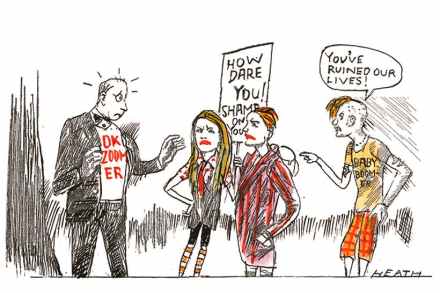
Every generation and teen subculture likes to put the boot into baby boomers like me. I’ve been physically attacked by skinheads, verbally assaulted by right-wing intellectuals and mocked by millennials. But I never thought I would be subjected to the derision and verbal lashings of Generation Z. The ‘zoomers’ — that is, people born after about 1995 — have come up with a cutting and dismissive retort for older people: ‘OK boomer.’ It all began when an elderly man posted a video on the social media app Tik-Tok denouncing the younger generation. They were, he claimed, suffering from ‘Peter Pan syndrome’ and ‘needed to grow up’.

Daddy issues: the fatherhood revolution has failed

This article is in The Spectator’s October 2019 US edition. Subscribe here. When I was growing up in the late 1960s, boys like me craved the admiration and approval of our dads; we wanted nothing more than to impress them. And now that we are dads, we crave the admiration and approval of our children; we want nothing more than to impress them. But the curious thing is, they don’t care about impressing us. In fact, our teenage children are just like our dads were — distant figures who are busy getting on with their own lives. Today we demonize dads of the recent past for being cold and uncaring. For failing to change diapers, read stories at bedtime, provide the unconditional love and praise children need to grow into happy, well- adjusted adults.

fatherhood

In praise of cultural elitism

From our UK edition

At present we have a series of ‘culture wars’ over a wide range of issues — race, gender, sexuality, power and privilege. But the one culture war we don’t have any more is over culture. Yes, we fight about the ideological messages of literary texts, but not about matters of personal taste. We scrutinise and interrogate works of art for their latent — or blatant — sexism and racism. Often what matters is what the work in question says about marginalised groups — not what it says about us as cultured individuals. It hasn’t always been so. There was a time when we judged people, labelled them, loved them or hated them because of their taste in literature, art and even pop music.

Daddy issues | 13 June 2019

From our UK edition

When I was growing up in the late 1960s, boys like me craved the admiration and approval of our dads; we wanted nothing more than to impress them. And now that we are dads, we crave the admiration and approval of our children; we want nothing more than to impress them. But the curious thing is, they don’t care about impressing us. In fact, our teenage children are just like our dads were — distant figures who are busy getting on with their own lives. Today we demonise dads of the recent past for being cold and uncaring. For failing to change nappies, read stories at bedtime, provide the unconditional love and praise children need to grow into happy, well-adjusted adults.

Hands free

From our UK edition

Eight years ago, I had an erotic epiphany. It was around midnight: I had sex on the brain and porn on my laptop. Suddenly, everything felt wrong and a wave of sadness washed over me. I felt like some sleazy man from a Michel Houellebecq novel. I no longer wanted to be that kind of man. So I made a solemn vow to abstain for at least 60 days. Back then, I thought I was the only man in the world who had taken such a vow. (And in case you’re wondering, I lasted 45 days that first time and now remain free of porn.) Little did I know then that that year — 2011 — was when a forum called NoFap was set up on social media platform Reddit by Alexander Rhodes to support men like me. The name NoFap is meant to be an onomatopoeic representation of the sound of masturbation.

With friends like these

From our UK edition

There was a time when you couldn’t walk down your local high street and not be set upon by a succession of ‘charity muggers’ — those relentlessly cheery and chatty young men and women who want your money for worthy causes like Cancer Research UK, Greenpeace, Oxfam or Age UK. These days the high streets are relatively free from their presence and their sales pitch is more restrained. But there’s a new breed of brazen ‘charity muggers’ who want your money — and they’re called your friends. I used to get emails from friends asking me to dinner or for drinks; now, on a daily basis I get emails from friends asking me for money — money for their favourite charity.

A class act | 10 January 2019

From our UK edition

The English love a story of posh people behaving badly, especially one that involves sex, drugs or drink — preferably all three at once — in some stately home or Mayfair pad. In 1963, following the Profumo scandal (yes, the one involving Christine Keeler) the nation was gripped by tales of sex parties involving prostitutes, pimps, peers and cabinet ministers. And then there was the infamous photograph of the Duchess of Argyll with something in her mouth that definitely wasn’t a silver spoon. The Denning Report — Lord Denning’s 1963 inquiry into what he referred to as ‘perverted sex parties’ — was a smash hit, selling more than 4,000 copies in the first hour of its publication.

Virtuous vice

From our UK edition

It hasn’t always been easy being a progressive-minded man who prides himself on his sensitivity to issues of race, gender, feminism and sexual exploitation — and still gets to walk on the wild side. Political principles tend to get in the way of politically incorrect passions. You like to watch porn, but as a good feminist man you know that porn exploits women. You like to take cocaine, but it exploits poor Latin American farmers and enriches corrupt drug cartels. And maybe you have a secret passion for prostitutes, but you hate the idea that you’re paying for sex with some underage Albanian who’s been trafficked for your gratification. No porn. No drugs. No sex. What’s a poor would-be decadent to do? Take up golf? Knitting? Stamp collecting?

Identity theft

I got some bad news this week. I discovered that I’m a ‘privileged, white male’. It was my agent who broke it to me. We were talking about the trouble he’s having in finding a publisher for my book — a work of non-fiction — when the following exchange took place. Me: What’s wrong with my book? Agent: There’s nothing wrong with your book. It’s brilliant. It’s moving. It’s funny. Me: OK. So what’s the problem? Agent: You’re the problem. Me: Excuse me? Agent: You’re a middle-aged, privileged white man. You’re out of fashion — and so is your book. Publishers think you’re too male. Too white. Things are difficult for writers like you at the moment.

Desperate housewives

From our UK edition

Freud famously asked: what do women want? And I think that after two marriages, a dozen long-term relationships and a thousand-and-one dates, I’ve discovered the answer to that great mystery: they want a man with a beautiful house. In my twenties I thought that what women wanted was a man who was funny, intelligent, sensitive and kind. A man who would be faithful to them and a good and caring father to their children. Yes, for the modern woman those are all desirable qualities in a man; but they won’t seal the deal. No, what women really want — well, many women — is a man with a big beautiful house. Preferably, a man with a big beautiful house in the beautiful British countryside or the south of France.

Problem children

From our UK edition

There was a time when middle-class liberals used to complain that the English were a nation of child haters. They packed them off to boarding school as soon as possible and banned them from the dinner table as soon as they got back. Why-oh-why, they asked, can’t the English just relax and enjoy the presence of children like the French did? Well, they’ve got their wish. That old, much-mocked Victorian proverb — children should be seen and not heard — has been replaced by a new dictum in child-centric Britain: children must be seen, heard, celebrated, praised and obeyed all of the time. Once children were expected to fit themselves around the needs of grown-ups; now it’s the other way around.

Bringing sexy back

Sexual intercourse, Philip Larkin famously wrote, began in 1963. And listening to contemporary commentators, you’d think that it came to an end in 2017 with the birth of the #MeToo movement. For these voices of doom, the end of the erotic is nigh; Britain is on the brink of sexual apocalypse. The recent news that Netflix has banned flirtation from film sets — along with lingering hugs, requests for phone numbers and extensive touching — is for these commentators just the latest example of #MeToo sexual correctness gone mad. They fear we are witnessing the making of a bland new world where the rules and regulations governing social relations between the sexes will become so oppressive that the very sexiness of sex itself will be snuffed out.

Too kind

From our UK edition

I originally thought of calling this piece: ‘Kindness is the New Rock ’n’ Roll’ — but only as a joke. And then I discovered that the rock band Peace have a new album out called Kindness is the New Rock’n’Roll. And they aren’t joking. Actually, it might be more accurate to say that kindness is the new mindfulness; but there’s already an offspring of the two that has been dubbed kindfulness. Suddenly, kindness is cool. And hot (or so zeitgeist-watchers keep telling me).

Bring back Girl Power

The recent news of a Spice Girls reunion will, I suspect, be greeted by some former fans with nostalgic longing and others with an embarrassed cringe. But whether you’re a fan or foe, I think it’s worth remembering that golden decade of Girl Power — the 1990s — when it was bliss to be young and female. With our present preoccupation with the abuses of male power, we’ve forgotten about Girl Power. It was a fun-fuelled feminism for the mainstream; a materialistic and hedonistic celebration of female assertiveness, ambition and self-reliance. Girl Power was Thatcherism in sexy underwear. OK, so maybe Girl Power didn’t produce much in the way of great pop music or feminist polemics.