Cosmo Landesman

Literary festivals are no fun

From our US edition

This is the season when literary festivals start to happen all over the UK. From the highlands of Scotland to the South London lowlands of Deptford, there are book festivals for every taste and tribe. Festivals devoted to crime fiction, women writers, LGBTQ writers and young novelists. Even old Marxists are having their own summer festival. I’m thinking of starting a literary festival for neglected and bitter writers like me who don’t get invited to literary festivals. I ask myself: why should I care? But I do. I spend long nights of self-torment scrolling through the lists of people appearing at various festivals and shouting at my laptop screen: who the fuck is he? What has she written? Why is Bono there and not me? For heaven’s sake, who invited Minnie Driver?!

Can I be a woman?

I have a friend who describes me as an ‘uptight boring old straight heterosexual’ – simply because I don’t use porn or prostitutes, don’t swing both ways and have no interest in orgies and dogging, or any desire to be tied up and flogged by some fat dominatrix in a ‘torture den’ in Pimlico. He is always on the lookout for a new kink or a fresh fetish to try, and one of his latest passions is autogynephilia – that is, experiencing sexual arousal at the thought or image of oneself as a woman. This means he can find a woman sexually attractive only when he thinks not of her but of himself as that woman. He used to call himself a transvestite; now he calls himself an autogynephile. ‘Do you feel anything?

The joy of missing out

From our US edition

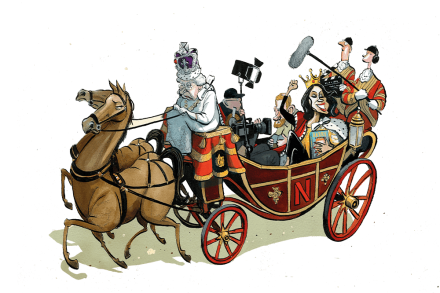
As I write this the coronation of King Charles hasn’t happened yet, but I’m having great fun watching the procession of those who have been royally snubbed by royalty. Only a thousand people have been invited to the King’s coronation in Westminster Abbey and a lot of other people — dukes, earls, A-list celebs, actors, society figures — are pissed they didn’t make the cut. The British press reports daily on the latest person to be “snubbed.” So far the snub scorecard is as follows: Prince William is snubbing his brother Harry. Harry is snubbing everyone. His wife Meghan is snubbing Charles and President Biden is snubbing Britain.

invited

I’m grey – and proud

In the wake of new research by New York University’s Grossman School of Medicine, scientists think a treatment for stopping our hair going grey – and even reversing it – may soon be possible. Their optimism is based on early positive experiments with mice, which is great news if you’re a mouse, but what if you’re a man over 60 and totally grey like me? Yes, women go grey too – but it’s different for them. The ones I know don’t make a big existential drama out of it the way men like me do. Women simply dye their hair or just let it go grey. Men panic and turn to desperate measures like concealing highlights, expensive anti-grey shampoos, exotic toners and total dye jobs. And usually with tragic results.

Make love, not culture war

From our US edition

I think I know how to end the culture wars at a stroke. My solution can be summed up in a simple slogan: make love, not culture war. Or, to put it another way — poke the woke. Let me explain. I have a new woman in my life and not just any woman. I have a Woke Woman. That’s right: a full-on, vegetarian, eco-activist, kill-the-rich, bisexual, transgender-defender and social justice warrior. She’s also a shrink. And not just any kind of shrink, but a Lacanian shrink! They’re the followers of the French psychoanalyst Jacques Lacan. In the UK we have a soccer team called Millwall that all the other fans hate. Millwall fans have a song that goes, “No one likes us, we don’t care!” Lacan therapists are the Millwall of therapy — nobody in the therapeutic community likes them.

culture war

The sex lives of writers

From our US edition

A fellow writer recently asked me if I would prefer to be famous as a great writer or famous as a great lover. I said a great writer because, well... that’s what you’re meant to say, isn’t it? My friend chose great lover. Why? “There are lots of great writers,” he explained, “but men who are great in bed are rare. And besides, great writers aren’t sexy anymore.” I used to think that when male writers — and I mean novelists, critics, journalists — complain about how literature has lost its cultural significance and that no one cares about the printed word anymore, what they really mean is: no one wants to shag me. And I suspect that they’re right. The era of the Great Literary Sex God is over.

writers

Confessions of a class tourist

Pundits writing for a young audience are always telling readers to ‘stop pretending to be working-class!’ and stop ‘fetishising the working class’. They seem more angered by the imitation of class than the iniquities of class itself. Singer Lily Allen and the rap star Yungblud have both been denounced on Twitter for – to paraphrase E.P. Thompson – the faking of the English working class. Personally, I don’t understand the fuss. For most of my youth I pretended to be working -class – and so did most of my middle--class mates (sorry, friends). And we were not alone. Throughout the 1960s and 1970s the voices of youth all sounded working--class, especially the middle-class ones like Jagger, Bowie and, yes, that faux working-class hero himself, John Lennon.

James Heale, Cosmo Landesman and Miranda Morrison

18 min listen

This week: James Heale asks whether the cabinet secretary Simon Case can carry on (01:00), Cosmo Landesman tells the story of when a man – and his axe – came to visit his home in London (05:03), and Miranda Morrison warns against the damaging obsession with STEM in secondary schools (11:10).  Produced and presented by Oscar Edmondson.

The day I sold my destroyed piano to the Tate

One day in October 1966 I came home from school and found a large man stripped to the waist, attacking the family piano with a woodman’s axe. Seeing the anxious look on my face, my father assured me there was nothing to be afraid of. The axe-wielding man was, he explained, an ‘artist’ who was ‘creating a work of art’. My 11-year-old brain was puzzled: how could this axe-wielding lunatic be an artist? Can you destroy a piano and call it art? These same basic questions came to my mind last week when I went to Tate Britain and found that very piano hanging on a wall after 11 years in the Tate’s storage rooms. The piece – entitled, ‘Duncan Terrace Piano Destruction Concert’ – was by the American destruction artist Raphael Montanez Ortiz.

My new life of relative poverty

From our US edition

As I write this, London is so cold that I’m wearing a large, heavy, World War Two Russian army jacket, a wool hat, two pairs of thermal socks, long johns, a scarf and fingerless gloves that allow me to type — the kind Fagin wore in the film Oliver! — and I’m still freezing. But I won’t turn on the central heating because it costs too much. But then, everything these days costs too much, so I’m making radical cuts in my expenditure. How radical? I now make one cup of tea, instead of a pot of tea with three bags. I’ve had to cut back on expensive organic foods — but I’ve kept the expensive organic sex lubricants. I think they call this genteel poverty — or is this gentile poverty?

poverty

Stuck in a love triangle with a shrink

From our US edition

I’ve met someone. The One. And now I’m in love. It’s a lunatic love, driven by insatiable lust. She’s funny. Smart. Sexy. I’d say she was perfect for me but there’s one major problem — she has another man in her life and refuses to give him up. Let’s call him The Other Man (TOM). She sees him five times a week and tells him all her secrets. I only get to see her once a week and she tells me she loves this man because he listens to her. She is in my bed and he is in her head — by which I mean TOM is her therapist. The One talks about TOM when we’re in bed, and he talks about me during her therapy. I talk about him — and her — to my therapist. My life at the moment isn’t imitating art; it’s imitating bad Woody Allen.

therapist

The other cancel culture

From our US edition

London, England We discuss and denounce the cancel culture of the woke all the time, but there’s another type of cancel culture that we never mention — the cancel culture of our friends. We cancel each other all the time. You arrange to meet someone and suddenly — you’re canceled! It happened again to me last week. I’d arranged to see a good friend when, a few hours before our meeting, up popped a text that read: “Sorry. Have to cancel x.” She offered no explanation. No signs of regret or guilt. Not even the suggestion that we reschedule our meeting. She wanted to cancel and so, I was canceled. In some ways this is nothing new.

cancel

How to throw a book party

From our US edition

London The launch party for my book has gotten sensational reviews. “Party of the year!” said one friend. “Simply brilliant!” said another. A hack from the Times declared, “It was like an old-fashioned Fleet Street Party” — by which he meant everyone was drunk, dancing and misbehaving. Unfortunately, my book has not gotten sensational reviews. It’s gotten no reviews — at least from the national press. This is a cause for worry. Or so my publisher Todd Swift of Eyewear Publishing thinks. The day after the party he calls me. I’m still buzzing with my party reviews; he’s buzzing with panic. Todd tells me that no reviews mean we can’t get my book into the major bookshops! I’d hate to see your great book die, he says.

book

I was upstaged by Jordan Peterson

From our US edition

I’ve been inviting friends to my book launch and have gotten all sorts of reasons why they (“sadly”) won’t be able to attend: away on holiday, work commitments, family obligations, etc. But the most interesting reason for not coming to my book launch is one a very old friend gave me: “That’s the night I’m having dinner with Jordan Peterson.” “What?” I asked incredulously, “Are you going to dump me and my big night for dinner with Jordan Peterson?” There was a long pause before my friend said, “Ahh... let me get back to you on that.” This conflict of interests — me versus Peterson — poses an interesting moral and philosophical question for my friend and for all of us: what are the duties and obligations of friendship?

Peterson

How I learned to stop worrying and love self-promotion

From our US edition

I have a new book coming out this month and it’s called Jack and Me: How Not To Live After Loss. Not long ago, I would have been too embarrassed to give my book such an obvious plug as that. But that was the old, reticent, self-deprecating me who didn’t feel comfortable engaged in acts of blatant self-promotion. Now that me is dead. Meet the new me: the shameless, self-promoting media slut that I’m trying to become. It’s hard to believe that there was a time in London society when the pursuit of publicity and self-promotion was considered rather vulgar and regarded as an American practice that no classy English person — especially an English writer — would ever stoop to. (Of course, they did it all the time.

self-promotion

Keiron Pim, Miranda Morrison and Cosmo Landesman

24 min listen

This week on Spectator Out Loud: Keiron Pim discusses what young Ukrainians can learn from the works of Joseph Roth (01:00), Miranda Morrison reflects on her decision to quit her job as a teacher (11:26), and Cosmo Landesman asks whether successful writers can be friends with less successful ones (19:39). Produced and presented by Oscar Edmondson.

Drama queens: the return of Harry and Meghan

36 min listen

In this week's episode: We look ahead to Harry and Meghan’s UK tour next week, how will they be received? Freddy Gray and Tanya Gold join the Edition podcast to discuss (01:01). Also this week: In the Spectator magazine, our Economics Editor Kate Andrews sat down with the three economists, or 'Trussketeers', that are informing the would-be PM’s economic plan. She joins us along with Julian Jessop, one such economist that has been advising Liz Truss (13:51). And finally: can successful writers be friends with less successful ones? Cosmo Landesman asks this question in the magazine this week and is joined by the author Ian Rankin (27:07). Hosted by Lara Prendergast and William Moore. Produced by Oscar Edmondson.

Why your more successful friends will drop you

You might have noticed the numerous glowing pieces by friends of Salman Rushdie about their ‘brave’ and ‘brilliant’ friend. I too would like to write a glowing piece about my brave and brilliant friend Salman Rushdie, but there’s one little problem: I’m not a friend of his. In fact I don’t have any famous novelist friends. I used to. There was the occasional lunch with Nick Hornby and the odd debauched evening with Will Self. I’ve drunk whisky with Norman Mailer and smoked pot with Ken Kesey, author of One Flew Over the Cuckoo’s Nest. (And I have a lovely thank-you letter from Edward St Aubyn – does that count?

Getting in touch with my inner groupie

From our US edition

I like to think that I’m too intelligent, too sophisticated and too cultured to get excited by the presence of a famous person. Let the manipulated masses enjoy the bread and circus of celebrity; we enlightened members of the metropolitan elite are far above that sort of thing! Or so we like to think. Whenever I encounter the famous, something very strange happens to me: I go all groupie. I get excited. I giggle. I inwardly drool. I long to please. I want to be their new best friend. I want to tell all my friends about meeting my famous new friend — who isn’t actually my friend, but never mind. I was reminded of my groupie tendencies the other day when I went to the Idler Festival, Britain’s best arts and literary festival. I usually hate those sorts of events.

famous

My Tina Brown fantasy

From our US edition

I met my first wife at a party. I met my second wife at a party — and I’m convinced that I will meet my third wife at a party too. As I write, London is awash with parties, so my chances of finding my next wife are looking good. So far, I’ve met a sweet, bisexual marine biologist, a German curator — I’m not sure of what, but then everyone is a “curator” these days — a beautiful art critic who is famously bad in bed and one living legend. Her name is Tina. Tina Brown. Yes, that Tina Brown. Younger readers might be scratching their heads wondering: who’s that? (That’s like when young people say, “who are the Doors?”) She was the editor of Vanity Fair, the New Yorker and Talk magazine. (Gen-Z readers will be wondering: were they bands too?

tina