Christopher Howse

Christopher Howse is an assistant editor of the Daily Telegraph.

The wondrous cross

From our UK edition

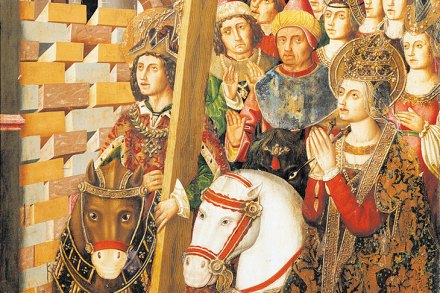
How did the cross, from being such a loathsome taboo that it could scarcely be mentioned, change into an image thought suitable viewing for all ages in public art galleries? There is no doubt about its early despicable reputation. A hundred years before the birth of Jesus, Cicero declared that ‘the very word cross should be far removed not only from the person of a Roman citizen but from his thoughts’. It was the cross that gave rise to the word excruciating. It makes me feel rather queasy to envisage the slow death by suffocation of the crucified man, left without the strength to draw breath, so I was glad that Robin M. Jensen trotted fairly briskly through the forensic evidence, which includes a first-century heel bone with a nail through it.

Piety and wit

From our UK edition

During the second world war, while one brother was editing Punch as a national institution (‘Working with him was a little like helping to edit the Journal of Hellenic Studies,’ said a colleague), and another brother, given to asking questions like ‘Which way does a clock go round?’, was breaking codes at Bletchley (as an interlude to piecing together fragments of the Greek low-life mime writer Herodas), Ronald Knox was translating the Bible. He did this at Aldenham Park, where he lived as a weekend guest who stayed for ten years, thanks to the hospitality of Lord Acton (whose grandfather was the historian) and more particularly Daphne, Lady Acton (whose grandfather had discovered argon), with whom he was sort of in love.

Spectator Books of the Year: The novel that Netflix should snap up

From our UK edition

Kate Loveman’s Samuel Pepys and his Books (Oxford, £60) abounded in memorable touches: Pepys buying a Mass book in 1660 and reading it aloud late into the night ‘with great pleasure to my wife to hear that she long ago was so well acquainted with’; or Pepys writing handy memos to self: ‘Consult Sir Wm Petty about the No. of Men in the World &c’. I like the ‘&c’. From The Making of the Oxford English Dictionary by Peter Gilliver (Oxford, £40) I learnt that Charles Onions, 1872–1965, the OED’s fourth editor, pronounced his name like the vegetable and, on a larger canvas, of the stupendous struggle to wrestle millions of pen-and-ink quotations from 1,000 years into a history of the language.

The Spectator’s Christmas quiz

From our UK edition

Say so In 2016, who said: 1. ‘Brexit means Brexit.’ 2. ‘We’ve got some leaders of some fantastically corrupt countries coming to Britain. Nigeria and Afghanistan, possibly the two most corrupt countries in the world.’ 3. ‘The Prime Minister — I should be pleased about this I suppose — seems to think he should be in Chippenham, paying homage to the town where I was born.’ 4. (On discontinuing his Twitter account for six months): ‘Too many people have peed in the pool.’ 5. ‘The UK is going to be in the back of the queue.’ 6. ‘Son of a whore, I will curse you in that forum.’ 7. ‘Watching Django Unchained — A Bally-murphy Nigger!’ 8.

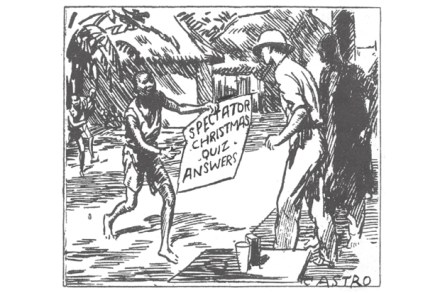
Christmas Quiz | 8 December 2016

From our UK edition

Say so In 2016, who said: 1. ‘Brexit means Brexit.’ 2. ‘We’ve got some leaders of some fantastically corrupt countries coming to Britain. Nigeria and Afghanistan, possibly the two most corrupt countries in the world.’ 3. ‘The Prime Minister — I should be pleased about this I suppose — seems to think he should be in Chippenham, paying homage to the town where I was born.’ 4. (On discontinuing his Twitter account for six months): ‘Too many people have peed in the pool.’ 5. ‘The UK is going to be in the back of the queue.’ 6. ‘Son of a whore, I will curse you in that forum.’ 7. ‘Watching Django Unchained — A Bally-murphy Nigger!’ 8.

The answers | 8 December 2016

From our UK edition

Say so 1. Theresa May 2. David Cameron (overheard on air, speaking to the Queen) 3. Jeremy Corbyn 4. Stephen Fry 5. President Barack Obama of the United States, warning against Brexit 6. President Rodrigo Duterte of the Philippines about President Barack Obama at an Asean summit 7. Gerry Adams, the Sinn Fein politician 8. Hillary Clinton 9. President Robert Mugabe of Zimbabwe, arriving at Harare airport from Dubai, countering rumours of his death 10. Lord Heseltine, of his mother’s dog. Beastliness 1. Beavers 2. Lynxes 3. Eagles 4. Cod 5. Sperm whales 6. A gorilla 7. Yorkshire terriers 8. Tomatoes 9. Donkeys 10. Jeremy. Odd 1. Japan 2. President Hassan Rouhani of Iran 3. Cheese 4. China 5. Leicester City 6. The Archbishop of Canterbury, Justin Welby 7. Helium 8. Human ashes 9.

Spectator books of the year: a new biography of the Pope changes Christopher Howse’s mind

From our UK edition

Two biographies that changed my mind. Gerard Kilroy’s Edmund Campion: A Scholarly Life (Ashgate, £80) vividly sketches the intellectual worlds of Oxford and Prague in the first half of Queen Elizabeth’s reign. They were not as cut off from each other as we might suppose. Campion, one of the men who connected the two, dominated his time with impressive composure, even as he suffered appalling treatment. Too late for last year’s best books was The Great Reformer: Francis and the Making of a Radical Pope by Austen Ivereigh (Allen & Unwin, £20), which shows why Pope Francis is not a silly old commie. The author’s insights into his Argentine background and hard spiritual road make sense of his rejection of the trappings of power and intellectual elitism.

To zyxst and back again

From our UK edition

What the Great Eastern was to Brunel, the New English Dictionary was to James Murray (1837–1915) — an unequalled task that was his life, and eventually his death. What was later known as the Oxford English Dictionary should be a ‘sweep-net over the whole surface of English literature’, said Richard Chenevix Trench, one of its instigators in the 1850s, to be prepared ‘by reading all books’. This stupendous aim would have guaranteed its failure had not that hard piece of Roxburghshire granite James Murray set up in his iron Scriptorium at 78 Banbury Road, Oxford, working, working, working, 90 hours a week for years, sifting with a mind full of languages through millions of quotations written on slips of paper in pen and ink by volunteers.

The gospel truth

From our UK edition

More brides in Britain go down the aisle to Gloria Gaynor’s ‘I Will Survive’ than to any other tune, Simon Loveday notes. He cannot resist adding that ‘it seems doubtful that they have fully taken in the words of the rest of the song’. That must be true. ‘I’m not that chainedup little person still in love with you,’ yells the defiant narrator in Gloria’s song. ‘You’re not welcome anymore.’ If anything, ‘I Will Survive’ belongs, it seems to me, to a genre of assertive anthems, like ‘My Way’ and ‘Invictus’, that appeal to people who are the imaginary heroes of their own Desert Island Discs and examine their lives as little as the lyrics that make them feel better.

On Moses’s mountain

From our UK edition

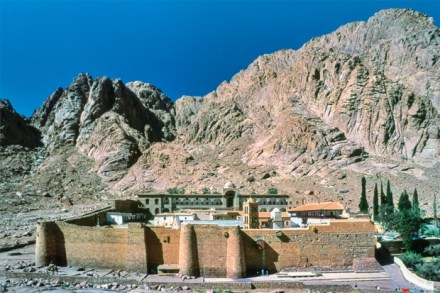
A medieval party of 800 Armenians at the top of Mount Sinai suddenly found themselves surrounded by fire. Their pilgrim staffs shone like candles but, wisely chanting ‘Kyrie Eleison’, they were relieved that after an hour or so the fire abated and not an eyelash of theirs was harmed. The top of Mount Sinai is no place to be stuck in an electrical storm, even less exposed to the fire of God’s presence. A steep mass of weathered granite 7,616 ft high overlooking the Red Sea, it could be climbed on foot (but not on mule-back) with the help of 3,700 steps built into the rock.

To be a pilgrim

From our UK edition

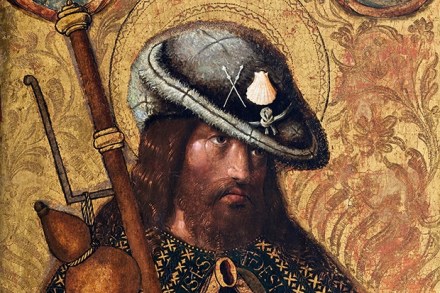
In his friendly and beguiling voice, Jean-Christophe Rufin explains (in a way that reminded me of the pre-journey relish of Camilo José Cela’s Journey to the Alcarria) that, before setting off on foot for Santiago de Compostela, he went to a little shop in Paris and joined the Association of Friends of St James. I have sometimes toyed with the idea of starting an Association of Enemies of St James. I suspect that in his worse, or better, moods Rufin might join. It’s not St James who’s the problem but his friends. Look at the evidence. Rufin walks to Santiago, but chooses the northern route from San Sebastian along the coast.

War on Mount Olympus

From our UK edition

It is a curious fact that the modern Hebrew for ‘atheist’, Tim Whitmarsh notes in passing, is apikoros. The word derives from Epicurus, who set up shop as a philosopher in Athens around 306 BC, but it became so domesticated in Hebrew that the medieval thinker Moses Maimonides, till he found out better, thought it was of home-grown Aramaic origin. In ancient Jewish usage, however, I think apikoros meant someone who denied that God takes care of the world, which was indeed the claim of Epicurus. Though Whitmarsh sets out to show that atheism was quite normal in ancient (Greek) history, atheism turns out to be a slippery notion. Epicurus declared that the whole boundless world was made up of an infinite number of indestructible atoms in unpredictable motion.

Away with the angels?

From our UK edition

I remember the shock, like a jolt of static electricity. One day, between taking my degree and beginning my first job, while looking through a 16th-century book about numerology that had once belonged to John Dee in the British Library, I came upon an annotation in his own neat italic hand casting up the numerical values of the letters of his name. The total he wrote down came to 666. John Dee (1527–1609) was a magus, but we must not think that this made him a loony witch. An early Fellow of Trinity College, Cambridge, teaching Greek, he acquired a reputation for learning in mathematics, navigation and astronomy. But his long pursuit was of something he knew was dangerous and which I am not convinced he always thought licit: angelic conversations.

Agony and ecstasy in the garden

From our UK edition

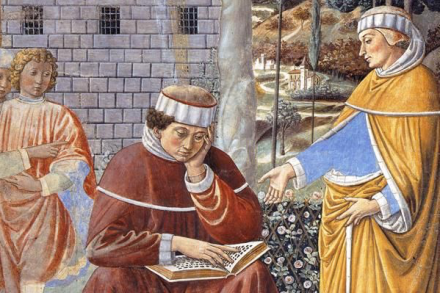
I usually throw away dust jackets but Robin Lane Fox chose his for a reason. He originally encountered Augustine of Hippo in the spring of 1966, after lunch and his first taste of brandy, in frescoes by Benozzo Gozzoli at San Gimigniano. The quattrocento painter showed a figure with an academic air, in a gown and cake-tin-shaped hat, sitting beneath a tall, smooth-barked fig tree in the garden of a villa, his head in one hand and the fingers of the other on some lines of script in an open book on his knee. Beside him stands a man gesturing towards him. This scene is the heart of an intense (if extensive) study by the ancient historian and garden master of New College of a man ‘educated to write like a marvel’.

Christmas Quiz | 10 December 2015

From our UK edition

On the record In 2015, who said: 1. We must get the cow off the ice. 2. It’s decision time — that’s what pumps me up. 3. Let me tell you about my trouble with girls. Three things happen when they are in the lab: you fall in love with them, they fall in love with you, and when you criticise them they cry. 4. Let us build a kinder politics, a more caring society together. 5. Only a mad person or someone in a dream could think that Russia could one day attack Nato. 6. I find it hard to apologise for removing Saddam. 7. We must not pretend to know what we do not know. 8. Am I tough enough? Hell, yes. 9. If these exit polls are right, I’ll publicly eat my hat. 10. One can have a mental brain fade. Animal magic In 2015: 1.

The answers | 10 December 2015

From our UK edition

On the record 1. Jean-Claude Juncker 2. David Cameron 3. Sir Tim Hunt 4. Jeremy Corbyn 5. President Vladimir Putin of Russia 6. Tony Blair 7. John McDonnell (quoting Mao Tse-tung) 8. Ed Miliband 9. Lord Ashdown (They were, he didn’t) 10. Natalie Bennett, the leader of the Green Party, after giving a poor interview Animal magic 1. Ants 2. A goat 3. Gerbils 4. Lancashire 5. A dachshund 6. A rabbit 7. Matisse 8. A spider 9. Bears 10. Nutella Right royal 1. Australia 2. Richard III 3. Princess Charlotte (Elizabeth Diana) 4. The Prince of Wales 5. Britannia 6. The Prince of Wales’s 7. Australia, at the Seppeltsfield Winery near Tanunda 8. Canada 9. China, Chen Dapeng being the sculptor 10. Queen Victoria, who reigned for 23,226 days, 16 hours and 23 minutes Numbers 1. Liz Kendall 2.

Remembering P.J. Kavanagh

From our UK edition

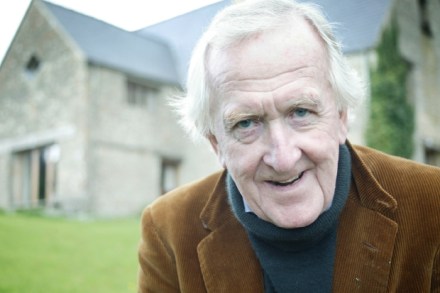
‘Elms at the end of twilight are very interesting,’ wrote Gerard Manley Hopkins in his journal: ‘Against the sky they make crisp scattered pinches of soot.’ P.J. Kavanagh, who has died aged 84, plucked out this observation for one of the columns that he wrote for The Spectator between 1983 and 1996. He was right to call a volume collecting these Life and Letters columns (with a later series from the TLS) by the name A Kind of Journal, for they possess the kind of narrative impetus that makes classic diaries such as Woodforde’s or Kilvert’s so compelling. But they were also a poet’s work-books, just as living in rural Gloucestershire, as he had since 1963, was to be in a poet’s workshop.

St George: patron saint of England, patronised by all

From our UK edition

What did St George do? Killed a dragon, as everyone knows. And yet, as Samantha Riches points out, no mention of the dragon is made before the Norman Conquest. Nor is the pairing ‘England and St George’, invoked by Shakespeare’s Henry V, much noted outside Britain. Foreigners do not know that the English think St George is theirs alone. Many other nations are keen on him — Ethiopia, with a 13th-century church carved out of rock for him, Egypt where the Copts rejoice in him, or of course Georgia — and they all tell local versions of his legend.

Christmas Quiz | 11 December 2014

From our UK edition

So they say In 2014, who was quoted as saying: 1. ‘There is no status for the partner of a head of state, and there has never been one.’ 2. ‘He’s there to serve a very important ceremonial function as David Cameron’s lapdog-cum-prophylactic protection device.’ 3. ‘Money is no object in this relief effort.’ 4. ‘I smoked pot as a kid. I don’t think it is more dangerous than alcohol.’ 5. ‘If Jesus Christ was alive today, I cannot see him, as the Christian person that he was and the great person that he was, saying this could not happen.’ 6. ‘Rush, O Muslims, to your state, because hijrah to the land of Islam is obligatory.’ 7.

Five of the best celebrity biographies of 2014

From our UK edition

Cilla Black has become a strange creature during her 50 years in showbiz. When her husband Bobby was in hospital she found to her dismay that she didn’t now how to take the dogs for a walk. That was some time ago, for Bobby Willis died of liver cancer in 1999. ‘They lived their lives almost like Siamese twins,’ writes Douglas Thompson in Cilla, Queen of the Swinging Sixties (Metro, £7.99, Spectator Bookshop, £7.59). He is an old hand in Cillagraphy, having published Cilla Black: Bobby’s Girl in 1998 and Cilla: the Biography in 2002. He is not the author of this year’s Cilla: the Adventures of a Welsh Mountain Pony, which will disappoint fans since it makes no reference to the long-term hostess of Blind Date (1985–2003).