Chilton Williamson, Jr.

A symbol of hope for Europe

Considering the way history has been going for the past quarter of a century, it seems not merely Panglossian but naive and sentimental to the point of bad taste to find grounds for historical optimism now. Nevertheless, positive facts ought to be recognized as well as negative, and without embarrassment. The world appears to have entered upon a new era when the author of a leader in the London Sunday Telegraph is comfortable writing: “Europe has many things to its credit — and the reconstruction of Notre-Dame stands in notable contrast to our own inability even to decide what to do with the Houses of Parliament. But if we are to retain global relevance and restore economic dynamism, it seems increasingly clear that we have more to learn from America.

Trump

The new political era

It seems likely that on Election Day the country entered fully upon the new political era that commenced with the fateful presidential election of 2016. Donald Trump spent the last four years in the howling political wilderness, savagely set upon by every species of Big Beast — legal, financial and political — but from which he emerged as a survivor — physically, mentally and morally intact to achieve what is acknowledged to be the greatest political comeback in American history. Donald J. Trump is, without a doubt, the most remarkable American politician to hold office since 1945. Whether or not he is a genuinely great man as well is a question that only the next four years can answer.

political

The climate ‘calamity’

"Those who cannot remember the past are condemned to repeat it,” George Santayana wrote in The Life of Reason, published in 1905. The philosopher’s aphorism, somewhat hackneyed after nearly a century and a quarter, and always true only in a limited way, assumes that men are capable of directing history to a certain end, while diverting it from other ones. Santayana was a very wise man and certainly no ideologue. Nevertheless, his maxim shares something with ideological thinking. Both assume that men are collectively aware of the realities of the present time and their possibilities, capable of determining where they wish their societies to go in future and in what shape or form, and then — with varying degrees of success — guiding them there.

climate

The joy of politics

Laramie, Wyoming The Joy of Sex, by the appropriately named Alex Comfort, was a bestselling illustrated sex manual published in 1972 and released in a new edition in 2008. In 2024, anyone with sufficient imagination to describe and illustrate The Joy of Politics would beat out Elon Musk in the race to become the world’s first trillionaire. Politics — like sex — has always been with us, but the conception of politics as “joy” began, you may argue, with the adoption of the “Ode to Joy” that concludes Beethoven’s Ninth Symphony by the European Union as its official anthem in 1985.

joy

The Basement Government

The last presidential election was one in which the term “popular front” took on new meaning owing to the Covid pandemic and a political contest that would have proved anomalous at any point — given the state of an opposition party badly compromised by the aging, uninspired, uninspiring and unpopular political hacks at the top of the party hierarchy and its radicalization over the previous four years by “Trump Derangement Syndrome.” Seeking a “moderate” Democrat with a better chance at defeating the incumbent Republican president, the Democratic Party settled finally and with loud cries of relief on the most confirmed hack in its roster of ranking hacks — one whom, moreover, even the rank and file understood to be mentally and physically infirm — as its safest bet.

Basement

Overnight in New Mexico

The three of us sat on folding chairs around the table where Dick had the microphone plugged into a tape recorder and directed toward the high-altitude evergreen forest and the sheer granitic bowl behind and above it. On the table also were three magnum revolvers and three blue enamelware cups of red wine. “I don’t expect anything the first night,” Dick McCuistion said. “Let’s forget about a watch, shall we?” The sound was the familiar half-human howl, beginning with a whoop, sustaining itself on the exhalation, and lasting three and a half minutes by my watch. It was a cry such as a man — a nine-foot-tall one — could produce; a headvoice bonded to a deep chest tone.

encounter

The era of ideological, overreaching and omnipresent government

It was a law of classical political philosophy that democratic polities devolve inevitably into tyrannical ones. This law is being validated in the twenty-first century, as liberal democracy creates societies antithetical to both liberalism and democracy by shaping citizens of a character for which neither was designed nor developed. In a parallel development over the past decade or so in Europe and the United States, liberals and democrats view their response to the problem as “reaction,” pure and simple, against the sort of thing they have been fighting since 1789. Only it is not reaction; it is apparently something new in history.

government

The joy of experiencing the Mountain West on horseback

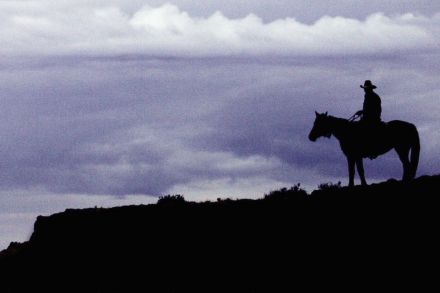
In his introduction to Desert Solitaire Edward Abbey wrote: “you can’t see anything from a car; you’ve got to get out of the goddamned contraption and walk, better yet crawl, on hands and knees, over the sandstone and through the thornbush and cactus. When traces of blood begin to mark your trail, you’ll see something, maybe. Probably not.” While what he says about driving, walking and crawling is true enough, my late friend Ed neglected to mention the alternative — and best — way to see and experience the Mountain West. That is on horseback, the optimal mode from the point of view of observational perspective as well as speed of travel.

horseback

Should elders be respected?

For the left, the world has always been, and always will be, a scandal. In this American election year, it has not escaped their anger and disgust that of the two presumed candidates for a second residential lease on 1600 Pennsylvania Avenue the incumbent is eighty-one years of age, while his challenger is seventy-eight. Yet that societies should be governed by their elders was taken for granted through all of human history down to very recent times. This was owing not to their experience alone, but to the fact that premodern people lived substantially in the past, recognizing that it — as Faulkner said — “is never dead, it’s not even past.

elders

A canyon caper

Lavender Canyon, Utah Spring, and the Manhattanite’s fancy turns to thoughts of West Palm Beach. Me, 2,000 miles away in Wyoming, mine turns to the slickrock canyon country of southeastern Utah some 600 road miles southwest from Laramie, a trip that requires a stayover in a motel along the way to relieve the horses and rest ourselves before continuing on to God’s country by way of Grand Junction, Colorado, and Moab, Utah; within recent memory raucous with the shouts of uranium miners, ranch hands come to town and whores, today the playground of mountain bikers, runners and rafters from Salt Lake City and its environs.

canyon

The age of mass revenge

Journalists have never been noted for originality in their choice of metaphor, so readers must be wearied by now of hearing that the world is on fire. Skeptics will observe that the flames have been more or less constant for well over a century, as the major powers and their allies, satellites and acolytes maneuver to establish, or reestablish, global power or hegemony. In fact, the present crisis extends well beyond the collapse of the international order that prevailed since 1945. The situation is actually far more complicated, the world today being infused with a generalized and simmering anger that extends beyond the great powers to include middling and minor ones everywhere, their societies and their various elements.

revenge

The digital habit

In an era that claims to value the authentic, the direct and the natural, the word "processed" has negative connotations, as in “processed” food. Nevertheless, it describes exactly how perhaps nine-tenths of the human race — including, I imagine, the lost Indian tribes of the Amazonian wilderness — experience reality these days, which is to say processed through electronic media, social media and the oxymoronic smartphone.

digital

The marvelous Montalbano

I visited Sicily in May 2005, when the airlines were still requiring all checked luggage to be left unlocked. After the flight from Paris touched down at Palermo, my wife and I went to collect our luggage at an apparently quiet and unrushed airport to discover my suitcase opened partway and an expensive dressing gown missing. Eighteen years ago, il Commissario Salvatore Montalbano was quite unknown to me. Otherwise, I should have immediately thought of the Sinagra family at the eastern end of the island, though the word “mafia” did come to mind as I rezipped the bag.

Montalbano
intellect

A history of intellect

It has it been widely noted that, as Western culture generally has grown steadily more materialistic in its values and interests (as if it were ever anything else, ungenerous critics might suggest) over the past half-century, it has become simultaneously more abstracted in its mental habits and orientation? Chesterton described a paradox as truth standing on its head to draw attention to itself. In this instance, we have an obvious example. But it’s a good question how this particular one came to be. Ancient Greece was an intensely intellectual world of ideas that were firmly grounded in empirical reality and in observed and confirmable truth.

The rebuilding of the Tower of Babel

The going explanation for the critical international situation today is that the authoritarian, statist powers of the world are cooperating with one another against the Western, democratic, capitalist ones to smash the supposed “rules-based” order on which they imagine Western hegemony rests. This is certainly one cause of the present global crisis but I do not believe it is the proximate one, which is rather the entirely predictable — though inexplicably unpredicted — result of the network of nearly instant electronic communications in which international society is enmeshed as if in the web of a malignant cosmic spider, combined with a reinforcing system of cheap global transport operating at not much below supersonic speed.

communication

The establishment and the mob

In The Revolt of the Masses — first published in 1930 — José Ortega y Gasset proposed that the most important fact in the public life of Europe was “the accession of the masses to complete social power. As the masses, by definition, neither should nor can direct their own personal existence, and still less rule society in general, this fact means that actually Europe is suffering from the greatest crisis that can afflict peoples, nations and civilization.” What Ortega did not live to witness is the ease with which the mass becomes a mob, or an aggregation of many and various mobs, by mental or emotional contagion similar to that of disease. This fact was left for the generations alive today to experience in the fulness of its reality.

mob

The liberal idea of sin

The Western world, once so firmly grounded in Christianity and its Gospels, dogma and teachings, retains in the twenty-first century virtually nothing of them, the almost sole exception being the notion of sin and thus of guilt — not the Christian concept of them, but rather the modern liberal one. To begin with, the liberal idea of sin is collective; it is also highly selective, being limited to the West in general and the Caucasian race in particular. And it is obsessive, as much so as was the Christian version among the Calvinists of Geneva, or the neurotic anticommunism prevalent among the more single-minded and hysterical outliers on the American right during the 1940s and 1950s.

sin

In search of the perfect martini

“I like bars just after they open for the evening,” Terry Lennox tells Philip Marlowe in the early pages of The Long Goodbye. “When the air inside is still cool and clean and everything is shiny and the barkeep is giving himself that last look in the mirror to see if his tie is straight and his hair is smooth. I like the neat bottles on the bar back and the lovely shining glasses and the anticipation. I like to watch the man mix the first one of the evening and put it down on a crisp mat and put the little folded napkin beside it. I like to taste it slowly. The first quiet drink of the evening in a quiet bar — that’s wonderful.” They’re drinking gimlets — gin and Rose’s lime juice — which some people, though not me, consider a type of martini.

martini

The Age of Unreason

The present time, which has justly been called the Age of Unreason, is also an exceptionally confused and neurotic one. Indeed, it is unreasonable because it is confused and neurotic, a fact that its blind faith in liberalism and science make it unable to recognize. Confronted by what it views as the existential crisis of climate change caused by human activity, progressive liberalism promotes the widening illusion that Homo sapiens is actually and morally responsible for endangering “the planet”; that humans can accomplish anything, including reversing and even halting the process, supposing they have the moral will to do so.

unreason