Charles Saumarez-Smith

Where the Whigs went

From our UK edition

A book about one of the London clubs, published to mark its 250th anniversary, might be regarded as of extremely limited public appeal, designed only for the enjoyment of its members, 800 of whom have subscribed more than 900 copies (one blenches to think why members might want more than one copy). But Brooks’s, halfway up St James’s Street, has always felt that its history deserves wider public interest, partly because of its association with the life and gambling of Charles James Fox and partly because it has been so central to the formation of the 19th-century Whig party. (This book includes the rather amazing statistic that, during the Melbourne administration in the 1830s, nearly half the members were sitting MPs and every member of the cabinet belonged to Brooks’s).
Rus in urbe

From our UK edition

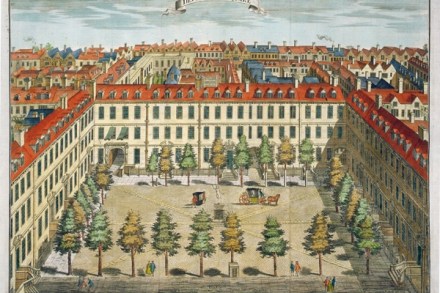
One of the pleasures of my week is walking across St James’s Square. The slightly furtive sense of trespassing as one opens the ironwork gates; the decision as to whether or not to follow the circuit of gravel paths or go straight across the grass; the equestrian statue of William III and readers from the London Library eating sandwiches. Although the surrounding architecture is an odd mishmash, the shape of the square and its urban form preserves a strong sense of its original 17th-century layout. St James’s Square plays a prominent role in the narrative of Todd Longstaffe-Gowan’s magisterial account of the ups and downs of the London square.

Last of the swagmen

From our UK edition

I have hitherto resisted my wife’s frequent recommendations that I should read a daily blog about the life of the denizens of Spitalfields, but, now that they have been published in book form, I can see why she is such an enthusiast. The Gentle Author is deliberately anonymous and bases his style on a combination of John Gay and Henry Mayhew, a pseudo-18th-century faux naïf, who wanders round his local neighbourhood collecting the tales of ordinary folk, including the last of the so-called swagmen who has a market stall in Spitalfields, the waiter in an Indian restaurant just off Brick Lane, Fred, who sells chestnuts at the corner of Bell Lane and Wentworth Street, and Paul Gardner, the fourth generation in his family to sell paper bags.

Singing in exultation

From our UK edition

Every Christmas, I face the problem of choosing an official card. The National Gallery Company sends through the range of choice some time in June, when it all seems far off. I can choose from the ‘Wilton Diptych’ (well, it’s not very Christmassy apart from the fact that it has a gold background) to the Leonardo Cartoon (too well-known) to a Chardin still-life (too secular for my taste because I still feel that Christmas should be about more than a bottle of wine). This year I have chosen a detail from Velázquez’s ‘The Immaculate Conception’, in spite of the fact that, as a detail, it looks rather too reminiscent of a Roman Catholic keepsake, bought in the side-aisle of a pilgrimage church.

God’s house with many mansions

From our UK edition

Institutional history is a tricky genre, so prone to over-reverence, so likely to be tedious to anyone but those attached to the institution described. So it was superficially brave of a commercial press to commission a quincentenary history of a Cambridge college: brave, that is, until one discovers that its authors include Quentin Skinner, the late Roy Porter, David Canna- dine and Simon Schama amongst others, all of them alumni of the Jack Plumb school of history, which was based in Christ’s during Plumb’s long postwar reign there as history tutor and which became the forcing house for an engaged, literate, civic style of historical writing which can make even the introspective mores of a Cambridge college interesting.

Temples of culture under siege

From our UK edition

A couple of years ago, I was walking up Quincy Street in Cambridge, Massachusetts with Ivan Gaskell, a curator at the Fogg Art Museum, when he asked if I had ever met Jim Cuno, the director of the Fogg. I hadn’t, so we knocked on his door and left three hours later, having embarked on a long conversation which I have continued, at intervals, ever since. Cuno was meditating about some of the implications of 11 September 2001: the sense that the public was beginning, once again, to seek out the therapeutic value of great museums; the hubris attached to the decline in the number of visitors to the Guggenheim; the importance of a huge endowment to the independence of the Harvard Art Museums.