Bruce Anderson

Bruce Anderson is The Spectator's drink critic, and was the magazine's political editor

The paradox of Burgundy

From our UK edition

I was trying to remember what I once knew about the theology of the Reformation and especially the various factions’ arguments about good works. Some of them thought that good works were a testimony to Grace. To others, they were a route to Grace. To the Calvinists, they were a mere irrelevance. All that mattered was the inexorable, terrifying verdict of predestination. That at least is my recollection. Choosing a via media, if not necessarily Anglicana, I prefer a phrase from the 1990s, ‘the active citizen’. Whatever its relationship to Divine Grace, that sounds a useful goal, and I occasionally try to pursue it, especially in relation to a club of which I am a member. We spend a lot of time worrying about the problems of ageing.

Birth of a dynasty

From our UK edition

Darkness, but not the blanket of the dark. This was a sinister darkness, beset by smoke and flames, by the clash of steel, by screams, by terror, by horror. The victims were Huguenots on the quayside at La Rochelle in 1688. They had heard the good news. James II had been overthrown, so it was safe for French Protestants to seek refuge in England. Others wished to violate their safety. For the previous three years, since the revocation of the Edict of Nantes (which had helped to cost King James his throne), the Huguenots had been persecuted. Swaggering, bullying dragoons had been billeted in their homes. Now, as the oppressed waited for a sea passage to asylum, their tormentors had a final opportunity to inflict pain. They wielded a branding iron.

Searching for God in the twilight

From our UK edition

My friend Jonathan Gaisman recently gave rise to a profound philosophical question concerning wine. Jonathan is formidably clever. He has a tremendous reputation at the Commercial Bar. Although he brushes aside any compliments from the unqualified, there was a recent case — Excalibur — where his performance won the awed approval of lawyers to whom even he might concede quasi-peer status. They aver that his preparation was exemplary, his cross-examination ruthless and relentless; his triumph total. That said, he is anything but a monoglot lawyer. Not only a music lover but a musicologist, modesty alone would prevent him from claiming that Nihil artium a me alienum. Among the minor arts, he is a practised oenologist.

Disloyal toast

From our UK edition

Drink and democracy have one important point in common: an ambivalent relationship with discord. They can mitigate it. They can also exacerbate it. Events at last week’s Tory conference led me to ruminate on that theme, as a little good wine did indeed mitigate political depression: these bottles I have stored against my ruin. In a modern society, by giving legitimacy to governments, democracy can underpin political authority. But that depends on two related outcomes. The government must be worthy of authority, and those who lose an election must accept the result. By transforming pluralities into sizeable majorities, the British voting system has encouraged all that.

Right as rain

From our UK edition

‘The doors clap to, the pane is blind with showers / Pass me the bottle, old lad, there’s an end of summer.’ The paraphrase was justified, for the weather was doing its best to reinforce Housmanic gloom — although the scene through the windowpanes was best described in Scottish, not Shropshire. There is a Scots word, dreich. It may not be quite onomatopoeic, but roll it round your mouth and you will get the message. We certainly did. Before us was a sodden lawn festooned with dead leaves. A few weeks ago, they would have been resplendent in dancing verdancy. More recently, it would have been a stately golden brown, the colour of mature Rieussec.

The depths of tranquillity

From our UK edition

Peace came dropping slow. I have never regarded west Flanders as part of la France profonde, but here we were, only a few miles from Lille, in the depths of tranquillity. Earlier in the summer, there had been an excitement. An enormous wild boar had erupted into the garden. Our host shot him, and excited littlies promptly renamed their grand-père: Obelix. I had entertained Yves at a club table. His reciprocity was embarrassingly more generous than his excuse for it. Inevitably, the conversation meandered into politics. The house had a complex history. Vauban is said to have billeted himself there before fortifying Lille. It suffered some damage in both world wars. The family lost relatives during that cruel necessity, the Allied bombing of Normandy to expedite D-Day.

Animal magic | 30 August 2018

From our UK edition

Roy Hattersley once wrote a plangent passage about a painful aspect of the human condition: the short span of animals’ lives. The owner who commits his affections condemns himself to the pain of bereavement. This thought has come to my mind recently. Roxy Beaujolais, that glorious ale-wife, has already been celebrated in this column. Her public house, the Seven Stars, is just behind the Law Courts and has almost acquired the status of a fifth Inn. I popped in the other day and found to my delight that it was as good as ever. Cured herring followed by rare cold roast beef: Roxy would be horrified if you described the Stars as a gastropub, but it could easily pass muster as one.

Wine, women and willow

From our UK edition

The first time I went to Lord’s was in 1970, just before the unofficial Test series which replaced the cancelled South African one. I was in the Long Room, discussing Barry Richards, one of the most elegant batsmen of all time. He did not seem to hit the ball. It was as if he had caressed it, after which it would rocket to the boundary. Has there ever been an opener whose stroke-play gave such aesthetic pleasure? An incredibly old buffer joined in our conversation: ‘I always knew young Richards would be good. Came over here as a 16-year-old schoolboy and hit a six off me.’ Who was this pompous so-and-so? Someone of a similar vintage promptly clapped him on the shoulder: ‘Morning, Alec.’ Er, yes: when Barry Richards was 16, Alec Bedser would have been 43.

Mindful drinking

From our UK edition

When I was at school, some time before the last ice age, the final day of term was a quasi-holiday. There might be slide shows, and I remember my housemaster introducing me to Klee and Mondrian (I am still unconvinced about Mondrian). Today, it is all very different. I gather that once the exams are over, the brats are sent on trips or expeditions. The fear is that if they were confined to barracks, they would wreck the place. The Tory high command (if there is one) clearly needs to consult a cunning modern schoolmaster. In the final days of the last term, Conservative MPs came close to sabotage and mutiny. Much the most formidable political machine of the past two centuries departed for the summer with all the dignity of an overturned ant hill. Against that background, some Tories met.

New reign in Spain

From our UK edition

The Kingdom of Spain always sends outstanding ambassadors to the Court of St James, none more so than the appropriately named Santiago de Mora--Figueroa, Marqués de Tamarón, who was en poste when José María Aznar was the Spanish premier. Santiago is also a highly regarded poet, and he has a further advantage. He looks like a Grandee of Spain as painted by Velázquez or Goya. So during one of his recent visits, a good audience assembled to hear him. There was an obvious agenda: Catalonia, the closely fought left/right conflict in Spanish politics, and Spanish attitudes to Brexit. We took wit and charm for granted, while awaiting enlightenment and controversy. We waited in vain.

London’s perfect Paris brasserie

From our UK edition

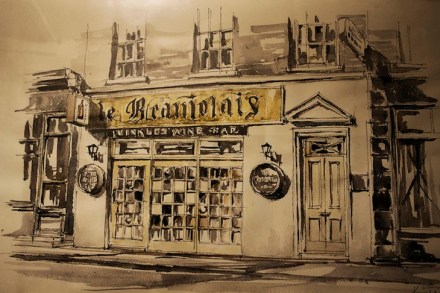
We order some French things better in London — often, admittedly, with French help. A grenouille friend recently took me to lunch at the Beaujolais Club just off Charing Cross Road. He said that it overwhelmed him with nostalgia. As a child, living in Paris, if the family were in town for the weekend, it was just the sort of brasserie in which they would have Sunday lunch (cook’s day off). Traditional dishes; proper bourgeois cooking; wine, no premiers crus, but solid, dependable bottles from solid, dependable growers — who were often friends or relatives of the owners. The children demonstrated their command of table manners and served an apprenticeship in gastronomy. In Paris these days, such places are harder to find.

That woman’s got me drinking

From our UK edition

It is enough to make a man turn to drink. On a distinctly non-abstemious day, I was sitting in one of my favourite places on earth. It is not a great garden, merely a characteristically English one: roses, benign verdancy and the joyous sunshine of gentle summer. My dear friends have just finished restoring their late medieval house. It is not a great house, merely a classically English one. Chillingham Castle, the Wakefield family’s seat in Northumberland, which resplends in grandeur, was described by Walter Scott as bearing the rust of the Barons’ wars. This place, by contrast, is more a case of the gentle patina of manorial peace over long centuries. You feel that if you caught the house off guard, it would be smiling at its latest owners’ enjoyment.

Farewell to wine every day

From our UK edition

Are there still travelling fairs? In many villages, they used to be part of the annual round. For weeks, the children’s anticipation would mount. Then the great day would come. Clowns, dodgems, candy floss: in those day no one knew about sugar-rushes so the brats grew delirious with excitement while the parents enjoyed themselves more than they let on. Does all that still happen – or do you have to go to Boris Johnson’s office for a similar spectacle? On a smaller scale, I entertain my friends about once a year with a fantasy which does not require so many props. It is called the Anderson diet fair. I announce my determination to lose weight and my audience responds with unalloyed scepticism.

Turning wine into words

From our UK edition

Words, words, words. Over a couple of sessions, we drank a selection of serious wines, starting with a Cantemerle ’05. As everyone else thought it was delicious, it would have been curmudgeonly of me to say that although it had been open for a couple of hours, it would have benefited from another five years. So I abstained from curmudgeonliness. Even so, although 2005 is a great vintage, it needs longevity. We moved on to a wine I had never heard of, let alone tasted, but was ready: an ’06 Clos Louie, from Castillion in the Côtes de Bordeaux. Only in business since 2003, it has pre-phylloxera vines: 70 per cent merlot, 27 per cent cabernet franc and only a soupçon of cab sauv. Seriously good, seriously promising, it is not yet as expensive as it is bound to become.

Hungarian rhapsody | 26 April 2018

From our UK edition

The wines of Tokaji run like a golden thread through Hungarian history. There are references to their nectar-like quality in the Hungarian national anthem. Imperial Tokaji, the world’s sweetest wine, has always been prized. As its name implies, much of it found its way to the Habsburgs’ cellars. Emperors often used it as birthday or Christmas presents for fellow monarchs. So I was delighted to taste some non-imperial bottles over dinner at the Hungarian embassy, courtesy of that impressive fellow Kristóf Szalay--Bobrovniczky, the ambassador, a good friend of President Orbán’s. Mr Orbán is much demonised. Along with President Trump and Brexit, he is seen to be a threat to the Fifth International: the pseudo-liberal bureaucratic one.

Too much too young

From our UK edition

This April is the cruellest month, but not in the sense that Eliot intended. Memory and desire are mixed: memory for previous verdant seasons; aching desire for a new one. Instead, we appear to have permanent midwinter spring, with the emphasis on midwinter. So this might seem to be absolutely the wrong time to drink rosé. Readers may be aware of my considered prejudice, that rosé works well south of Lyon as a wine to drink mid--morning with the last crumbs of croissant. But there is the Domaines Ott, whose pretensions and prices soar well above the ground level of normal Provençal plonk. I had some the other day, in the most depressing environment possible. ‘The doors clap to: the pane is blind with showers.

The paradox at the heart of the Good Friday agreement

From our UK edition

Today marks twenty years since the Good Friday Agreement. Here, Bruce Anderson writing in the Spectator in April 1998, talks of Tony Blair's key role in securing a deal: Occasionally, one is glad to be wrong. In this column last week, I wrote about the imminent collapse of the Ulster peace process. It seemed then as if everything was unravelling; the gaps between the various sides had been narrowed and narrowed, but still seemed insurmountable. The ball had brushed the fielder’s fingers, but was now plunging irrevocably to the ground. For the previous three months, heads of agreement had been established, along similar lines to the Sunningdale agreement of 1973. The SDLP MP Seamus Mallon has described this new settlement as ‘Sunningdale for slow learners’.

No place like Rhône

From our UK edition

As often, a good glass stimulated good talk. We were drinking some promising young Rhônes and the discussion ranged wide, moving onwards from the Rhône itself, to the differences between the UK and our sweet enemy France, then to the merits of democracy and the challenges facing it. Democracy has the overwhelming merit of providing governments with legitimacy, thus ensuring that conflicts are resolved in the legislature rather than on the streets or the battlefield. Though this does not always work — see Germany in the 1930s — it does so often enough to justify the Churchillian maxim: the worst form of government apart from all the alternatives. Yet there is a problem. If the electoral process is based on PR, governments are likely to be weak.

Big two-hearted river

From our UK edition

The Rhône is a strong river. The Loire derives graciousness from its châteaux. The Rhine and the Thames have been sentimentalised: not the Rhône. There are no Rhône-maidens, no suggestion of ‘sweet Rhône run softly till I end my song’. A powerful onrush of water rips past the banks of a river that knows how to drown men. But it also brings fertility in abundance. This is probably the oldest wine-growing region in France. The romantic version is that Greeks brought the Shiraz grape from Persia; 2,500 years later, Syrah is still the region’s vinous bedrock. As one would expect from a combination of the River God and the Sun God, these are powerful wines, easily hitting 14 degrees.

Sweet drams

From our UK edition

‘What seas what shore what grey rocks what water lapping the bow’. So evocative, which seems strange: one would have assumed that Eliot would have been seasick crossing the Channel. Yet he understood the gentle little tides — and also the beauty and the fear, the other-worldliness, the implacable grandeur, of the great waters’ vast dominions. In these islands, throughout the centuries, men have earned their bread from the sea. But it was rarely an easy harvest. The ‘-Mingulay Boat Song’ captures the perils of the quest. ‘When the wind is wild with shouting/And the waves mount ever higher/ Anxious eyes turn ever seaward/ Wives are waiting, since break of day/ To see us home, boys, to Mingulay.’ Not all those boys made it home.