Antonia Fraser

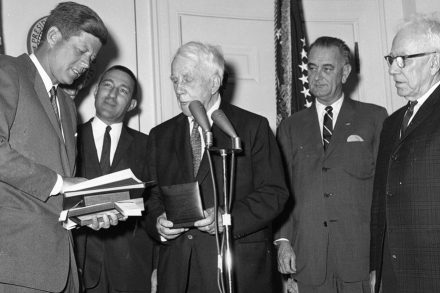
The time I danced with Lyndon B. Johnson

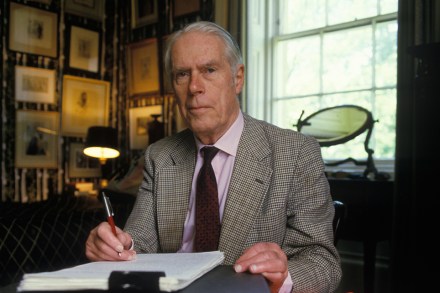
There is general excitement among the legions of fans of A Dance to the Music of Time: next week a plaque to Anthony Powell will be placed on 1 Chester Gate, the London house where he started to write the many-volumed work of genius. I have a particular interest in attending, not only because Powell was married to my father’s sister Violet, but also because I took advantage of the relationship to lodge for several years in Chester Gate. This was when my parents chose to live maddeningly in Hampstead Garden Suburb and at the age of about seventeen I was beginning to go to parties. Go to them? But how to return? That was the problem. No taxi would go so far. I batted my eyes in vain. Fortunately, Violet was one of the kindest and most tolerant people I have ever encountered.
Johnson

I’m glad Anthony Powell didn’t take my writing advice

From our UK edition

There is general excitement among the legions of fans of A Dance to the Music of Time: next week a plaque to Anthony Powell will be placed on 1 Chester Gate, the house where he started to write the many-volumed work of genius. I have a particular interest in attending, not only because Powell was married to my father’s sister Violet, but also because I took advantage of the relationship to lodge for several years in Chester Gate. This was when my parents chose to live maddeningly in Hampstead Garden Suburb and at the age of about 17 I was beginning to go to parties. Go to them? But how to return? That was the problem. No taxi would go so far. I batted my eyes in vain. Fortunately, Violet was one of the kindest and most tolerant people I have ever encountered.

How would Jane Austen have fared at a book festival?

From our UK edition

I’ve been to two of my favourite book festivals recently, Chalke Valley History Festival and Charleston, and the experience has set me thinking about festivals in general. If I could listen to a great writer — any great writer — at a literary festival, I think I would choose Anthony Trollope. He would probably go on and on, just as his books go on and on, but be highly engaging in exactly the same way. Still in the 19th century, I don’t imagine Jane Austen would be much fun at a festival — but I am quite sure she would have the sense not to accept. Sir Walter Scott would lecture one at length about tartan history but his enthusiasm would be contagious.

The last of Rebus?

From our UK edition

Exit Music by Ian Rankin ‘You ... are ... history.’ Approx- imately halfway through Ian Rankin’s latest and surely most brilliant thriller Exit Music, these appalling words are spoken to D. I. John Rebus by his superior. What is worse, Chief Constable James Corbyn means it. He’s not simply referring to the fact that Rebus is within an ace of his 60th birthday (bad enough) but also going much, much further: ‘I know you’ve got three days left until retirement but you’re going to spend them on suspension.’ When Rebus counters, ‘Isn’t that just a tiny bit petty and pathetic, sir?

A meditation

From our UK edition

I’m at Washington airport on a book tour. My escort, an agreeable man whom I have encountered on several previous occasions, says farewell and then asks, ‘Are you still writing?’ I smile nervously. ‘A few more years left?’ he ventures, either in hope or dread, it doesn’t matter. Still. The ‘still’ word. ‘Are you still playing tennis?’ I’m not but I (still) was when I was first asked the question — in my early sixties from memory. ‘Are you still ...’ well, alive, active? It’s no good replying, ‘See for yourself’ because that’s presumably just what they haven’t been able to see. Still. Such a beautiful word.

Diary – 14 October 2006

‘History in the making can be most exhausting.’ When I first read these words — by Noël Coward — I immediately assumed they applied to the writing of it. Having just finished a long book about the loves of Louis XIV, I thought I knew all about that exhaustion. So much for solipsism. Noël Coward was actually recording in his diary for 3 September 1945 his feelings at the end of a long war with ‘the world in physical and spiritual chaos’. I read the entry in a wonderful book, The Assassin’s Cloak: An Anthology of the World’s Greatest Diarists, edited by Irene and Alan Taylor, with multiple extracts for every day of the year — no bathroom is complete without it.

Staying with the old firm

From our UK edition

There have been many books over the years with titles that approximate to Why I Am Still a Catholic. In the Fifties a dream team would have included, I suppose, Evelyn Waugh and Graham Greene with Alec Guinness, received into the Church in 1956, as a promising newcomer.

From Africa back to Scotland

From our UK edition

The publishing world is full of romantic stories, not every one with a happy ending. (I was brought up on the tale, possibly apocryphal, that Evelyn Waugh’s brother-in-law, Edward Grant, kept a framed copy of his letter turning down Gone with the Wind in his office.) One truly happy story, however, so far without an end, is that of Alexander McCall Smith. With a day job as Professor of Medical Law at Edinburgh University, he is the author of The No. 1 Ladies Detective Agency series, creator of the immortal Mma Precious Ramotswe, she of the ‘traditional’ Botswana build. Published originally in hardback by the small Edinburgh firm of Polygon, the series has now sold millions worldwide, its fame spread by that surest of all methods, delighted-reader recommendation.

A most superior street

From our UK edition

Nancy Mitford did not enjoy readers’ letters, according to Harold Acton’s sprightly memoir (how unlike us, Miss Beale and Miss Buss). But she did enjoy this one from a certain Mavis Mitford-Potts, following the enormous success of her first historical biography, Madame de Pompadour. It was along these lines: ‘I live alone in a bungalow and shall soon no doubt be murdered by one of the many people who think all Mitfords better dead’ and had the PS: ‘Please don’t think I admire your idiotic books.’ Nancy Mitford described this missive as ‘a breath of fresh air’ compared to the stack of fan-letters she was receiving: ‘It’s so odd why they should think one should want to know their boring reactions to one’s work.

Swedish exercises in crime

From our UK edition

Henning Mankell, the Swedish crimewriter who is the creator of Inspector Kurt Wallender, is being taken increasingly seriously: an international bestseller but also the subject of profiles in literary papers. He has already won the prestigious (British) Crimewriters’ Gold Dagger Award with Sidetracked. It seems the measure of the success of his dour, dispirited and diabetic Inspector that the last Mankell, The Return of the Dancing Master, made a feature of ignoring Wallender altogether — much as Agatha Christie created a middle-aged lady sleuth in Ariadne Oliver, sated perhaps with Poirotmania. However, the latest Mankell offering is right back with Wallender and in my opinion all the better for it.

Diary – 28 June 2003

From our UK edition

The word 'traitor' seems to be bandied about a good deal at present. 'So you're a traitor, then,' said the complacently smiling lady sitting next to my husband Harold Pinter at the British Library literary dinner – rather a surprising venue for such an accusation, I thought at the time. They were discussing our recent stay in Paris. Harold explained his approval of French foreign policy over the Iraq war, coupled with his disapproval of the British action. Then I was alerted by John Guare to the possibilities of www.probush.com. Clicking on the word 'Traitor' produced a rather more sinister result. This voice was male as well as soft and low. 'You're a traitor!' it hissed at me from my hitherto friendly screen. What, me? What is it with us Pinters?

Diary – 15 March 2003

From our UK edition

A non-stop drive for housing: when my father, then Frank Pakenham, fought as Labour candidate for Oxford in 1945, he hired a pony and cart and, stuffing his numerous children in the back, set forth along the streets with this striking placard. Unfortunately, the pony came to an abrupt halt quite soon and would not be budged. The stop as opposed to the non-stop was commemorated in a photograph in the Oxford Mail. Such is the emotive power of photography that I remember it well, as Maurice Chevalier would say, including the discomfort of the crowded cart, the tiresome behaviour of my scowling siblings, my mother in the cheerful red Socialist mac she wore for electioneering (as opposed to the politically incorrect grey squirrel which was her usual wear). Ah yes, I remember it well.