Angus Colwell

Angus Colwell

Angus Colwell is The Spectator’s daily newsletters editor, and lead author of Morning Press. Sign up here.

Bugs, biscuits, trench foot: from the front line of the uni protests

From our UK edition

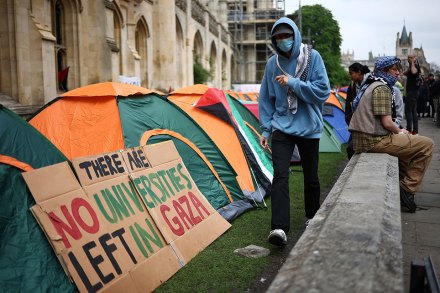
On the grass in front of UCL’s main building, on Sunday night, there were about 30 tents and the portico was plastered in handwritten signs: ‘Students: You’re in debt so UCL can fund a genocide!’ Some protestors sat on chairs, eating biscuits. Others stood at the front gate chanting ‘From the River to the Sea’. ‘Do you want a tent, bro?’ asked one protestor. I explained that I was a reporter and was immediately whisked away to talk to a spokesman. ‘Spectator, Spectator … yeah, I think that’s left-wing. All good.’ A girl who had come along for the day received a keffiyeh tutorial and as night began to fall, I watched as most of the demonstrators headed towards the front lawn to pray. One student didn’t fall asleep until 6.30 a.m.

Matthew Parris, Laurie Graham, Rachel Johnson, Laura Gascoigne and Angus Colwell

From our UK edition

32 min listen

This week: Matthew Parris questions what's left to say about the Tories (00:57), Laurie Graham discusses her struggle to see a GP (07:35), Rachel Johnson makes the case against women only clubs (13:38), Laura Gascoigne tells us the truth about Caravaggio's last painting (19:21) and Angus Colwell reads his notes on wild garlic (28:58).  Produced by Oscar Edmondson, Margaret Mitchell and Patrick Gibbons.  Presented by Oscar Edmondson.

City folk go wild for wild garlic

From our UK edition

For a certain type of Barbour-clad middle-aged man, the best time of year is late summer, and the arrival of the grouse season. But if you’re in your twenties and living in Hackney, you’re more likely to get excited for spring and the arrival of wild garlic. Foraging has become a fashionable activity for twentysomethings. ‘Instagram has changed the game,’ says the nature writer and wild garlic picker Patrick Galbraith. ‘People love the foraging aesthetic.’ Some fans generously compare notes online on the most fruitful spots. Others gatekeep. The Instagram page ‘Real Housewives of Clapton’, which satirises the lifestyles of young bourgeois east Londoners, has gained a following making snide memes about hopeless amateurs foraging in Dr Martens.

Thank goodness pubs shut at 11

From our UK edition

A group of four stagger out of a pub in Britain at around 11.20 on a Thursday night. The search begins for somewhere to have one more drink without a £20 entry fee. Men on doors say no by shaking their heads. Pubs show their appetite for more visitors by turning their lights up a little brighter than an exploding sun. There are bars open, but the mark-up on a glass of white seems out of sync with the occasion and the bank balance. Half an hour’s increasingly muted search ends halfway across the other side of town. Nothing is open. Google maps is opened. Everyone mutters goodbye. If we were given late-night pubs, it would be carnage for two weeks, and then we would shun them Some of us younger Brits have become agitated at how early everything shuts.

The lazy corpspeak of the Foreign Office establishment

From our UK edition

Mark Sedwill is a serious man. He has a master’s in economics from Oxford. He worked in Cairo, Nicosia, Baghdad and Islamabad over several decades as a diplomat. He was a UN weapons inspector, Her Majesty’s Ambassador to Afghanistan and served as the Nato senior civilian representative there. He became cabinet secretary in 2018 after the death of Jeremy Heywood, and left just two years later after the first wave of Covid. Throughout the document, thoughtless language produces thoughtless thinking A shame then, considering his pedigree, that he has entered the world of corpspeak and insubstantial guff.

Chicago doesn’t know what limits are

From our UK edition

Chicago residents bristle when you ask them whether they eat deep-dish pizza. ‘Yeah’, they sigh, ‘we might occasionally when someone visiting wants to try it out’. Sigh. ‘We have great thin crust though’. But lots of places have good thin crust. I came to Chicago to try the deep dish. But deep-dish pizza is stupid. It’s not a pizza, more a dense pie: the sauce sits at the top, and the filling beneath is quicksandy cheese. Sausage meat, jalapeños, chorizo, bacon, red onions and mushrooms are thrown into it and expected to learn how to swim. I got a deep dish on my last day in Chicago and found it wasn’t good. Not for any explicable reason – something like this can’t taste bad — but from my own somewhat pompous sense that God must be against it.

Abolish the food hall

From our UK edition

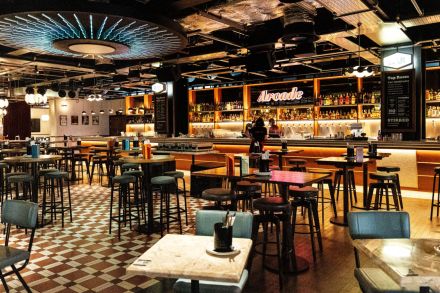
I remember going to Westfield Shepherd’s Bush to visit my first food hall, still a relatively new concept for British diners. They’re big rooms filled with shared seating and different kitchen stalls, serving everything from Thai to burgers, wontons to bratwurst. You can have a burrito and your friend can have a pizza. Oh, how I loved it. I was instantly gratified, gloriously free from the convention of menus, courses or ‘cuisines’. I was excited. These places were born in a boardroom to the sound of marketing ‘insights’ I was also a teenager. And that’s the problem: food halls are childish places. Surely the more choice there is, the better? Nope, it’s not true.

Lionel Shriver, Angus Colwell and Toby Young

From our UK edition

32 min listen

On this week’s episode, Lionel Shriver asks if Donald Trump can get a fair trial in America (00:39), Angus Colwell speaks to the Gen-Zers who would fight for Britain (08:25), Matthew Parris makes the case for assisted dying (13:15), Toby Young tells the story of the time he almost died on his gap year (20:43), and Harry Mount tells us about the grim life of a Roman legionary (25:38).

How the Tories gave up on liberty

From our UK edition

43 min listen

On the podcast: have the Tories given up on liberty?Kate Andrews writes the cover story for The Spectator this week. She argues that after the government announced plans to ban disposable vapes and smoking for those born after 2009, the Tories can no longer call themselves the party of freedom. Kate is joined by conservative peer and former health minister Lord Bethell, to discuss whether the smoking ban is a wise precedent for the government to set. (01:22) Also this week: can the UAE be trusted on press freedom? At The Spectator that’s a question close to our hearts at the moment as we face possibly being sold off to an Abu Dhabi backed fund.

Your country needs you, Gen Z

From our UK edition

Gen Z doesn’t look like it wants to fight for Britain, but last week, General Sir Patrick Sanders, the Chief of the General Staff, said we might have to. He suggested that people my age should be prepared to join a ‘civilian army’ in case we go to war with Russia. But could we handle being cut off from our phones and friends? Do we have the fellow-feeling necessary to defend our country? What if we won’t submit to authority? There are any number of reasons why my generation might reasonably not want to enlist. Accommodation will be uncomfortable and the food will be grim, according to army discussion forums. The application process will take 18 months, and at the end it’s just a 50 to 60 per cent acceptance rate. Then if you do serve, the future of war looks bleak.

AI won’t be humanity’s ‘co-pilot’

From our UK edition

One of the world’s most powerful men was trapped in a central London basement this morning. Satya Nadella, the CEO of Microsoft, had come down to the lower ground floor of Chatham House to talk to the former chief mandarin of the Foreign Office about artificial intelligence. He had precisely 40 minutes, our host said, because he needed to catch a plane to Davos. ‘Thank you for choosing Chatham House for your London destination’, Nadella was told, in the same way that passengers are thanked for ‘choosing’ Ryanair to Dublin. Chatham House was the perfect stage: if you want somewhere to talk about the impact of things, how to harness things, and how to discover the potential of things, you come here. This is lanyard Valhalla.

Britain and US launch airstrikes against Houthis

From our UK edition

The US and the UK have launched airstrikes against Houthi rebels in Yemen whose continued attacks are disrupting trade in the Red Sea. Rishi Sunak convened his cabinet on Thursday night to discuss what action would be taken. Strikes were reported in Yemen’s capital, Sanaa, and the Houthi stronghold port of Hudaydah. Downing Street said that the strikes were carried out by the Royal Air Force on military facilities. The UK’s National Security Council met on Thursday, and an emergency meeting of Cobra was convened. The Leader of the Opposition and the Speaker of the House of Commons were briefed. It’s understood that Sunak will not recall parliament on Friday to discuss the intervention.

Is the West at war in the Red Sea?

From our UK edition

Britain and the US are getting ever more drawn in to the conflict in the Red Sea, as Iran-backed Houthis fire missiles at commercial ships. The USS Carney has downed 14 attack drones launched from Houthi-controlled territory and the Royal Navy destroyer HMS Diamond is also there shooting down missiles.  The Houthis are firing from Yemen, and the Iranian regime is reportedly sending them real-time intelligence and weaponry. The Houthis claim that they are only targeting ships headed to Israel, but evidence suggests otherwise. On Saturday a ship travelling from Saudi Arabia to India was struck. Christmas Eve was one of the busiest days yet: US Central Command said that it had ‘shot down four unmanned aerial drones originating from Houthi-controlled areas in Yemen’.

‘Rizz’, ‘vibes’, and what we lose with Very Online language

From our UK edition

Welcome to our language: ‘rizz’. Here’s the OED definition: colloquial noun, ‘defined as ‘style, charm or attractiveness; the ability to attract a romantic or sexual partner’. It was announced on Monday as the Dictionary’s word of the year, and it’s here to stay sadly, because that’s how language works. That’s why we don’t speak like George Eliot characters. Rizz became popular the way all words do nowadays: they start somewhere opaque online, then filter effortlessly into real life. As a 23-year-old, I hear it semi-frequently, although I kind of wish I didn’t. What does it mean for a word to go ‘viral’? It means that everyone starts using them, and then we get a stale monoculture. These words, by definition, become clichés immediately.

‘I was astounded’: Gary Marcus on the Sam Altman saga

From our UK edition

This morning, OpenAI – the firm behind ChatGPT – rehired its chief executive, Sam Altman, after it fired him on Friday. Altman is the most prominent ambassador for the world of artificial intelligence, and was set to join Microsoft after leaving the company. After his sacking, more than 95 per cent of OpenAI’s employees demanded that the board leave and reinstate him. Many staff were threatening to quit the lab, and Microsoft had agreed to match their pay. Today, OpenAI caved and welcomed him back. What’s going on here? Did a firm that was set up to make AI ‘for the benefit of humanity’, whose whole idea was to not be dictated by the whims of the market, forget itself? I spoke to Gary Marcus, whose Substack is one of the most interesting around.

Svitlana Morenets, Sean Thomas and Angus Colwell

From our UK edition

21 min listen

This week, Svitlana Morenets says Ukraine’s counteroffensive is not living up to the hype (00:59), Sean Thomas says he likes travelling to crappy towns (10:27), and Angus Colwell defends London’s rickshaw drivers (17:38).  Presented and produced by Max Jeffery.

In defence of Rickshaws

From our UK edition

London rickshaws, or pedicabs, are always described as a scourge. They’re too bright and they’re too loud, the charge sheet reads: they block up the road and rip people off. Last week, the government announced in the King’s Speech that Transport for London will be given powers to license them. Drivers will have their fares regulated, their backgrounds checked and their driving abilities probed. At the moment, it’s a Wild West. If you buy a pedicab – congratulations, you’re a pedicab driver. You can now take German families over Westminster Bridge and play ‘Despacito’ as loud as a jet engine. I went out over the weekend to speak to some of London’s pedicab drivers about their trade, and whether they were worried it’s going to die.

Inside the Armistice Day protests

From our UK edition

The Metropolitan Police today staged their largest-ever operation with two marches – the pro-Palestinian march and a smaller counter-protest – taking place in London. The latter, centred on Westminster, provided most of the arrests. The main route of the pro-Palestine march (which started in Park Lane and was moving towards the US Embassy in Vauxhall) passed more peacefully with fewer scuffles. The demonstration drew perhaps 300,000 (although Jeremy Corbyn claimed a million) and the main arrests seem to be those who decided to sit down at Waterloo station and not move when asked. No one person on the march can hope to give an account on the whole thing. But I can say what I observed and summarise some of the various reports.

Kamala Harris doesn’t get AI

From our UK edition

At least Kamala Harris managed to avoid the dreaded phrase that we should ‘harness AI’s ‘potential’. But that was just about the only blessing in the Vice President’s impressively rubbish speech yesterday at the US embassy in London. Artificial intelligence, it is generally agreed, is the most important issue facing humanity, yet all we had was 14 minutes of waffle from the Veep. Still, it was nice of her to turn up. Joe Biden has put Harris in charge of artificial intelligence. You can read that one of two ways: either Biden thinks that Kamala Harris is perfectly suited to grappling with the gravest existential threat, or that he thinks this AI malarkey is all a bit airy, so that looks like a good one for giving Kamala something to do.

Both sides deny being behind Gaza hospital strike

From our UK edition

Who is responsible for the bombing of a hospital in Gaza? This evening as many as 500 people are thought to have been killed in one terrible act in a medical building in Gaza. Thousands of civilians were reportedly sheltering there, after fleeing their homes following an Israeli order to evacuate the northern part of the Gaza strip. Israel were quick to deny having a role in the attack, blaming Palestinian militants – and a misfired Palestinian rocket barrage – for the disaster. It follows an incident earlier on Tuesday, when – according to the UN – a school in central Gaza where 4,000 people were sheltering was hit, killing at least six people.