Andy Miller

Having your cake

For those in the know, Jimmy Webb is one of the great pop songwriters of the 1960s and 70s, up there with Lennon and McCartney, Brian Wilson, Goffin and King, Holland, Dozier and Holland, and Bacharach and David. The hits he wrote for Glen Campbell alone earned him his place in the Songwriter’s Hall of Fame: ‘By the Time I Get to Phoenix’, ‘Galveston’ and of course ‘Wichita Lineman’, the dying fall of which — ‘And I need you more than want you/ And I want you for all time’ — is so perfect that I am fighting back tears even as I type it. The song was written in an afternoon at the request of Campbell who, after the success of ‘Phoenix’ was looking for ‘something about a town’.

A passion for vinyl

Every year at this time, as trees come into bud and flowers bloom, middle-aged men (and a few women) sleep overnight on pavements to ensure they don’t miss the year’s crop of Record Store Day releases; April may indeed be the cruellest month if one fails to acquire that limited 12” picture disc of Toto’s ‘Africa’. It is with such dedicated individuals that Magnus Mills’s new novel is concerned, memory, desire and vinyl being the constituent parts not only of Record Store Day on 22 April but also this authentically square book. The Forensic Records Society has been printed to look like a collectable 7” single, complete with die-cut dust jacket resembling a vintage paper sleeve.

A genial green guide to 2000 AD

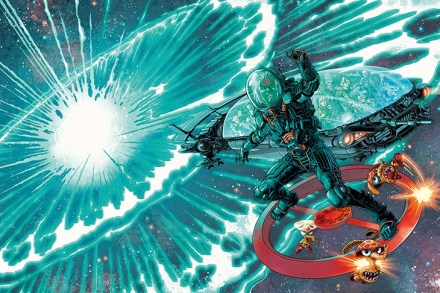
I can recall exactly where I was 40 years ago when I didn’t buy the first issue — or ‘prog’ —of 2000 AD. The just-launched sci-fi comic, featuring ‘space-age dinosaurs’, ‘the new Dan Dare’ and a ‘FREE SPACE SPINNER’, i.e. a mini frisbee, looked quite exciting and, at 8p, good value for pocket money; but, as a regular nine-year old consumer of Whizzer and Chips etc., I stuck with my usual comedy fare and opted for a copy of Buster instead. It was a decision I soon came to regret (eh readers?) I can also recall exactly where I was when I bought the most recent issue of 2000 AD — in Gosh! Comics in Soho a fortnight ago. Times may have changed but the future has not. ‘BORAG THUNGG, EARTHLETS!

Jolly good fellows

‘Leonard Michaels (1933–2003) was one of the most admired and influential American writers of the last half century,’ states the blurb on this reissue of the author’s first and penultimate novel, originally published in the US in 1978. Admired and influential Michaels may have been, but that was largely in his homeland and then as an essayist and author of short stories, rather than as a novelist. The Men’s Club was not published in the UK until 1981 (by Jonathan Cape) and is only now, 35 years later, being made available in paperback by Daunt Books in the category of ‘lost classics’.

Grubby, funny shaggy dog story

The Mexican author Juan Pablo Villa-lobos’s first short novel, Down the Rabbit Hole (Fiesta en la madriguera), was published in English in 2011. It was narrated by the young son of a drug baron living in a luxurious, if heavily guarded palace, whose everyday familiarity with hitmen, prostitutes and assorted methods of disposing of unwanted corpses was both hilarious and unsettling. The novella was the first work of translated fiction to be shortlisted for the (now sadly defunct) Guardian First Book Award and was described admiringly by the writer Ali Smith as ‘funny, convincing, appalling’. Villalobos’s new novel, his third, has again been translated by Rosalind Harvey, whose work on Down the Rabbit Hole was nominated for the PEN translation prize.

We’re all curators now

In January 1980 Isaac Asimov, writer of ‘hard science fiction’, professor of bio-chemistry and vice-president of Mensa International, penned a column for Newsweek magazine in which he addressed a prevailing ‘cult of ignorance’ in America. ‘The strain of anti-intellectualism has been a constant thread winding its way through our political and cultural life,’ he wrote, ‘nurtured by the false notion that democracy means that “my ignorance is just as good as your knowledge”.

An innocent abroad | 10 March 2016

For those who read the weekly music press during the 1980s, David Quantick’s was a name you could rely on. Unlike some of the more Derridean elements at the NME, his reviews of new bands and LPs were both comprehensible and authentically funny. He has gone on to become a successful comedy broadcaster and writer for radio, TV and film: The Day Today, The Thick of It, Harry Hill’s TV Burp. Recently he was part of the team that won an Emmy for the US political comedy series Veep. The Mule is Quantick’s second novel (his first, Sparks, came out in 2012).

Alive and kicking | 28 January 2016

Four years after his death, it is still faintly surprising to recall that Christopher Hitchens is no longer resident on this Earth — or on any other sphere, if his friend Richard Dawkins is correct. A quote from Dawkins graces the cover of And Yet..., a final gathering together of Hitchens’s essays and the sequel to the bestselling anthology Arguably; he was, notes his ‘fellow horseman’, the ‘finest orator of our time’. And here is that voice again, alive, fiercely engaged with many of the same issues he left us to deal with: politics, patriotism, God or His absence, death and, inevitably, books. There was much about Hitchens that was contradictory and he knew it and embraced it in his work.

To wit, deWitt

Patrick deWitt is a Canadian writer whose second novel, a picaresque and darkly comic western called The Sisters Brothers, was much praised and shortlisted for the Man Booker prize in 2011. For the follow-up, deWitt has produced a picaresque and darkly comic middle-European fairy tale called Undermajordomo Minor. Instead of brothers named Sisters, it features a lone anti-hero with a girl’s name: Lucy (Lucien) Minor. As is traditional in storybook narratives, Lucy leaves his village of birth to seek his fortune — well, not to seek his fortune so much as just because he hates his village and everyone in it. He accepts a position assisting the caretaker (i.e. majordomo) of the castle of the Baron von Aux.

The lives of the artists — and other mysteries

Benjamin Wood’s first novel, The Bellwether Revivals, was published in 2012, picked up good reviews, was shortlisted for the Costa First Novel Award and the Commonwealth Book Prize and has become a bestseller in France — a promising start to a literary career, in other words. Wood’s new novel The Ecliptic is both an attempt to consolidate the success of his debut and also a meditation, among other things, on how to sustain such a career over decades while producing original and important art. On an island off the coast of Istanbul lies Portmantle, a remote community for painters, writers and musicians.

An American Wodehouse

Wake Up, Sir! is the latest novel by the American humourist Jonathan Ames; the book first appeared in the States a decade ago, but Ames hasn’t published a novel since, so the title still stands. He has produced a collection of short stories, several volumes of essays and a comic in the interim, as well as creating the HBO comedy series Bored to Death, in which Jason Schwartzman stars as a Brooklyn-based writer turned private detective called… Jonathan Ames. So he’s been busy. But Pushkin Press is to be applauded for bringing Wake Up, Sir! to British readers at last, firstly because Ames is a funny writer and this is a frequently hilarious novel; and secondly because its premise is quintessentially — and, in at least one respect, bizarrely — British.

Pure word music

Since his debut with the Booker-nominated The Restraint of Beasts in 1999, Magnus Mills has delighted and occasionally confounded his loyal readers with a series of novels and short stories about projects, schemes and expeditions that never quite seem to pan out. In these situations, his characters tend to dither politely between cautious enthusiasm and mild exasperation. It’s the deadpan comedy of thwarted logistics. Similarly, a person could drive him or herself slightly mad trying to puzzle out exactly what Mills’s books are about. Do they have a hidden meaning? Are they parables, allegories, fables? One often has the sense that the author knows but enjoys not telling. What matters is not the purpose of the fence but the job of building it.

Ray Davies: part of Swinging Sixties London — and apart from it too

As Johnny Rogan notes in this new biography of Ray Davies and the Kinks, it is almost 50 years since the term ‘Swinging London’ was first used by a newspaper to describe ‘the most exciting city in the world … all vibrating with youth’. Those smashing times may not have lasted long but the vibrations carry on to the present day. Happily, many of the protagonists are still with us — David Bailey, Mary Quant — and so is Ray Davies CBE, part of the swinging city scene but apart from it too. The Kinks were a superb proto-rock group but they were also, in the words of George Melly, ‘brilliant piss-takers’.

A brief, witty look at the coming of the e-book

Paul Fournel is a novelist, former publisher and French cultural attaché in London, and the provisionally definitive secretary and president of the select literary collective known as Oulipo, whose fellows have included Raymond Queneau, Georges Perec and Italo Calvino. Members of Oulipo remain members after their deaths. In this respect, it is the French literary equivalent of the Hotel California, a comparison I suspect its followers would neither welcome nor necessarily understand. But playful and defiant obscurantism is all part of Oulipo’s raison d’être. Dear Reader is set in the world of publishing and tells the tale of a middle-aged editor, Robert Dubois, struggling to adapt to the rise of the e-book; the surname is no accident.

The greatest sitcom that never was

Funny Girl is the story of the early career of the vivacious, hilarious Sophie Straw, star of the much-loved BBC situation comedy Barbara (and Jim), the television programme that ran for four series in the mid-1960s, helped define its era and, crucially, does not exist. The imaginative kernel of Nick Hornby’s new novel is a classic Sixties British sitcom somewhere between Marriage Lines and Till Death Us Do Part, starring the sort of person who rarely received top billing in such shows at that time: a bright, beautiful and naturally funny young woman. Barbara Windsor, Sheila Steafel, Eleanor Bron or either Liver Bird: none of them was Sophie Straw, quite. In fact, Hornby is explicit in naming Sophie Straw’s inspiration and, presumably, his own: Lucille Ball.