Andrew Watts

Daddy issues

Just in time for Fathers’ Day, when thousands of British men will receive cards addressed to ‘The World’s Best Dad!’, a new report from the Fatherhood Institute has come out demonstrating the statistical improbability of the claim. The average father in the UK spends only 24 minutes looking after his children for every hour their mother spends, the lowest ratio in Europe. And given that these figures are based on self-reporting questionnaires, rather than a researcher with a stopwatch, this is almost certainly an overestimate. The Fatherhood Institute concludes that government action is needed, in the first place by increasing the parental leave available to fathers.

The cruellest month

In six months’ time, my son is due to attend an assessment day for a nursery. The details on the nursery’s website are deliberately sketchy — presumably to avoid parents coaching their children — but it seems to involve my son being observed while he plays and graded on the results of his burbling: it sounds very much like an interview. He is going to be two and a half. It is easy to be satirical about a child going for an interview at the age of two and a half — his PowerPoint skills are not up to it; we haven’t arranged a single internship for him; he doesn’t have any particularly insightful questions to ask. But my wife and I thought we had better put him forward for it.

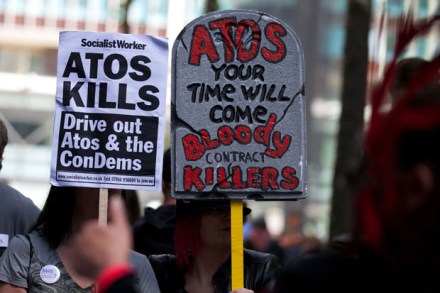
Why I’m thankful that Atos found me fit to work

I was signed off work five years ago. I had lost my job and was, unsurprisingly, feeling low; I went to see my GP, as I was having difficulty sleeping. Rather than dishing out a few sleeping pills, as I had hoped, my doctor googled the letters PHQ-9 on his computer and quickly went through the multiple-choice test for depression he found. Within a few minutes, I walked out of the surgery with a diagnosis of depression and a sick note stating that I was, in his medical judgment, unfit for work. Looking at the Patient Health Questionnaire now, one thing immediately stands out: the copyright notice.

Send in the clowns – how comedy ate British politics

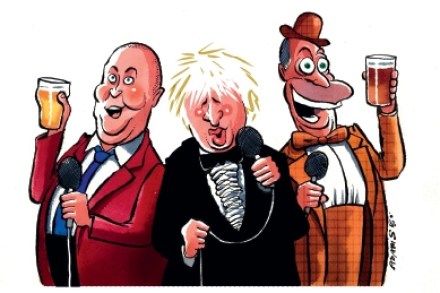
Something funny is happening in this country. Our comedians are becoming politicians and our politicians are becoming comedians — and public life is turning into an endless stream of jokes. Last week, the comedian Al Murray announced that he would be standing at the next general election in the constituency of South Thanet, the same seat that Nigel Farage is contesting. Al Murray performs in the persona of ‘The Pub Landlord’. A sexist reactionary, never pictured without a beer in his hand, forever declaiming ‘common-sense’ solutions to Britain’s problems, Nigel Farage has welcomed the additional competition.

The starchy, conservative lawyer who freed every slave in England

Americans make movies about slavery and its abolition. In the past two years we’ve seen the Oscar-winning Twelve Years a Slave, based on a 19th-century slave narrative, and Django Unchained, with Christoph Waltz as a bounty-hunter who, uniquely among bounty-hunters of the period, did not make his living from capturing fugitive slaves. Spielberg’s Lincoln was about the Great Emancipator himself, as was the less historically rigorous Abraham Lincoln: Vampire Hunter. But the abolition of slavery in England has never received the same attention. Perhaps it is because abolition here came not through blood and glory, but through the common law; or perhaps because emancipation does not frame constitutional debates here in the same way it does in the States.

The church of self-worship: Sunday morning with the atheists

I had always assumed that the one thing atheism had going for it was that you could have a lie-in on Sundays. For the past year, however, an atheist church has been meeting in London on Sunday mornings. Founded by two comedians, Sanderson Jones and Pippa Evans, the Sunday Assembly is a symptom of what Theo Hobson identified in this magazine as ‘the new new atheism’, the recognition that the new atheism of Professor Dawkins et al had, in rejecting God, gone too far in rejecting all His works. Churches, the founders felt, had much to recommend themselves — a space for inspiration, reflection, and a sense of community in an atomised city — and they found a willing audience.

Shalom, I’m Santa — how to be Father Christmas in diverse North London 

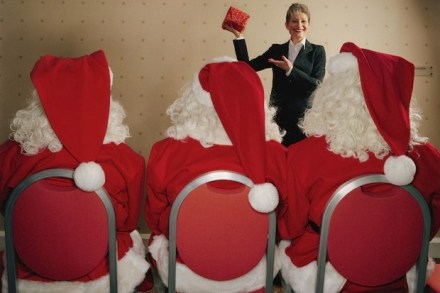
Twenty of us are gathered in the management suite of a shopping centre to learn about benchmarking grotto deliverables, exceeding customer expectations and, inevitably, Elf-and-Safety. Most are tiny teenage girls; they will be the elves. I gravitate to the only other middle-aged man. ‘Santa?’ he asks, nodding in the direction of my stomach. I nod back towards his. It’s 1 November. It couldn’t have been any earlier, as some of the elves have been engaged as scary monsters until Hallowe’en. Not all of them — department store ghouls don’t drive sales quite like Father Christmas — although my fellow Santa had been a Cannibal Killer at a farm shop. He’s been a Santa for 15 years.

What the butler did

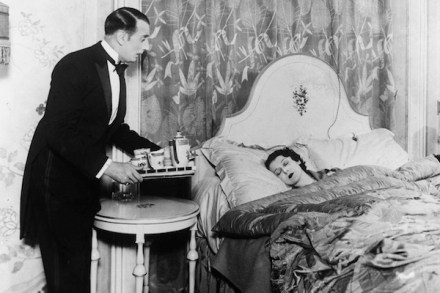
What has happened to butlers? They used to be the epitome of discretion and loyalty: but last week the Pope’s former butler, Paolo Gabriele, began an 18-month prison sentence for passing documents from his employer’s desk on to a journalist. The trial of Paoletto, or ‘Little Paul’, as the Pope fondly called him, follows the trial of another butler nicknamed ‘Small Paul’, Paul Burrell, who was also found to have concealed his employers’ property in his home. (The main difference was that, despite hints that a Papal pardon might be forthcoming, Gabriele was not rescued from jail by the intercession of an 80-year-old head of state.

Alex Salmond’s wind farm delusion

Last year, in an interview with the Today programme, the chief executive of National Grid told the show’s no doubt stunned listeners that they would have to get used to not having electricity as and when they wanted it. That here in the developed world we should be wondering whether the lights will be going out in a few years time, whether our children will go to bed in the cold or whether we will spend our evenings shivering around log fires is rather amazing. That our political leaders have achieved this — if achieved is the right word — in the face of the shale gas revolution with its promise of cheap and abundant energy for centuries to come is truly extraordinary. How have we come to this?

The new Establishment

The Establishment Club reopens in Soho this week, and it is easy to see why. Peter Cook started the original club in 1961, when there was an unpopular Conservative government, led by a cabal of Old Etonians, presiding over a recession; and the Establishment Club’s Soho premises were at the centre of the satire boom that mocked the Tories and led to their losing the 1964 election. Aside from the satire on the stage, Private Eye briefly had its offices in the club; upstairs there was the studio where Lewis Morley took the photograph of Christine Keeler naked astride a chair which illustrates every article about the Profumo affair. This is the reason for the club’s legend: for the first and only time in English history, it seemed that satire worked.

Edinburgh notebook

One of the rites of passage for a comedian is walking through the rain at the Edinburgh Fringe, looking down and seeing one of your own flyers being trampled underfoot. If you want a vision of the Fringe, imagine a boot stamping on a flyer of your own face — for ever. Or until the end of August, which feels much the same. •••  Conventional wisdom is that flyers are the only way of making your show stand out. You can make the world’s best one-man production of The Mousetrap, but the world won’t beat a path to your door unless they’re handed a picture of your face and selective quotations from every review you’ve ever had. Selective quotation is an art form.