Alistair Elliot

A Day Off

From our UK edition

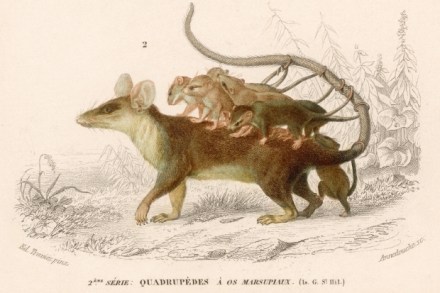
Well, I’ll go window-shopping in Larousse for seeds of words. Strangely, they’re not for sale — you help yourself to what the worlds produce. Here are the conic sections, there the whales, the art, the musical instruments, the wigs.... My search is stopped by a picture of the sarigue, Didelphis, a marsupial of the west, with young. O Marianne Moore, come, look! She curves her ‘long prehensile tail’ right back towards her neck — it’s like the pantograph of an old tram — the little ones climb on, lift their own small prehensile tails, attach, and off they ride to bed. See, one’s still trying to get on. Wait! Wait for me!
Porridge Season

From our UK edition

Tuesday morning. The Chopin of golden syrup is going to perform his Breakfast Fantaisie for teaspoon and dessertspoon. Such a treat to see those thin arthritic fingers pose a moment over the tranquil creamy surface. The oats lie quiet, possibly getting cold. But on the left a deep and mellow chord lands in the centre of the quivering target. Arpeggios, scribbles, signatures from the right cover the margins. What a score! It seems to wander clockwise now and widdershins in the same second, trailing off to silence with a few final isolated notes. All we can do now is to clap, and eat.

The Old Man Comes Out With an Opinion

From our UK edition

This long orchestral piece records a day the composer spent one summer meditating in Dibnah’s yard on the sounds of dereliction, or possibly the dereliction of sound: the settlement of rust, the flake and drift toward the earth of forged and hammered things, the creak of shiny flanges in the wind, and the occasional crash of martial metal as boys dribbled a biscuit box along between the ornamental tetanus hedges of Fred’s Versailles, parterres of ferrous oxide. Sometimes I wish that Fred’s new crush-compactor had crumpled the composer (violin solo) and his jalopy (piano, timpani) in one bright ingot, multicoloured foil (cymbals), and hoyed the lot in the canal (a genuine splash!, an hommage to John Cage).

Love-making in Water

From our UK edition

Seals — well, they rhyme with steel — can stand the cold. And they can even dive and mate at once. They hold their breath; and one knows how to fold his vulnerable parts into the other’s. Even virgin seals don’t need experience to do this properly so no one smothers. We need warm waters — and we might be coy, but sirens can undo our modesty striding across the liquid corduroy. The upright aleph, the round omega line up discreetly in the shining sea. The Indian Ocean lifts him into her. All this might look suspicious from the shore: is it the rollers bobbing up and down? The sex-police suspect but can’t be sure. The siren saunters back with dripping haunches, leaving her lover seemingly to drown, past old men trying to control their paunches.

Seals (Iona)

From our UK edition

No angels listen when you cry out here, but seals rise up to see, and criticize perhaps, as you intone the omega (their favourite vowel) or the medical alpha (sticking your tongue out) for these gods of ocean. Words wouldn’t do. There are no consonants in the mouths of seals. They can appreciate only the modified howl, the growly roar, and perhaps the loudest purr a man can make. It’s not the singing; that just summons them. It’s curiosity that makes them stand in the water on their useless feet, to stare at the creature with two tails, unnaturally split beside its genitals, the loose skin, the weed that seems to be an ornament on the head. But when we sing to them, they hear pure sound without the situation for a howl: we’re standing still.

Wingless Words

From our UK edition

Let us praise poets who are not afraid of Therefore – or of other wingless words that do what they are told, and nothing more. The shiny words fly in with their ideas scattering light, and settle on the hand of these old neighbours, friends from Lexicon Street: their wooden arms hold up such procreant cradles, such rainbow angels – and such smelly fiends – almost invisibly, like the anonymous tree on which the phoenix sat, and sang, its claws grasping the bark, sensing the ancient hardness that lets us flash our iridescent scales. With them we praise Lucretius, his great song of Whatsoever – the nature of the world. He picked his way among the filmy visions and saw how sheep speckle a mountain-side, and how the breathing earth creates big waves.