God bless German ingenuity
From our UK edition
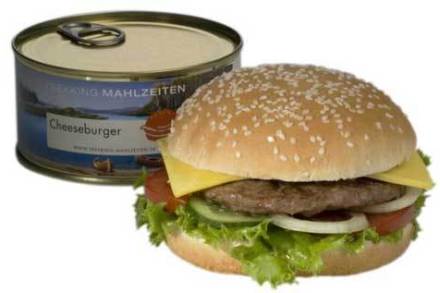
Next time you're stuck on a mountain...

From our UK edition
Next time you're stuck on a mountain...
From our UK edition
Ezra Klein writes: Sources tell me that the Bush administration has stopped using the term "protectionist" because they found it polls really well. Instead, skeptics will now be termed "economic isolationists," so as to better smear them as people who would've lost World War II. But how can it be a smear if it's, well, true? Protectionists are economic isolationists.
From our UK edition
I don't trust the St Barack stuff either, but there's no point in doubting that Obama has something his rivals don't. There's a clarity that comes to the Democratic race when one views it from a distance (in this instance, the best part of 4,000 miles). Yes Obama is inexperienced, yes a good deal of the talk about how he would unite the country is wishful thinking, yes there are times when he seems a little too keen to bathe in the symbolism of his campaign and yes, god knows how he would actually do as President. But all of these concerns - perfectly legitimate though they may be - seem dwarfed by a single, simple truth: for the first time in American history there is the prospect of voting for a black candidate who actually has a reasonable chance to win.
From our UK edition
Teddy Kennedy endorses Barack Obama and, predictably, it's all kicked off. I'm sure Kennedy gave a fine speech. But as Isaac Chotiner observes: you should tune into the cable networks, all of which are implying that today's endorsement ranks somewhere between the moon landing and global warming in terms of planetary importance. And this, of course, is one problem with the American electoral system. The myth of the omnipotent Presidency endures and the office itself is treated as though its holder is some kind of Priest-King. That being the case, one may say that Hillary Clinton is Ready to Disappoint from Day One. Obama will take a little longer to let everyone down.
From our UK edition
So farewell, Adam Gilchrist. Norm marks his retirement with all the right links: You may not know him from Adam, but I have to mark the retirement from Test cricket of one of the greats of the game. In the Adelaide Test, just concluded, he passed Mark Boucher to go to the top of the table for the most Test dismissals by a wicket-keeper. Soon afterwards he annouced that he was calling it a day. What a day it has been. Two of its highlights I saw with my own eyes: his 152 at Edgbaston in 2001 - during this innings he shared a partnership of 63 with Glenn McGrath, McGrath's contribution to which was a single run - and the second-fastest Test century of all time, at Perth in 2006. Adam Gilchrist, people - it's been a pleasure to see him play.
From our UK edition
Barack Obama wins big in South Carolina. But here's what National Review's David Freddoso has to say: He was clobbered with white men and white women. He came in third among both groups. Obama showed in Iowa and New Hampshire that he can win white votes. But the exit polls suggest that this victory in South Carolina is about race, plain and simple. UPDATE: That is to say, except among the youngest voters (who backed Obama first regardless of race). Well. I thought black people's votes counted too. But apparently not if a victory on such a crushing scale can be so easily discounted. The numbers suggest Obama won 80% of the African-American vote. What's wrong with that?
From our UK edition
Thanks to John-Paul Pagano for ensuring I didn't miss this while on hiatus. In an illuminating passage National Review's Kathryn-Jean Lopez reveals the reasons why John McCain cannot be considered a conservative: I’m second to none in praising him on his surge leadership. But on a whole host of issues — including water boarding, tax cuts, and the freedom of speech — he’s not one of us. Rush Limbaugh has emphatically stated that McCain is not a conservative — and he has more than a few listeners with similar instincts. John McCain, of course, opposes water-boarding, taking the old-fashioned view that the United States should not be subjecting prisoners to the kinds of torture favoured by the Khmer Rouge.
From our UK edition
Would John Edwards want the Vice-Presidency in return for playing kingmaker in the Democratic primaries? Perhaps not. After all George HW Bush is the only sitting 20th century Veep to have reached the top job absent assassination, death by natural causes* or the boss being forced from office (Nixon of course was defeated in 1960, but being Veep didn't harm him). Megan asks: The VP slot seems to be a lot less important than it used to be. Thoughts on why this is? The obvious answer is that the Vice-Presidency has rarely been very important but that, contra the idea that it is a graveyard post, it is probably more important now than it has ever been and, subject to certain circumstances, a better springboard for the top job than it has been before.
From our UK edition
An entry for Pseud's Corner. Adam Gopnik on Sarko's romance with Carla Bruni: It is possible to imagine that Sarkozy is not simply a man governed by his impulses and appetites but one trying to use a situation to make a strategic point. In the past, all French politicians were involved in an organized hypocrisy, where mistresses were known, and hidden with a wink. Just as Tony Blair used the cold body of Princess Diana to underline the need for a departure from the national habit of perpetual emotional postponement, Sarko conceivably is using the very warm body of Bruni to make the point that the French need to escape from their habit of perpetual cloaked privilege—of allowing an educated élite to have prerogatives and manners different from the great mass of the people.
From our UK edition
In its way, this anecdote - culled from AN Wilson's touching eulogy for the great Hugh Massingberd is a very telling illustration of how, regardless of technological changes, newspapers have got themselves into such a mess: Part of the secret of Hugh’s overwhelming charm was in his vulnerability. He played up the moments when he had been humiliated, and made jokes about them. But he also really did mind. Just when he thought the new obituaries page had got off to a flying start, a thrusting ‘exec’ on the Telegraph complained to him that there were too many heroic brigadiers with absurd nicknames, and moustachoied wing-commanders. ‘Why’, asked this person, ‘can’t you write about more young people on the obituaries page?
From our UK edition
Among the many pleasures of The Spectator - greatly improved under Matthew D'Ancona's watch - few are greater than Charles Moore's weekly column. Having edited the Speccie himself Mr Moore knows how to write a notebook-style column. Ranging over acres and acres of ground - an archive of the column is here - it's classic Toryism of the finest sort. Some recent snippets of common sense, wry humour and insight. Proof of the column's excellence is that one need not agree with it to appreciate it. For instance: The working week began with what the press call ‘Blue Monday’, the day in January when all the worst things about being alive — post-Christmas credit card bills, the dreariness of work, foul weather etc. — combine.
From our UK edition
Barack Obama: still not a muslim. No word, as far as I can tell, from Hillary Clinton explicitly condemning the Obama-is-a-muslim-which-means-he-wants-to-destroy-America whispering campaign... Reihan, again, puts it most splendidly: I was wondering. What do you think would happen if Islamist radicals were a more important constituency in Democratic primaries than voters who instinctively distrust anyone who may have at some point spent time in a majority-Muslim country? I imagine Clinton would don a burka and issue a fatwa against Obama on grounds of being an apostate, which is of course technically true, and then perhaps calling for his beheading. That is the great charm of the Senator — her flexibility. This is one of those things that seems deliciously harsh but fair.
From our UK edition
I mentioned Norm's latest poll in which he asks: you to send in the list of your favourite English-language novelists. Note that I ask for your favourites and not for those whom you consider to be the greatest (should the first group not coincide with the second). My selections, in no particular order: PG WodehouseRL StevensonEvelyn WaughF Scott FitzgeraldRaymond ChandlerJohn BuchanGore VidalFlann O'BrienErnest HemingwayJames Kennaway Plus, as I've said, William McIlvanney as my absent-mindedly forgotten 11th choice. UPDATE: Ooops, I forgot Patrick O'Brian too. That makes an even dozen then. If pressed, he and McIlvanney would be included at the expense of Hemingway and Flann O'Brien. No women you will notice, and*, RLS aside, nobody from the 19th century either.
From our UK edition
One of the penalties of a three week blogging hiatus is that one misses stuff. For instance, I hadn't realised Barack Obama's favourite TV show was The Wire. The Las Vegas Sun reported: Michael Kostroff, an actor who was in town to volunteer for Obama and had a chance to meet him, told the Sun that Obama’s favorite TV show is his own: HBO’s “The Wire,” which chronicles Baltimore’s violent drug culture and the police who quixotically try to stop it. Obama told the Sun his favorite character is Omar, a stick-up artist who steals from drug dealers and then gives the loot to poor people in the neighborhood. “That’s not an endorsement. He’s not my favorite person, but he’s a fascinating character.
From our UK edition
Great stuff from William Hague in the Commons as he imagines the terror of Tony Blair, President of Europe. American Anglophiles will also like it, since Hague's ability at the Dispatch Box trumps anything the United States Congress can offer. [Thanks to the ever-redoubtable Mr Eugenides. As th eGreek says, David Miliband's genuine and unforced laughter is worth half a raised eye-brow too.
From our UK edition
Reihan Salam, in characteristically excellent form, dismantles the New York Times' lazy and baffling endorsement* of Hillary Clinton and, as a bonus, comes up with the best line I've read today: Clinton must sorely regret that she can’t use proxies to pointedly accuse Obama of fathering a black child — because, after all, he has two of them, and they are adorable. *As a veteran of comfy days writing editorials myself, might I also suggest that you could scarcely hope to find a better example than this of the stuffed-shirt pomposity that plagues the genre. The Times' leader is simultaneously platitudinous, banal, witless and appallingly written. To wit, for instance: "this country faces huge problems, and will no doubt be facing more that we can’t foresee.
From our UK edition
There are those people - mainly on the right - who don't think it a problem that, for one reason or another, the United States has an image problem overseas. Of course one may disapprove of American policy - or merely the manner in which it has been implemented - while remaining enamoured of the United States itself. Still, the United States does have a problem. Don't take my word for it; the US tourism business - despite the weakness of the dollar! - seems to have got the message. How else to explain the rash of advertisements on British TV making the case that your next holiday should be taken in the United States?

From our UK edition
This is a depressing paragraph: William Wallace was a failure who only won one key battle; Robert the Bruce was a usurper struggling to retain power; Scotland was a willing entrant into the Act of Union. Such claims will infuriate nationalists and unionists alike when the BBC seeks to explode myths in Scottish history in a landmark series. It is, of course, depressing that such judgments might be considered "controversial". Why they should infuriate anyone remains a mystery given that they are, well, true. I don't think I need re-iterate my objections to the Braveheart fetish. Suffice it to say that it is all too typical that we should concentrate upon the noble failure (Wallace) rather than the complex - and oft conflicted - victor (Bruce).
From our UK edition
Don't get too excited. Blogging hiatus may not be entirely done with... Apart from anything else, finding more than 2,500 items on one's RSS feed is enough to weary any sensible fellow. Also, I've been struck down with flu (cure: hot whisky and lots of Wodehouse, especially the Blandings Castle novels). Anyway, this, from the always estimable Matt Welch made me smile today: When I was back there in elementary school, I thought Thomas Jefferson was a total sellout for buying Louisiana from Napoleon, because it contradicted his lifelong beliefs about the exercise of executive federal power. Yes, that's what I was like at age 10.
From our UK edition
Norm wants to know your top ten favourite English-language novelists. I ballsed my ballot up by forgetting to include William McIlvanney. No excuse for you not to do your bit however. Votes for this fellow - interest declared! - always permitted...