Adam Nicolson

The healing power of Grasmere

From our UK edition

William Wordsworth’s life is the foundational version of the nature cure. After a disrupted, troubled childhood, sent to live with unsympathetic relations after his mother’s death, a chaotically disaffected time at Cambridge and a muddled youth, fathering a child on a woman he loved but scarcely knew in France, Wordsworth refused all his family’s urgings

In the footsteps of the Romantic poets

From our UK edition

Shelley, walking as a boy through his ‘starlight wood’, looking for ghosts and filled with ‘hopes of high talk with the departed dead’, found nothing in reply. Nothing reverberated. The ghosts were silent. But he felt something else non-human: the springtime breezes bringing a sense of the marvellousness of life itself. And so in that

Geology’s dry, rocky road

From our UK edition

There has been an argument recently on Twitter about how to do nature-writing. Should it involve the self? Should it be poeticised? Has the oh-my-oh-me-ism of recent nature books got out of hand? Can one not see a blackbird now without considering the nature of consciousness and the tragedy of existence? In short, shouldn’t the

Dispatches from the underworld

From our UK edition

Edmund Burke, as a young Irish lawyer in 1756, first made the distinction between beauty and sublimity. Beauty for Burke was about continuity and connectedness. ‘Vegetables,’ he says, in one of the great pre-Romantic sentences, ‘are not sublime.’ Vegetables are beautiful because they are constant and continuous, and because beauty is the quality of perfect

The land beneath the sea

From our UK edition

Somewhere deep in the water-thick layers of Time Song, Julia Blackburn says, funnily, that in Danish, ‘the word for book is bog’.And Time Song itself is a kind of beautiful bog, a memoir-cum-meditation focusing on the stretch of land that once connected Britain to the Continent but was drowned by the rising waters at the

Spirits from the vasty deep…

From our UK edition

‘The sea defines us, connects us, separates us,’ Philip Hoare has written. His prize-winning Leviathan, then a collection of essays called The Sea Inside and now RISINGTIDEFALLINGSTAR together make a loose, meditative trilogy on people, the ocean, its inhabitants, its threats and delights, the comings and goings, the whole tidal business, its excitements and its

Perils of the Pacific

From our UK edition

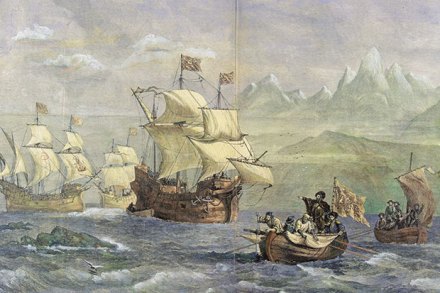
In the great Iberian empires of the 16th and 17th centuries, a career was already avail-able in global administration not very different from the lives of the bankers or lawyers who globe-trot today. In 1509, as one example among hundreds, Duarte Coelho Pereira, a soldier for the Portuguese crown in Morocco and West Africa, went

A Mile Down: David Vann’s memoir of a disastrous career at sea

From our UK edition

When the novelist David Vann was 13, his father — a difficult, unhappy dreamer in his thirties, constantly in dread, as Vann puts it, ‘of becoming something other than what he had always imagined himself to be’, and who had failed first as a dentist and then as a commercial fisherman in Alaska — blew

Poetic injustice

From our UK edition

‘Why do another translation of Homer?’ Richmond Lattimore asked in the foreword to his own great translation of the Iliad first published in 1951. It was a doubt he was grateful his friends and family had refrained from expressing in the long labour of translating the Greek. But he had a response for any who

The Edge of the World: deep subject, shallow history

From our UK edition

The Mediterranean glows in our conception of the Continent, the warm source of everything that is best in us, the seat of civilisation, from which one delicious wave after another has washed up on our shores. But what about the Mediterranean’s twin, the other great lobe of the Atlantic which defines the northern edge of

Bleak beauty

From our UK edition

Adam Gopnik’s dazzlingly knowledgeable and beautifully told essays on winter began life as the Massey Lecture Series on Canadian National Radio, the Canadian Reith lectures. But dismiss from your mind any of the rather stodged up seriousness that always seems to hang around Important Radio Talks on the BBC. Gopnik is serious, and believes and

A chronicle of brutality

From our UK edition

In the 1820s and 30s, London used about 20 million goose quills a year. The government’s Stationery Office on its own was still getting through half a million a year in the 1890s, roughly a quill a clerk a day. The administration of Victorian Britain and its global empire rested on a vast flock of

Enchanting waters

From our UK edition

This is a book which is sometimes so private that reading it seems very nearly like an act of invasiveness. There is nothing salacious or rude in it, but its tone of voice is whispered, intimate, as though the reader were an interloper, a clumsy stumbler into the most secret thoughts of the author. Its

Beyond pretty

From our UK edition

For the last 30 years John Lister-Kaye has lived at Aigas, in the valley of the River Beauly, seven or eight miles from the sea and half an hour west of Inverness. For the last 30 years John Lister-Kaye has lived at Aigas, in the valley of the River Beauly, seven or eight miles from

Behind the wit

From our UK edition

Home to Roost and Other Peckings by Deborah Devonshire, edited by Charlotte Mosley As Alan Bennett says in his introduction, ‘Deborah Devonshire is not someone to whom one can say “Joking apart . . .” Jok- ing never is apart: with her it’s of the essence, even at the most serious and indeed saddest moments.’

Out of his shell

From our UK edition

Notes from Walnut Tree Farm, by Roger Deakin, edited by Alison Hastie and Terence Blacker The writer, Robert Macfarlane, said of his friend, Roger Deakin, that everything Deakin had ever said tended ‘towards diffidence, an abrogation of the self’. It was a fierce verdict. Not a denial of the self or even a suppression of