Women

Did most women want the vote?

From our UK edition

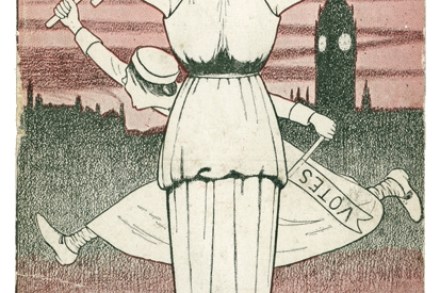
One way or another, we’re going to be seeing quite a lot of Helena Bonham Carter and Carey Mulligan in ankle-length coats with pale faces this season. They’re in the film Suffragette, which has been shooting in the House of Commons in recent weeks. The suffrage campaign was not only successful, it was successful to the extent that any other course now seems a bit preposterous. But what’s rarely mentioned is that the bulk of the resistance to it was from other women. It’s quite easy to visualise the suffrage campaign in terms of men vs women and that’s obviously the focus of the film. But the fact is, lots of women campaigned against being given the vote on the basis that it was unwomanly.
One member of Team Gove is a Theresa May fan

From our UK edition

Sarah Vine is famed for using her column in the Daily Mail to share embarrassing personal anecdotes about Michael Gove (often involving his underpants) and to offer deeply unhelpful advice to the Tory government. Today’s article is a case in point; it says that David Cameron's women problem is 'the biggest hurdle the Tories face'. The wife of the Education Secretary adds: 'as my husband is fond of saying, "Happy wife, happy life". And Mrs Electorate isn’t happy.' And Vine laid it on thick for Theresa May; suggesting that the Home Secretary 'looks more and more like the true heir to Margaret Thatcher.... whose tractor beam glare makes Anna Wintour’s seem positively Bambi-esque'.

Boko Haram proves the Nigerian government to be corrupt and useless

From our UK edition

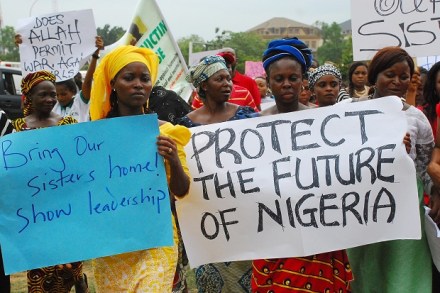
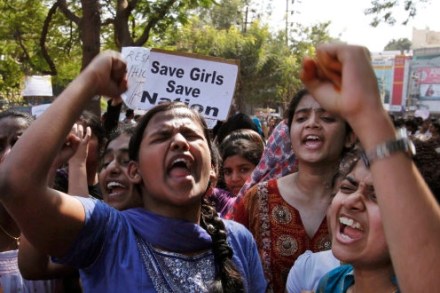
You know, the more we hear about the uselessness of the Nigerian government in dealing with the abduction – the rape, in the original sense of the word – by Boko Haram of 230-odd schoolgirls, the less appealing that government appears. The most striking and urgent action it took in response to the crisis in the three weeks since it happened was yesterday to arrest Naomi Mutah Nyadar, one of the women behind the mass demonstrations calling on the unhappily named president, Goodluck Jonathan, to get a grip and do something. Apparently his wife Patience took against her because she spoke about rescuing “our daughters” when in fact she was not the mother of any of the victims; she was speaking metaphorically, you see.

Civilisation doesn’t need a woman presenter – and it doesn’t need to be remade!

From our UK edition

I was pleased to see that June Sarpong had added her weight to Kathy Lette's petition to get a woman to present the BBC's remake of Civilisation. I've often wondered what became of her after Five Go Dating, a show I used to watch religiously, and one which - if you're listening, Channel 4 - equally deserves to be resurrected. Lette's letter is in yesterday's Times. She complains that Kenneth Clark's original had little to say about women (true) and that because of this, a 'female historian' should take the reins this time. 'A female presenter', argues the Australian novelist, 'would ensure that the series is not just about History but also Herstory. It’s imperative that women also have a voice in the story of our world.

Red hair is having a renaissance

From our UK edition

Much like supporting Millwall or contracting Parkinson’s Disease, red hair has traditionally been seen by the prejudiced as an affliction worth avoiding. The biographies of Mary Magdalene, Van Gogh and Sylvia Plath will confirm this. Rod Liddle sticks it to the gingers in his column this week: ‘I took my youngest son to a football match on Easter Monday. It used to be something I wryly called a ‘treat’ when the kids were younger, but we usually lost in such depressing circumstances each time that I would then feel the need to give them another treat immediately afterwards, to alleviate the misery. Bowling or pizza or something. Not any more.

Dolly Parton’s secret for surviving decades of celebrity

From our UK edition

It’s a shame Dolly Parton has never gone into politics. She’s someone who’s lived her life very much in the public eye and yet has never lost sight of who she is, of her claim to fame as a country singer. You can tell by the way she sings, even now after more than 50 years in the business, that it’s straight from the heart, nothing synthesised, nothing stage-managed. Her voice just ripples out, tripping lightly through those lyrics of broken hearts, feckless men, without ever sounding bored, trite, as if she didn’t really care.

The real original kitchen-sink drama

From our UK edition

Rewrite the history books! Tradition tells us that kitchen-sink drama began in 1956 with Look Back in Anger. A season of lost classics at the White Bear Theatre has unearthed a gritty below-stairs play that predates John Osborne’s breakthrough by five years. Women of Twilight by Sylvia Rayman (which has transferred to the Pleasance) was a thumping West End hit in the early 1950s. It spawned several touring productions, one of which featured the young June Whitfield. When the script was filmed in 1952 it became the first British feature to attract the enticing ‘X’ certificate (over 18s only). The setting is a lodging house in Hampstead where unmarried mothers are crammed together, three to a room.

I’ve finally found a point for St George’s Day

From our UK edition

We (the English that is) share our patron saint’s day with the Catalans. On Sant Jordi’s day Barcelona fills up with bookstalls and flower sellers. The men give their women flowers and the women their men books. I lived in Barcelona a few years ago and found the whole thing charming but also a bit sexist. How typically Latin, I thought, that the men would receive something cerebral whereas the women would get something decorative. Recently though, I’ve revised my opinion. Far from being an example of old-fashioned chauvinism, the Catalans are actually indulging in some progressive social engineering. A report by the Reading Agency commissioned for World Book Night states that almost 30 per cent of men have not read a book since leaving school.

Parliament unusually full of women

From our UK edition

It's quite easy to grow quite used to the way things are, and only realise that they're a bit odd when there's a momentary shift. Today Parliament is packed with women, which is a bit of a shock to the system. They're in New Palace Yard to film scenes from 'Suffragette', rather than as part of a new influx of female MPs or journalists. I have to admit that I often don't notice how masculine this place is: you just get used to it and by and large Parliament is a very pleasant place to work indeed. It was only when a visiting female journalist remarked after the post-PMQs huddle this week that the discussion had been dominated by blokes asking about the gender balance of the new Cabinet that I realised how few women journalists had been present - and how many men.

Women should not fight on the frontline

From our UK edition

Writing in the Spectator Diary some time ago, the evergreen Peregrine Worsthorne, observed that one of the things about getting on was that you ended up forgetting the reason why you believed things and ended up having to think things out all over again. I know what he means. A little while ago I was invited to be interviewed on Sky about my opposition to women having close combat roles in the Army. And you know how it is; you’re busy beforehand, you don’t have the chance to do research, you don’t have time to look up your original thoughts on the subject. And it dawned on me en route to Milbank that I couldn’t for the life of me remember why I was opposed to women fighting.

Let women fight on the front line, but only if they pass the tests

From our UK edition

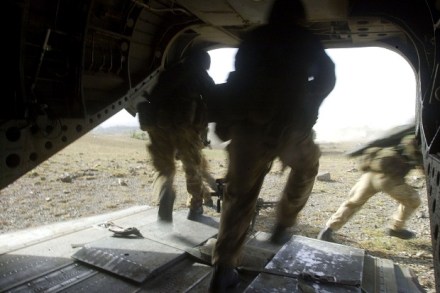
The head of the British Army has given the clearest sign yet that women will soon be given the right to fight on the front line in a combat role. General Sir Peter Wall, chief of the general staff has said that lifting the ban on women serving in combat units was ‘something we need to be considering seriously’. It is. Women can already serve on the front line with the artillery and as medics, engineers, intelligence officers and fighter pilots. So let’s open up all areas to women – but only if they can pass the tests to prove they are up to it. No quotas; no easier trials. There will be women who pass, and women who don't. The ones who pass of course deserve to fight in frontline combat units . The ones who don't may well be suited to other areas of the military.

Why do people always assume critics are male?

From our UK edition

I offer you a riddle. It’s worthy of the Sphinx guarding Thebes, but if you’ve got half the brain of Oedipus you might get it. A father and his son are travelling in a car. The father loses control of the steering and the car crashes. The father dies at the scene but his son survives. The son is rushed to hospital. Severely injured, the boy is sent down for surgery. The surgeon looks down at the boy and says, slowly. “I can’t operate. This is my son.” How, you will ask, is this possible? This riddle did the rounds about 35 years ago. It was probably old even then.

Is full employment just another of George Osborne’s political stunts?

From our UK edition

‘Full employment’ usually means the lowest achievable rate of unemployment — somewhere south of 5 per cent compared with 7.2 per cent today, or to put it in numbers, fewer than 1.5 million compared with 2.3 million last month. You might think it ought to be a target of every Chancellor of the Exchequer. Only Norman Lamont ever said otherwise in public, telling the House of Commons in 1991 that ‘rising unemployment and the recession have been the price that we have had to pay to get inflation down. That price is well worth paying.’ Now George Osborne has embraced the full employment target, taking a little more wind out of Labour’s sails as he did so, and has said he wants us to have the highest employment rate in the G7.

George Osborne’s last chance: 40p…or childcare?

From our UK edition

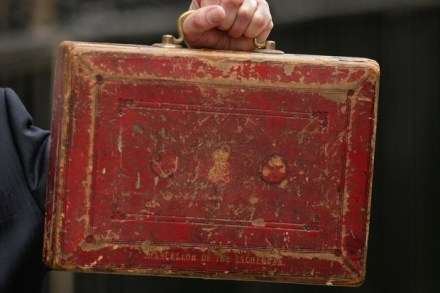
Next week’s Budget is the last chance for George Osborne to make a ‘game-changing reform’. Backbench Tories have been clamouring for Osborne to reduce the number of people paying the 40p rate - in the hope that this will secure middle class votes. Lords Lawson and Lamont have added their august voices to that camp. And UKIP joined the fray this afternoon by pledging, according to the Telegraph, to raise the 40p threshold to £45,000. Without denying that the 40p rate has become a serious issue (our own Melanie McDonagh takes a dim view of the government for having lowered the threshold), The Spectator proposes a simpler and politically more inclusive reform option: childcare.

Any other business: Turn down those token directorships, girls, and tell them you want to be chairman

From our UK edition

Last Saturday was International Women’s Day, but we celebrated early in Helmsley when my Yorkshire home town was featured in national news last month as a beacon of recession-beating female entrepreneurship: 60 per cent of our new ventures have female owners. This is shaping up to be a good year for women in business generally, what with Vince Cable voicing support for all-women shortlists for directorships of FTSE 100 companies with a view to achieving 25 per cent representation by 2015, up from 20 per cent today. The Business Secretary has been busy behind the scenes, too. ‘We had a letter from Vince telling us we should appoint a female non-exec...’ one chief executive told me last week ‘...

New play forgets that rape is not just an Indian problem

From our UK edition

A play about the 2012 Delhi rape was never going to be easy viewing and unsurprisingly Yael Farber’s Nirbhaya is painful to watch. It’s easy to close a newspaper when details are too graphic or flick a TV channel when the news becomes unbearable. But this performance is painful because it confronts the most difficult of truths in the most gritty detail. And we, as the audience in the stifling intimacy of the Southbank’s Purcell Room, were unable to look away. Conceived by Indian actress Poorna Jagannathan and scripted by South African playwright Yael Farber, Nirbhaya is currently being performed in London as part of the Women of the Word festival at the Southbank Centre.

The dream pill may not always be worth it

From our UK edition

A couple of years ago, I was put on the third-generation contraceptive pill Yasmin. ‘It’s good for your skin and stabilises your weight,’ the doctor said. And it’s true. I’ve found it to be wonderful. Most of my friends are on similar types of third–gen pill, like Femodene and Marvelon; many swear by them. Out of the 3.5 million women in the UK using the combined contraceptive pill, 1 million are on third–gen versions. But things aren’t all rosy. In the past week, all British GPs have been ordered to warn anyone taking these popular pills that they are at risk of developing potentially fatal blood clots. The statistics make for an uneasy read.

How does the Tory party solve its ‘women problem’?

From our UK edition

It's a week since Harriet Harman claimed it was 'raining men' in the Tory party, and yet the debate still rages about whether the Conservatives have a 'women problem'. Tory backbencher Tracey Crouch has written a forceful piece for the Mail on Sunday on why she felt Ed Miliband's intervention at Prime Minister's Questions on Wednesday was patronising. It's worth a read, not least because she tries to dispel the myth that women are being turned off Parliament just because it's rowdy: 'Some of the loudest and, in some cases, most effective hecklers in Parliament today are women MPs. Even the most unruly Labour men think twice before taking on Conservatives such as Anna Soubry and Claire Perry because they know they will be cut down to size by an even sharper and wittier putdown.

Tories and Labour both losing 8% of their female MPs

From our UK edition

Another day, another female MP decides to quit politics. Ann Clwyd has announced that, after 30 years in the Commons, she will not be standing in 2015. Female MPs have been in the news of late – either because they are retiring or fighting de-selection. On yesterday’s edition of the Andrew Marr Show, Harriet Harman said: ‘My concern is that we're having a sort of cull of senior, authoritative women and they're all being replaced by men’. She then went on to use this as evidence that the Tories have a ‘women problem’. The numbers, though, tell a slightly different story. There were 48 female Tory MPs in 2010. Lorraine Fulbrook, Jessica Lee and Laura Sandys have announced that they will not be seeking re-election.

Thirsk and Malton Tories boot out Anne McIntosh

From our UK edition

So the Constituent Spring continues. Thirsk and Malton Conservatives have just announced that they have voted to not re-adopt their MP Anne McIntosh. The party has announced that selection for a candidate will open shortly, but McIntosh has vowed to fight on. She said: ‘I’d like to thank all those who supported me throughout, from both Vale of York and Thirsk and Malton. ‘It is my intention to stand for Thirsk, Malton and Filey constituency at the next General Election. ‘Meanwhile I remain committed to the Conservative Party locally and nationally and shall continue with my constituency and parliamentary duties with my customary passion.