Wales

Another disappointment for Ed Miliband

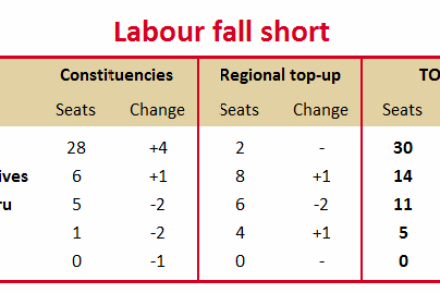
The final tally from Wales is just in — and it's a minor disappointment, on a day of many disappointments, for Ed Miliband. There was a time when Labour looked set for a comfortable overall majority in the country. But it isn't to be. They did gain four seats, yet that leaves them one short of an overall majority. Now, with thirty seats — exactly half of those in the Welsh Assembly — they will have to make do with a tighter, working majority. Far from terrible, but not the red groundswell that Miliband might have hoped for. The problem for Miliband is the overall picture: a precarious sort of victory in Wales; solid, but unspectacular, results in England; an evisceration in Scotland; and, most likely, defeat for AV.

Your guide to tomorrow’s elections

In light of ICM's latest poll, Lib Dems might be relieved to hear that tomorrow isn't all about the AV referendum. But it's a meagre sort of relief: they're facing a drubbing in the local elections too. We've put together a quick guide to those elections, as well as those in Scotland and Wales, so that CoffeeHousers know what to look out for, and Lib Dems know what to fear. Here it is: England The main question hovering over England's local elections is: how big will Labour's gains be? There are around 9,400 seats up for contention, of which the Conservatives currently hold about 5,000; Labour, 1,600; and the Lib Dems, 1,900.

Mountain miracles

Lamb is a foodstuff intimately connected with Wales. Long subjected to cheap humour, Welsh farmers are now enjoying the last laugh: since 2006, the European Union has conferred on Wales the distinction of a Protected Geographical Indication (PGI), making it the equal of products such as Parma ham. So when the opportunity arose for me to learn about different aspects of its production, it was too good to miss: and first, I decided to acquaint myself with its terroir by climbing Mount Snowdon. A blustery Friday morning seemed an unlucky day to climb one of the highest mountains in Britain, but I trusted in a favourable weather forecast which, for once, was not mistaken. Along the way there was plenty of evidence of the foodstuff-in-waiting which I had come to investigate.

Annals of Leadership: Welsh Division

David Lloyd George is, I think, the only Welshman to have become Prime Minister but he was born in Manchester. Does this mean that Julie Gillard is the first Welsh-born person to become Prime Minister (or its equivalent) anywhere on earth? Surely Wales must have spawned someone who has been in charge of somewhere before now. But if so, who? (Entries are restricted to modern politics: in other words you can't have Henry VII.) (Tom Switzer's dyspeptic piece on Gillard's kinda-victory is worth your while.

Old South Wales socialism made Gillard who she is

Australia’s 27th prime minister is not only the first female holder of the office, but also only the second foreign-born PM. Like the first, Billy Hughes, she is Welsh. Ironically, Wales has now produced twice as many prime ministers of Australia as it has of the UK, of which it remains a constituent part. However, Julia Gillard makes little of her heritage. ‘I always knew, growing up,’ she said, ‘that we had chosen this place [Adelaide] because it offered us opportunities beyond those our homeland could have delivered. My parents could muse on what life might have held for them in Wales. Frankly, I cannot. Australia is and always has been my reality.

Mountain sheep aren’t sweeter

Anyone who can speak Welsh is going to get a lot of fun from this book. Antony Woodward buys a six-acre smallholding 1200 feet up a mountain near Crickhowell in Wales where he sets about trying to fulfill his dream of creating what may be the highest garden in Britain. The smallholding is called Tair Ffynnon, which, he informs his readers, means Four Wells. Ooops. For this is where the Welsh will start to snigger. Part of his mad project on the mountain is the creation of a pond, which involves diverting water from his four wells into this. Only he has, of course, first to locate them, which proves difficult. Very difficult. And even now an increasingly frantic Woodward may be up there in the clouds trying to locate his lost fourth well. For Tair Ffynnon does not mean Four Wells.

Paxman vs Wales

Not a great showing by Jeremy Paxman last night as he wrestled with a Welshman* (who seemed to be named after an Icelandic volcano) and lost. And it wasn't even close. Immensely entertaining, therefore. The real fun starts just after the two minute mark: *Plaid Cymru's** economics advisor Eurfyl ap Gwilym. **Typo fixed, Jeremy.

Cameron gets his message spot-on

Just a quick post to encourage CoffeeHousers to read David Cameron's speech to his party's Welsh conference today. It's not just the clearest, and most sensible, exposition of the Tories' economic message that I've come across so far – it's also the finest overall speech that I can remember Cameron giving for some time.  Plenty of hard-hitting passages, both attacking Labour's record and – crucially – setting out a positive alternative. What really makes it so impressive is the simplicity of its central message: that you can achieve better government, and better services, for less money.

Today Wales! Tomorrow Scotland?

Iain Dale says he has absolutely no idea why the Scottish Tories have failed to make as much headway as their Welsh counterparts. A new opinion poll puts the Conservatives on 32% on Wales, only 3% behind Labour, and a massive 11% up on the last general election. However, in Scotland, the Conservative ratings are only marginally up on 2005, Why is this? Why are Welsh Conservatives so much more successful than their counterparts north of Hadrian's Wall? We've ridden these marches here before, but another trip can't do any harm. The first and most obvious answer is that the SNP is a much stronger beast than Plaid Cymri for reasons that have plenty to do with the last 700 hundred years of history and the fabric of the Union since its foundation.

Racists, pigs and hysterics

I cannot remember getting so much pleasure from a book. It is not just its beauty, the handmade paper, the quarter leather, the engraving of the Rhaeadr Falls cut in purple into the cover cloth of something the size of an atlas. These are accidental details (as, I note bemusedly, is the fact that it costs £300 more than the current value of my car). For this, quite simply, is the funniest book I have read in years. Its godfather seems to have been Napoleon, whose wars sealed Europe off to the Romantics. In other words, he deprived them of their fixes of the Sublime, the Picturesque, the Prospects of Infinity; the Emperor deprived them of mountains. So where were they to go?

Two polls to please the Tories

There have been two polls today which are worth mentioning belatedly.  The first is YouGov's voting intention poll for Wales, which Anthony Wells has analysed here and here.  It's not often you see a Welsh voting poll - which is a shame - and the results of this one are striking.  Labour are on 34 percent; the Tories are on 31 percent; Plaid Cymru on 15 percent; Lib Dems on 12 percent.  Overall, that's much better news for the Tories than it is for Labour: the last time the Tories scored 31 percent in Wales was in the 1983 election.

Men of Harlech

It's a bank holiday weekend, so what better way to spend a Sunday afternoon than by watching Zulu one more time? Granted, the movie is riddled with historical inaccuracies but so what? 'Tis grand, stirring stuff. And the "sing-off" between the Zulus - "Well, they've got a very good bass section, mind, but no top tenors, that's for sure" - and our Welsh heroes is splendid, ranking behind only the superb rendition of the Marseillaise in Casablanca.

Boldly for restoration

Wales, by Simon Jenkins Last year, having been to Scotland, I called on the mother of an old friend. Mrs Molly Jones of Carmarthen, I found to my great surprise, was very enthusiastic about Scotland. It was so unlike Wales, she said. All those castles . . . ‘But Mrs Jones, there are castles at six-mile intervals from where you’re sitting.’ ‘Yes, but they’re so . . . well . . . dilapidated.’ The first delightful thing about this gazeteer to what his publishers describe as ‘the best Welsh buildings’ is that Simon Jenkins is quietly, and sometimes not quietly at all, of her persuasion. This is Jenkins on Caernarfon, the best preserved (having had a 19th-century makeover) of all Welsh castles.