Uk politics

A report that should influence welfare reform for years to come

From our UK edition

Iain Duncan Smith's Centre for Social Justice has released a very important report today, and one which should influence the welfare debate for years to come.  At around 350 pages, it's a weighty enough tome, but I'd recommend that CoffeeHousers give it a flick through. Its subject is how to fix a benefits system which incentivises worklessness.  At the moment, unemployed people are eligible for so many benefits – there are 51 in total – that they can accumulate an income which rivals, or sometimes even exceeds, the wage they'd get by taking a job.  And even if they could get more money in work, the current benefits system still acts as a disincentive.
The Tories’ Treasury mole exposes Labour’s cuts deception

From our UK edition

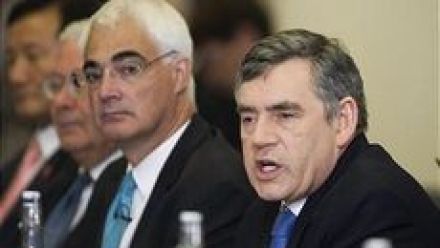
On July 2nd, Gordon Brown told the House of Commons: “I have always told the truth and I've always told people as it is...we don't want to have the 10 per cent cuts the Conservatives are talking about.” The Tories’ extremely destructive Treasury mole has leaked documents proving that Labour has been planning substantial cuts in front line services since before the budget. The DEL figures, printed below, are key: suggesting that a cumulative 9.3% cut was planned for 2011-2014, and Paul Waugh is right to point out that these revelations may explain why the government delayed its comprehensive spending review.

Europe rears its head once again for the Tories

From our UK edition

One of David Cameron’s chief successes has been to marginalise Europe as an issue. But the expulsion of Edward McMillan-Scott MEP from the Conservative party, for refusing to withdraw allegations he made against Michal Kaminski, the leader of the controversial Eurosceptic grouping of which the Tories are members, has disinterred the fractious European problem. The Europhile McMillan-Scott launched a pointed attack on the Tory leadership and its European policy on this morning’s Today programme. He said: “I think David Cameron has got most things right on Europe, but this partnership (the grouping) matters...What we will see is the party becoming much more Eurosceptic than it seems now.

A woman apart

From our UK edition

Anticipate the demise of Gordon Brown. Imagine Labour’s search for a leader with voter-appeal. Picture a younger Shirley Williams, but with the experience and affection she already commands. Wouldn’t she be a powerful contender? Couldn’t a new Shirley Williams, updated for the 21st century and reinserted into the Labour Party, give the rest a run for their money? Lady Williams’s style of politics has weathered better than that of any of her erstwhile Labour contemporaries. She’s just the sort of thing they need. Climbing the Bookshelves is the story of the woman who forsook all that, and what made her. The story of what made her is much the more interesting half.

A sneak preview of the election campaign

From our UK edition

One of the features of the coming general election campaign is going to be the use of video attacks ads by outside groups. The idea is that a sufficiently well-produced or controversial one will be able to drive the news agenda and, rather like Dan Hannan’s European Parliament speech, become a story in and of itself. Conservative Home’s response to Gordon Brown’s use of the word ‘cuts’ today is a preview of the kind of thing we can expect come the spring.

Brown missed a trick by not deploying the ‘c-word’ earlier

From our UK edition

Six months after a Politics Home/Spectator poll illustrated that ‘cuts’ was no longer a dirty word, Gordon Brown squared up and let slip the c-word. A new Politics Home ‘insider poll’ reveals that 86% of respondents believe Labour would be in a stronger position now if they had admitted the need for future cuts at the time of the Budget. That is almost certainly true: the obvious contrivance that was ‘Tory cuts versus Labour investment’, together with the invention of 0% rise economics, torpedoed the government’s credibility.

Cable: no budget should be ring-fenced

From our UK edition

Vince Cable has joined the cuts debate, arguing that the “time for generalities is over” and that “politicians must not shy away from explaining in detail how they will tackle the problem of deficits and debt”. He identified 9 areas for specific savings: public sector pay and pensions, centralised education, family tax credits, defence procurement, quangos, asset sales, ID cards and the NHS super computer. Crucially, he stated that no department should be “ring-fenced”, and proposed cutting fees paid to hospitals and scrapping the strategic health authority, a move backed by Michael Fallon in a Telegraph article last week.

Osborne: Tories will hold emergency Budget if they win the election

From our UK edition

George Osborne has just announced at The Spectator’s inaugural conference, Paths to Prosperity, that there will be an emergency Budget in June or July of 2010 if the Tories win the election. Osborne told Andrew Neil that the aim of this Budget would be to reduce borrowing for fiscal year 2010-11, which will already be under way at that point, and for the years thereafter. Presumably this will be done through a combination of tax rises, spending cuts and asset sales.

Ouch | 15 September 2009

From our UK edition

From the write up in The Times of the latest Populus poll: “Almost half of voters think that anyone would do a better job than Gordon Brown as Labour leader. Nine months at most from a general election, a Populus poll for The Times suggests that 48 per cent of voters believe that “literally anyone” from Labour’s ranks could do better, without naming alternatives.

The irrefutable fact about cuts is that they are needed now

From our UK edition

I did Lord Myners a disservice by suggesting he’d gone off message by saying that spending would continue until recovery was “firmly rooted”. Peter Mandelson’s cuts speech yesterday supported that line, renewing the cuts versus investment dividing line. Steve Richards argues that the government’s approach is correct and Tory policy is a recipe for disaster. He writes: ‘He (Cameron) is now pledged to a revolutionary shrinking of the state without being able to specify how he will go about making the big changes. His speech last week about cutting the subsidies on meals in parliament was beyond parody. Yesterday Mandelson made use of the space that has opened up in policy terms by highlighting the differences.

This’ll be worth watching

From our UK edition

The Daily Telegraph reports today that Cherie Blair will campaign for Gordon Brown at the next election. She told Tim Walker that "I will personally get involved in the electoral campaign". The idea of Cherie campaigning for Gordon is rather comic. Relations between the two were famously tense. At Tony Blair’s last conference as Labour leader, Cherie was heard to say ‘that’s a lie’ when Brown said how much of a privilege he had found it to work with Tony. As Tony Blair quipped in his speech, he never had to worry about Cherie “running off with the bloke next door”. Personally, I’m intrigued by how much campaigning the other Blair will do.

On a scale of 0-5, how much does this look like leadership positioning?

From our UK edition

Scoopmeister Paul Waugh has a cracking developing story over at his blog.  He revealed earlier that Harriet Harman's people have been canvassing Labour party members with questions like: "Who do you think is the best person to sell the Labour party?" "On a scale of 0 to 5, how do you rate Harriet Harman?" But, now, it turns out that there was another question on the list: "On a scale of 0 to 5, how do you rate Gordon Brown?" Smells fishy, doesn't it?  Team Harman are claiming that she's just trying to keep in touch with the Labour grassroots, but it's very difficult not to see this as leadership positioning on her part.

Blairites and the Left are on an inevitable collision course

From our UK edition

I suspect that union leaders have always believed that they ought to drive the Labour party’s agenda. But now, after a year of economic misery and electoral disasters for the centre-left party leadership, the old left’s confidence is back and ought implies can. In a blatant assault on Blairism, rabble-rouser-in-chief Derek Simpson branded Peter Mandelson, David Miliband and James Purnell as “thick” and “Tories”. I can’t imagine Arthur Scargill, even when completely carried away, denouncing Roy Jenkins or David Owen in such terms, and it speaks volumes about the unions’ expectations of an imminent lurch to the left. Alistair Campbell has attempted to pooh-pooh Simpson’s provocation.

Striking the right balance

From our UK edition

How worried should we be about national debt? I just had a rather enjoyable spat with Will Hutton on Simon Mayo's Five Live programme. The situation is atrocious, I said. And that set him off: why did I use such a word? I replied that we are spending more in debt interest than educating our children or defending the realm. That is a dismal state of affairs, and will soon become even worse. Forget about the economics, it is a moral failure to blithly keep spending now and knowingly saddle the next generation with billions upon billions of our debt to pay off. Hutton said all this was hysterical, that an 80 percent debt ratio has been managed before and will be managed again. But last time, I said, the debt was the price of winning a war.

Mandelson loses his touch

From our UK edition

Peter Mandelson got rather badly caught out on the Today Programme this morning. Mandelson tried to deny that the Labour line was shifting, saying: “You know, I did ask [Robinson] recently when exactly the prime minister had defined this simply and crudely as Labour investment versus Tory cuts, and Nick was unable to [put] his finger on such a quote.” The problem, as Nick Robinson rapidly pointed out, was that Gordon Brown has repeatedly put it that crudely. As for Mandelson’s wise spender line, that’s not particularly new. Gordon Brown told the Labour conference in 1995, “'We want wise spending rather than big spending. We put value-for-money first, and before more money.” If only he had followed his own dictum.

Can Labour re-engage with its core vote by attacking middle class benefits?

From our UK edition

Derek Simpson’s complaint that Labour has failed to keep in touch with its core vote and his half-threat to withdraw Unite’s support over cuts feature prominently across the papers this morning. Simpson’s observation concurs with the consensus that Labour’s disastrous showing in June’s local and European elections and the Norwich by-election was the consequence of its core vote abstaining or defecting to fringe parties; the party’s continued poll freefall is also explained in these terms. So, how to woo the working class and the unions whilst selling divisive public service cuts?

The government’s latest ‘child protection’ idea is positively harmful

From our UK edition

Alsadair Palmer neatly sums up the absurdity of the government’s new child protection plans in the Telegraph: “Once it receives your application, the ISA will invite people to submit information about you. The ISA’s officials will be looking for any claim to the effect that you have done something which might have caused “physical, emotional, financial or developmental harm” to a child. Don’t ask for a definition of such “harm”, for there is none – the term will be interpreted in any way the Government’s assessors choose. Those assessors will not be required to ascertain whether or not “harm” actually took place, nor whether you were in fact the cause of it.