Uk politics

Brown’s new dividing line ignores that banks are our route to salvation

From our UK edition

Gordon Brown and Alistair Darling will launch their umpteenth fight back today by talking tough on banks and bonuses. They hope to prove the Conservatives are interested solely in “helping their rich friends”. The Times has the details: ‘The Chancellor will tell the party conference in Brighton that legislation to be introduced in the next few weeks will scrap automatic year-after-year bonuses and stop executives getting payouts unless they can prove they are deserved. Bonuses will be deferred over a period so that they can be clawed back if they are not warranted by long-term performance.’ This is not a dividing line.
Either debt goes up, or goes down. It really is that simple.

From our UK edition

Last night, I appeared on an hour-long phone in on Five Live listening in amazement as Angela Smith and Barry Gardiner defended Brown. You’d be amazed the lines the Labour MPs are being sent out with: that the shallow media is personality-based, but real people know that Brown did a great job on the economy. Seriously. That Brown’s fiscal decisions have somehow saved us all – rather than bankrupted us all. They are suggesting that the idea of 9% Labour cuts was a Treasury speculation, when it is a hard plan contained in the Budget.

Mandelson: I would work with the Tories

From our UK edition

The Conservative party’s seizure of the progressive agenda and the rhetoric of liberal democracy suggests that Cameron intends to build a broad coalition. But how large would the Tories’ tent be? Peter Mandelson reveals that he would have no trouble “serving his country” under a Conservative government. ‘In an interview with The Sunday Times magazine, the business secretary said he would be willing to put his “experience at the disposal of the country”, if Labour lost power. “As I grow older, I can imagine more ways of serving my country than simply being a party politician,” he said.

Question Time conundrum

From our UK edition

I was a panelist on Question Time last night, and it started me thinking about how they will handle the BNP episode – which I expect fairly soon. Make no mistake, a Question Time slot is as big for the BNP as winning seats in Europe. When I was on the campaign trail with them for a cover story in June, I noticed how they would refer to Question Time as a goal – almost as much as getting to Brussels. It represents one thing: the political mainstream. With two MEPs and almost a million voters the BNP have a legitimate claim to that Question Time panel. For them, it is totemic. It will be an historic moment – and one which could work to the BNP’s favour.

Brown ignores the small issues which precede the “big choices”

From our UK edition

James has already highlighted the New Statesman's interview with Gordon Brown, but it's worth flagging up this passage as well: "Again and again, throughout our interview, Brown refers to the next election as being about 'big choices', not the small issues, which he says the Conservatives would prefer. 'What was the latest thing? The cost of food in the House of Commons?' he asks, referring to David Cameron's recent gimmicky pledge to cut public spending by reducing subsidies on MPs' food. This theme of 'big choices', say Brown's aides, is one he is likely to pursue in his conference speech and beyond." To my mind, this exemplifies one of the main reasons why Brown will struggle to be trusted on the issue of the public finances.

Eureka!

From our UK edition

Brown's pursuit of Obama through the UN canteen has finally paid dividends: PoliticsHome is reporting that Barack Obama will hold bilateral talks with Gordon Brown later today. After yesterday's negative headlines, Obama was always going to make a gesture that indicated how much he valued Brown; but from the Prime Minister's point of view, the damage has already been done.

Getting ready for reform

From our UK edition

Given their position in the polls, and the challenges that face the next government, it's understandable that the Tories are turning their minds to the post-election period.  They've been meeting with high-ranking civil servants for months now, and have been hammering out the details and design of a cuts agenda.  But one of the most striking examples of the Tories' preparedness is outlined in today's Guardian: Michael Gove's team has called in the lawyers to help draft their first education bill. From the details the Guardian gives, the prospective bill is much as you'd imagine.

Mackay and the special relationship

From our UK edition

The news that General Andrew Mackay has quit over the government's failure to properly equip the Afghan mission is significant. For one thing, it will have ramifications for the UK US military relationship. Mackay is the British general from whom General Petraeus feels he has learnt the most; Petraeus affectionately called him the "King of Scotland" in his Policy Exchange lecture the other week. Mackay's departure will increase the US military's concern about the war-fighting capabilities of the British military.

Dereliction of duty

From our UK edition

The Ministry of Defence is the subject of two very damaging stories this morning. First, there are twice as many former service personnel in prison than there were six years ago. And second, Major General Andrew Mackay, a former commanding officer in Helmand, who masterminded the recapture of Musa Qala, has resigned his commission. Mackay is understood to have been dismayed at the direction of the war and army restructuring. The Independent has the details: ‘Mackay was disillusioned with what he considered to be a failure to carry out adequate reconstruction and development in Helmand. He had said privately that British soldiers risking their lives in the conflict had been let down by the Government in carrying out the vital tasks necessary to win over the local population.

Bercow wants Lords Mandelson and Adonis to be questioned by MPs

From our UK edition

Speaker Bercow has suggested that prominent cabinet ministers who sit in the House of Lords should be brought before the backbenchers for scrutiny. The Telegraph’s James Kirkup has the details: ‘Mr Bercow said: “I find the fact that backbenchers have no means of directly questioning prominent Ministers of the Crown because they happen to sit in the House of Lords to be less than satisfactory,” Mr Bercow said. “That is even more true at a time when the Cabinet contains the esteemed Lord Mandelson, whose empire is of a scale not seen since the death of Alexander the Great.” He also highlighted the role of Lord Adonis.

Can things get any worse for Brown?

From our UK edition

Yesterday was bad enough, but today’s turning into an utter catastrophe for Brown. First, it emerged that the Tories enjoy a 4 point lead in Labour’s traditional northern strongholds, then Baroness Vadera leaves the government to work for the G20, and now another former GOAT, Lord Malloch Brown, tells the World at One that Brown was too “desperate” in his pursuit of a meeting with President Obama. Malloch Brown said: “I don’t know whether they were frantic or not, they shouldn’t have been frankly so desperate.” When handpicked former ministers make such statements it's clear that the writing’s been on the wall for so long it’s started to fade.

Is Vadera about to resign?

From our UK edition

If, as the Westminster rumour mill suggests, business minister Baroness Shriti Vadera is about to resign from the Government, it is a far greater blow to the beleaguered prime minister than the loss of a PPS no one's ever heard of over the Baroness Scotland affair, the potential loss of Lady Scotland herself, or even the refusal of Barack Obama to grant him a private audience ahead of the G20 summit. Vadera has been one of Brown's most loyal sidekicks for more than a decade, and unlike anyone else who fits that description, she is the very opposite of a spin doctor or political hack.

The Tories lead in the north

From our UK edition

Financial Times research has revealed that Labour has lost its traditional northern strongholds under Gordon Brown. Here are the details: ‘The Tories have built a narrow four-point lead in the north, eradicating the 19-point Labour lead in the region that underpinned Tony Blair’s last general election victory, the research shows. The 11.5 percentage point swing from Labour to the Tories in the north since the May 2005 poll is the largest for any region of Britain. The FT analysis suggests Mr Cameron has yet to win over fully pivotal “Middle England” voters. He has built a convincing lead among the well-off AB upper and upper-middle socio-economic groups.

From the ridiculous to the damaging

From our UK edition

The ‘Appeal to Conscience’ World Statesman of the Year ought to be treated with more respect, otherwise the award becomes a mockery. The news that President Obama rebuffed the PM’s requests for bilateral talks at the UN or G20 meetings capped a dreadful day for Gordon Brown. A White House spokesman told the BBC: “Any stories that suggest trouble in the bilateral relationship between the US and UK are totally absurd.” To imply that the ‘special relationship is on the rocks is exaggeration, but there’s no doubt that Obama, who held bilateral talks with the leaders of China, Russia and Japan, departed from the Bush administration’s Anglo-American axis.

Clegg embodies his party’s incoherence

From our UK edition

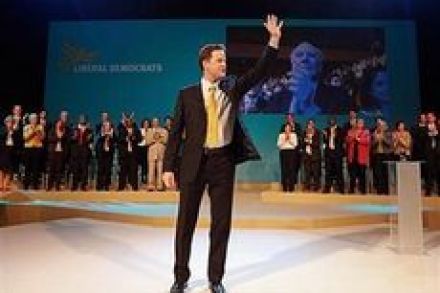
Nick Clegg started the Lib Dem conference with an interview calling for ‘savage cuts’ in public spending and ended it with a speech trying to position the Lib Dems as the main party of the left in Britain. That pretty much sums up the strategic incoherence of this conference which has left the Lib Dems worse off than they were before.   The Lib Dems have had an awful week for several reasons. First, they haven’t done the basics well—putting Clegg up against Obama was hardly clever programming and not informing every spokesperson of policy announcements before the media was told was bound to cause trouble. (How no one thought to tell Julia Goldsworthy of a change that so dramatically impacted on her brief is beyond me).

Nick Clegg at the LibDem conference

From our UK edition

What a week for the LibDems. The conference began, as always, with the sound newspapers being arranged across sleeping faces as the mass snore-in started. A few hopeful souls wondered if the LibDems might finally tell us exactly what their party is for. And LibDems went about their usual business of behaving like some cuddly cult for Terribly Nice People. Then everything changed. Out came their true colours and they started scrapping in the sand-pit like a pack of ruthless cockerels. It began with Nick Clegg’s misuse of the word ‘savage’ in reference to cuts. It got worse when Vince ‘Capability’ Cable announced a muddled new levy on million-pound houses. At a stroke the Mansion-Muncher had jeopardised every Liberal Democrat vote in Greater London.

Government aide resigns over Scotland’s survival

From our UK edition

Sky News reports that Stephen Hesford, who was PPS to the law officers, has resigned over the Baroness Scotland scandal. His resignation letter reads: ‘Whilst I have great personal regard for the Attorney General, I cannot support the decision which allows her to remain in office. In my view the facts of the case do not matter. It is the principle which counts, particularly at a time when the publics' trust of Whitehall is uncertain to say the least.’ This is profoundly embarrassing for the government, who can hardly turn around and sack Scotland now. Baroness Scotland’s position is increasingly untenable. She should resign.

Banging on about Europe will cost the Lib Dems seats

From our UK edition

In his interview with the FT, Nick Clegg says that the Lib Dems have been too “reticent” about making Europe a dividing line with the Tories. There’s little doubt that Clegg, a former MEP is an ideological pro-European. But if he starts banging on about Europe he’ll cause his party problems. The Lib Dems have several seats in the South West, one of the most Euro-sceptic regions of the county. As the European elections results there showed, when Europe is the issue the Lib Dems do badly. If Clegg really does intend to make Europe a key campaign dividing line, then the Tories will fancy their chance of picking up a fair few of these South Western marginals.