Uk politics

Saving the world | 25 November 2009

From our UK edition

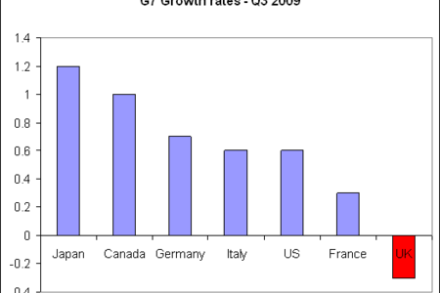
Today’s revised GDP data confirms that the UK remained alone of the world’s major economies in recession in the third quarter of this year*. The fact that the UK remains mired in recession long after most economies have recovered makes clear how uniquely badly positioned the UK economy was to handle a downturn.  While some investment banks continue to argue that this performance reflects the inability of the Office of National Statistics to calculate the data correctly, there is good reason to believe that this huge underperformance is grounded in reality. Economic history teaches that bank crises are amongst the worst things that can ever hit an economy. The collapse in credit availability and soaring bank margins have posed very substantial risks to economic growth.
Cause for concern

From our UK edition

That Ipsos-Mori poll is still making waves, with both Steve Richards and Daniel Finkelstein devoting their columns to the prospects of a hung parliament. Steve is excited by the possibility, thinking that it would restore the Commons to its rightful place as the cockpit of the nation. Danny is concerned by it, fearful of the consitutional damage it could inflict. But it strikes me that the real reason to worry about a hung parliament is the financial markets. How would gilts traders react to a weak government that was incapable of making cuts? One of the few advantages Britain has - as it strugggles to deal with a deficit which is almost three times as large as a proportion of GDP than when we called in the IMF in the 1970s - is that our system tends to create strong governments.

Missing the point | 25 November 2009

From our UK edition

The Today programme really let Paul Myners off the hook this morning. The interviewer obsessed with why the loans had remained secret for so long. It’s a fair question, and it seems bizarre that we only learn of them ten months after the borrowing was repaid in full. However, there are more important questions. As I wrote yesterday, these disclosure’s most potentially volatile revelation is that Gordon Brown was propping up HBOS whilst urging Lloyds to purchase the ailing giant. Was this issue examined in any depth? No, though it must be determined whether the Lloyds’ board understood HBOS’s predicament in its horrific entirety. The equally crucial question of how the government is addressing the banking system’s continued frailties received scant attention.

With friends like these | 25 November 2009

From our UK edition

Bob Ainsworth has publicly criticised President Obama’s slothful deliberation on an Afghan troop surge. The Defence Secretary said: ‘We have suffered a lot of losses. We have had a period of hiatus while McChrystal's plan and his requested uplift has been looked at in the detail to which it has been looked at over a period of some months, and we have had the Afghan elections, which have been far from perfect let us say. All of those things have mitigated against our ability to show progress... put that on the other side of the scales when we are suffering the kind of losses that we are.

There are more pressing financial concerns than this

From our UK edition

The two top dogs at the Treasury Select Committee, John McFall and Michael Fallon, give remarkably different reactions to the news that ministers withheld details of emergency loans to RBS and Lloyds for over a year. McFall argues that secrecy was necessary to avoid a run on the banks; Fallon expresses outrage that Lloyds’ shareholders were not privy to all information when considering the disastrous purchase of HBOS, urged on them by the Prime Minister.   Both have their points. Blind panic is the defining recollection of those autumnal days. If the situation had been exacerbated by full disclosure of the mess RBS and Lloyds were in then God alone knows what pandemonium would have ensued.

Yet another poll for the mix

From our UK edition

After the Ipsos MORI hullabaloo, it's tempting to treat the YouGov/Telegraph poll on Westminster voting intentions in Scotland with extreme caution.  But, for the record, here are the headline figures, and a hefty rise for Labour: Labour --- 39 percent (up 9 points from August) SNP --- 24 percent (down 2) Conservatives --- 18 percent (down 2) Lib Dems --- 12 percent (down 6) As this fits in with another recent poll, it's safe to say that Labour have solidified their support in Scotland during and after the Glasgow North by-election.  And there's more discouraging news for the SNP: at 29 percent, support for Scottish independence is hardly overwhelming – even if it's practically unchanged since the last poll on the issue.

Mandelson downplays Van Rompuy and Ashton – and bigs up the EU’s financial influence

From our UK edition

To my eyes, there's more than a little dose of mischief in Peter Mandelson's article for the FT today.  Discussing the recent EU jobs grab, he seems to suggest that the new economic and financial commissioners may have a more important role to play than either Herman Van Rompuy or Lady Ashton, the EU’s president and high representative, respectively: "Some commentators felt that the EU’s choices for its new president and high representative for foreign affairs lacked this kind of continental ambition. Herman Van Rompuy and Lady Ashton will no doubt aim to prove them wrong. But Europe’s dilemma is not just one of influence projection. Europe’s influence will inevitably be tied to its economic strength.

Osborne’s recycling giveaway is actually an Age of Austerity measure

From our UK edition

I don't want to be a stick-in-the-mud when it comes to an idea which is actually quite promising, but it's worth pointing out that George Osborne's plan to pay people to recycle – featured in quite a few of today's papers – was first mooted by him back in July 2008.   The difference between then and now?  That this particular nudge was worth up to £360 a year for families who took advantage of it – whereas now the figure has come down to £130 a year.  In which case, it's probably better to regard at least this part of Osborne's announcement today as an Age of Austerity-inspired cutback, rather than new policy.  Not that that's a bad thing, of course, given the desperate state of the public finances… P.S.

A debased database

From our UK edition

As with much police work, the questions surrounding a DNA database come down to one thing: striking a balance between civil protection and civil liberties.  Going off a new report by the Human Genetics Commission, reported on the cover of today's Times, the government are getting that balance seriously wrong: "Jonathan Montgomery, commission chairman, said that 'function creep' over the years had transformed a database of offenders into one of suspects. Almost one million innocent people are now on the DNA database... ...Professor Montgomery said there was some evidence that people were arrested to retain the DNA information even though they might not have been arrested in other circumstance.

A poll taken at the same time as the Ipsos-Mori poll had the Tories 14 points ahead

From our UK edition

The Observer’s Ipsos-Mori poll has dominated political discussion since its publication on Sunday. But two things that I have heard tonight have increased my scepticism that it marks a dramatic shift in public opinion. First, I hear that another of the big pollsters had a survey in the field at the same time and it showed a fourteen point Tory lead. Second, a new poll for Political Betting has Labour down on 22, only a point ahead of the Lib Dems. With polls it is the ones that are surprising that make waves; I’m sure we’ll all run down a few more rabbit holes before election day. The odd surprsingly tight poll is not all bad for the Tories. It helps, as one candidate in a marginal seat said to me yesterday, get the activists out and deals with any sense of complacency.

Dodgy expenses referred to the CPS

From our UK edition

And so the expenses scandal rumbles on.  This morning's Telegraph lead with home-flipping allegations against Andrew Dismore, a member of the Commons Committee on Standards and Privileges.  And now it's emerged that the Met have referred the cases of four parliamentarians to the Crown Prosecution Service.  All of which makes Brown's decision not to mention expenses in the Queen's Speech seem even more unwise.

Hold your horses | 23 November 2009

From our UK edition

The blogosphere is alight with all kinds of chatter about yesterday's Ipsos MORI poll for the Observer, which showed Labour closing the gap between them and the Tories to 6 points: from James Macintyre's claim that the Labour fightback has begun to Nick Robinson's call for calm.   Myself, I'm on Team Robinson.  Sure, the poll is an eye-opener for CCHQ - but, by itself, it's hardly evidence of a tidal shift in voting intentions.  Indeed, going off two very useful posts by Anthony Wells and Stephan Shakespeare, there's a considerable chance that this is a rogue. Polls will always be imperfect, but they've been particularly volatile recently.  Since party conference season, we've seen the Tories achieving 17-point leads as well as this low of 6 points.

Bradshaw goes to war against the Sun

From our UK edition

Peter Mandelson has already claimed that the Tories and the Sun have “effectively formed a contract", but today Ben Bradshaw takes the insinuations even further.  Here's the relevant passage from his interview with the Guardian, with my emphasis in bold: "Echoing the views of the business secretary, Lord Mandelson, Bradshaw says of News International and the Tories: 'There is no doubt there's a deal ... The Tories have basically subcontracted their media and broadcasting policy to News International. It's brazen.

Brown goes for growth – fails

From our UK edition

So the dividing line persists.  Today, both Gordon Brown and David Cameron will talk about "going for growth" at the CBI's annual conference.  But it all, more or less, comes down to the same, dreary "investment vs cuts" line that we've heard countless times before.  According to the Times, Brown is going to say that growth is the best way of tackling the deficit, rather than those nasty Tory cuts.  And, what's more, "he hopes investment from China will drive the recovery". Of course, growth will have a role to play in reducing the deficit.  A vibrant economy will have a better chance of tackling record deficits and debt levels than a sinking one.  But to indicate that extensive cuts will not be necessary is disingenuous in the extreme.

What should be in the British Bill of Rights?

From our UK edition

The success or failure of Cameron’s EU policy rests in part on the promised British Bill of Rights. What is clear is that Tories are unclear what should be included in it. One question that is yet to be answered is whether aspects of the constitution should be entrenched? Writing on the Blue Blog today, Michael Howard writes: 'Any decision about these rights requires a balancing of competing rights. The fundamental question is who should be responsible for striking that balance: elected MP’s or unelected judges? On terrorism, Parliament twice, after great debate, reached its view. Yet twice the judges have held that Parliament got it wrong.

A fine line between love and hatred for Peter Mandelson

From our UK edition

So far as Downing Street is concerned, this morning's Sunday Times cover is a presentational nightmare. It reports that Peter Mandelson is calling on Brown to make him Foreign Secretary – a move which would create all kinds of internal difficulties for the PM. Sounds a little bizarre to me: we all know that Mandelson would, in theory, like the role which was once occupied by his grandfather, but would he really want it under such controversial circumstances and for what would likely be only six months? Perhaps not. But, true or no', it still feeds into the idea that the government is divided and self-obsessed. It's also the kind of story which could loosen Mandelson's grip on the government. Over the past year he's enjoyed a remarkable renaissance within the Labour Party.

Where to start cutting

From our UK edition

Michael Portillo believes that a future Tory government, like those that came before it, will not succeed in cutting public spending. I agree with Pete: public finances are so parlous that cuts have to be made. Demolishing the state is not an overnight job; it will take time and cost money, and so it should because the stakes are too high for a quick fix, cowboy politics solution. But, immediate savings are to be made through efficiencies. ‘Efficiency savings’ are derided as being insubstantial. Such an analysis is simplistic. Endemic waste is perpetuated by irrational systems. The Department for Work and Pensions runs an administrative budget of £2.7bn.