Uk politics

The case for John Hutton as a New Labour hero

From our UK edition

Ok, so identifying the heroes of the New Labour era may not sit well with CoffeeHousers - but I'd still recommend you read through the latest Bagehot column in the Economist, which does just that.  It identifies five figures from the past 12 years who have "done the state and country some serious and lasting service," and whose "virtues [are] not be clouded or cancelled by grave mistakes or misdemeanours".  They are: Lord Adonis, Donald Dewar, Lord Mandelson, Sir William Macpherson and Robin Cook.  James Purnell, Alistair Darling and, strikingly, Bill Clinton finish in the runners-up list. You can debate the merits and demerits of those names all day long, but I'd rather suggest another person for the list: John Hutton.

Cutting the deficit sooner won’t risk the recovery

From our UK edition

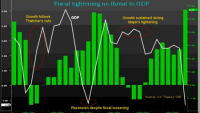
Would cutting spending “risk the recovery?” This claim is, literally, Gordon Brown’s re-election manifesto. He is hoping that the Tories haven’t learned to use numbers as weapons – so any economic message he has will not be effectively countered. In fact, his claim is very easily exposed as being bogus by a simple look at recent British economic history. Bloomberg’s Chart of the Day shows that economic growth in the past two recessions (white line) was not at all threatened by fiscal tightening (green graph). Even Goldman Sachs – which is acquiring a reputation as the Labour Party’s house broker – is conceding the central point.

Festive cheer

From our UK edition

Well, Nick Clegg's reponse to the Labour chief whip's Christmas card made me smile: "Both myself and Nick Brown have good reason to be embarrassed. I posed for pictures in ridiculous fancy dress 20 years ago - and he is an MP for the Labour Party.

And so it rumbles on…

From our UK edition

Expenses, expenses, expenses.  This morning's Telegraph splashes with the news that the junior culture minister Sion Simon paid over £40,000 in taxpayers' cash to his sister.  How so?  Well, he rented a London flat from her between 2004 and 2008, and claimed against it as his "second home".  Problem is, the practice of renting a property from a family member at taxpayers' expense was banned in 2006.  Simon has since said he'll pay back the money that he "inadvertently" claimed. Aside from the fact that it's yet another example of, at best, gross error on a politician's part, two other details stand out.

What happens when quantitative easing stops?

From our UK edition

Where the Gilt market goes in coming months is going to be very important for the UK economy and politics. There is little history of countries being able to sustain deficits of the UK's magnitude, for very long, without serious market problems. At the moment, we're getting by thanks the sticking plaster approach of quantitative easing. The Bank of England has purchased £186bn of gilts so far this year, almost perfectly matching the £179bn the Debt Management Office has needed to sell so far. As long as the Bank is willing to support the market with a fast-rolling printing press, government funding at attractive rates is assured.

Brown’s class war could doom Labour for years

From our UK edition

A lot of pixels have been expended on Labour's new class war and soak-the-rich strategies, so it's worth highlighting the in-a-nutshell argument which Tom Harris deploys against them on his blog: "Rather than using opinion polls as a basis on which to judge the wisdom of class politics, let’s take a rather different measure: general election results. In 1979, 1983, 1987 and 1992, Labour promised tax increases (but only for the wealthy) and got hammered. In 1997, 2001 and 2005, we pledged not to increase the basic or higher rates of tax. And golly! Look what happened!" Ok, correlation and cause aren't necessarily the same thing.

Pre-empting Chilcot

From our UK edition

Sir John Chilcot’s Iraq inquiry has begun honing in on failures of US and British post-conflict planning. As General Sir Frederick Viggers told the inquiry, problems arose from “not having defined the ends, ways and means of how we were going to deliver this phase of the campaign.” None of this is particularly new. As further evidence is provided to the inquiry, it will become even clearer how unprepared the British state – the Government, civil service and military - were for the task at hand, and how soldiers, diplomats and development workers were expected to deliver near-miracles with limited resources, limited backing, limited security and limited public support. I was there and it was not very pretty.

The spectre at the climate change feast

From our UK edition

Today the TaxPayers' Alliance is releasing a new report which sets out the huge and excessive burden that green taxes impose on families and business across the UK. At the moment, 14 percent of domestic bill costs are the result of climate change policies.  Increasing the price of energy hits the poor and elderly hardest - which, in turn, increases poverty and benefit dependency.  At the same time, 21 percent of industrial electricity bills are the result of climate change policies.  If we want to make our economy less dependent on financial services, driving up a major part of many manufacturing firms' costs isn't the way to do it. Despite these costs, the current approach doesn't appear to be achieving the desired cuts in emissions.

A parting shot

From our UK edition

I need a new radio for Christmas. Whilst listening to Dr. Sir Liam Donaldson tell the Today programme that parents should not offer their fifteen year old offspring alcohol, my pocket-radio had an altercation with a wall. The soon to be retiring chief medical officer said: “The more they get a taste for it, the more likely they are to be heavy drinking adults or binge drinkers later in childhood.” This latest soothsaying counts among Sir Liam’s other alcohol-related triumphs; he also gave us the inscrutable phenomenon of “passive drinking” - I don’t know about you but this guy makes me drink actively.

What will today mean for the expenses saga?

From our UK edition

So MPs have until the end of today to declare whether they're appealing against Sir Thomas Legg's request that they repay certain expenses claims.  Three have already done just that, one from each of the main parties: Jeremy Browne, Frank Cook and Bernard Jenkin.  You imagine that more may follow throughout the day, especially given the rumblings that the Legg review contained a fair few errors. Now, it's only fair that MPs have a right of appeal – but you still wonder what it will mean for the expenses saga more generally.  From the public's perspective, a swathe of appeals could look like MPs resisting reform.

Unless they defuse the issue, the Tories will face Ashcroft questions every day until the election

From our UK edition

If PMQs today showed anything, it's just how eager the Tories' opponents are to bring up the issue of Lord Ashcroft.  Vince Cable set the ball rolling by referring to the Tory deputy chairman as a "non dom", and Harriet Harman gleefully followed up by firing questions in William Hague's direction.  She was cut off – and rightly so – by John Bercow.  But the insinuations about the Lord and his tax status had already been made. Now, you could say that this is pretty low stuff from Labour and the Lib Dems.  After all, David Cameron pledged earlier this week to legislate so that all MPs and peers are UK taxpayers.

The Tories need an attack dog

From our UK edition

Iain Martin has a thought-provoking post up about how the Tories lack an attack-dog. Certainly, the Tories lack a shadow Minister for the Today Programme, someone who can be relied to go on when it is a bad morning for the party and deal robustly with a tough interview. This is a position the Tories will need to fill before the campaign gets under way. As Iain says, Chris Grayling was at one point used as the party’s attack dog. But this has come to overly define his political persona and he hasn’t really recovered from his Wire speech and a lacklustre conference, although his recent more thoughtful speeches on crime have been worth reading. I suspect that Sayeeda Warsi might soon be auditioned for this role. Andy Coulson is very impressed by her media skills.

Tax cuts are a better form of stimulus than more spending

From our UK edition

Greg Mankiw is one of the best academic economists out there and having been chairman of the Council of Economic Advisors has a good sense of how to turn theory into policy. His column last weekend in The New York Times is essential reading for anyone wondering about how Britain can avoid a double dip recession. In it, Mankiw summarises the recent academic evidence which shows that cutting business and income taxes is a more effective form of stimulus than increasing spending. The challenge for Osborne in drawing up his first Budget, if the Tories win, will be how to foster a private sector stimulus for the economy. Without that we could easily end up in double-dip recession, something that would doom the Tories.

Inflation nation<br />

From our UK edition

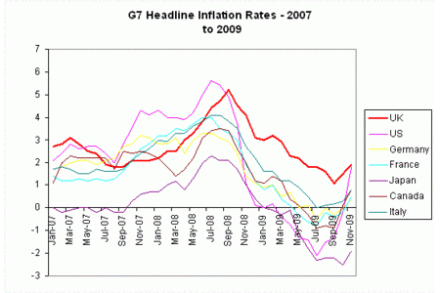
The inflation surge is now upon us. The CPI rate again “surprised” to the upside – Britain is the only major economy in the world to have inflation doing this. But given that the Bank of England’s printing presses have been working overtime to fund a fiscally irresponsible government then little wonder things are different here. To understand just how unusual the UK situation is, consider the below graph: despite suffering the longest recession in G20, we have one of highest rates of inflation in the developed world. The next few months will see this push higher, potentially reaching 4 percent in March and busting the 2 percent target.

The world’s favourite airline

From our UK edition

Unlike Ben Brogan and Iain Martin, I don’t have a vested interest: British Airways weren’t going to be flying me anywhere this Christmas. Having spent days roasting on the aprons of the world, I’ve ceased to entertain the notion that BA is capable of flying me anywhere. I suspect the million or so who face the prospect of the grimmest ever escape to the sun will develop a similar antipathy. Cooked up by Len McCluskey, who cut his teeth with that doyen militancy, Derek Hatton, this strike has tragedy written all over it. As Billy Hayes and the posties proved, the unions rarely realise their unshakeable terms and conditions these days; it’s compromise or, in the language of Scargill, a fight to death.

Should an opposition sell itself as a responsible government?

From our UK edition

One of the Tories’ favoured lines recently has been that they are acting like a responsible government while Labour is behaving like an irresponsible opposition. But I wonder if this attitude is entirely healthy for an opposition, or whether it ends up blunting its campaigning edge. For example, the Tories’ refusal to say for definite that they will repeal Labour’s planned increase in national insurance stems from their view that they aren’t certain where they would find the £8 billion from. But given the number of black holes and blanks in the PBR and that the deficit is over £170 billion this seems slightly absurd.

So what if Zac Goldsmith’s loaded

From our UK edition

Hold your breath, the ‘Zac’s filthy rich’ furore is coming to a front page near you. In addition to scurrilous insinuation about his tax status and the fact that he has spent Walpolean sums on campaigning in Richmond, Paul Waugh breaks the news that the Electoral Commission intends to investigate an allegedly impermissible donation Zac made to the Conservatives. An impermissible donation is of course illegal, but Goldsmith is innocent until the local Tory association’s case that his was an honest mistake made during the interim between moving out of Kensington and Chelsea and registering in Richmond is disproved. Other criticism is simply bunk.