Uk politics

Osborne must ask: why trust the party which ran up the credit card bill in the first place?

From our UK edition

Public sector net borrowing, public sector net debt, total managed expenditure, departmental expenditure limits ... zzzzz.  One of the main reasons why Labour has been able to fashion an economic narrative, against all odds, is because they can rely on some pretty esoteric language.  Thus debt becomes interchangeable with deficit, and cuts can be hidden under layers and layers of different spending metrics.  Perhaps more than anything, this almost-casual deception is Brown's greatest skill. Which is why it's encouraging that the Tories have tried to demystify some of the fiscal debate, putting it into language that everyone can follow.  They've set out their "more for less" argument by referring to the practices of supermarkets.

The most corrupt parliament ever?

From our UK edition

It makes you proud to be British. Where resourcefulness and self-worth are concerned, our political class is unmatched. Former Sports minister and ambassador for the 2018 World Cup bid, Richard Caborn, has been stung by the Sunday Times soliciting influence for £2,500 a day ‘plus expenses, obviously’. Obviously Richard, we would expect nothing less from a man of your eminence. So to for former Defence Minister, Adam Ingram, who takes lobbying so seriously he charges VAT. I wonder how Colonel Gadaffi reacted to the 17.5 percent extra charge when Ingram facilitated the construction of a new Libyan defence academy? Hypocrisy is more ubiquitous at Westminster than Pugin.

Explaining the NotW endorsement

From our UK edition

The News of the World's endorsement of the Conservatives today is worth reading. It has taken some time and much soul-searching for the paper to make this decision. Papers, even under the same proprietor, have different readerships with different outlooks on life. The Sun came out for the Tories on the last day of the Labour conference last September, but its stablemate has taken far longer. It has been firm in its denunciation of Brown's failings but – like many voters – it has looked long and hard at just how a Tory government would correct them. The reason for its endorsement now is laid out in the leading article. It started with the reasons for why it backed New Labour in 1997 – what would it change?

Three Sunday polls have growing Tory leads

From our UK edition

We're operating in or around the margin of error here, so we can't be certain whether this is truly the result of the Budget – but it's still striking that three polls in tomorrow's papers have growing Tory leads.  The ICM poll for the News of the World has the Tories up one to 39 percent, Labour down one to 31, and the Lib Dems on 19.   YouGov's daily tracker has the the Tories unchanged on 37 percent, Labour down one to 32, and the Lib Dems on 19.  And Anthony Wells is reporting a BPIX poll for the Mail on Sunday, which has the Tories on 37 percent, and Labour on 30 percent.  So that's Tory leads of 8 points, 5 points and 7 points, respectively.  Enough to calm a few Tory nerves.

How Brown would get Darling out of the Treasury

From our UK edition

After reading Brown's claims in the Guardian today, this Kill A Minister mechanism in his speech today rather jumped out at me: "I will set out a clear and public annual contract for each new Cabinet Minister, detailing what I expect them and their department to deliver to the British people, and that their continued appointment is dependent on their delivery just as it would be in a business or any other organisation." I mean, you can just imagine what Alistair Darling's first "contract" would look like: You, the Chancellor, will undertake to deliver the following to the British people: i) Economic growth of 5 percent in 2010-11 ii) A sufficient level of investment in our schools, hospitals and families, to be determined by Number 10.

Will anyone take any notice of Labour’s five pledges?

From our UK edition

So the Labour pledge card is back – and, this time, it's a good deal more nebulous than in 1997 or 2001, but quite similar to 2005.*  Here are the themes that Brown & Co. will be campaigning on: i) Secure our recovery ii) Raise family living standards iii) Build a high tech economy iv) Protect frontline services v) Strengthen fairness in communities There's another key difference with previous elections too: one of trust.  Sure, voters have always been reluctant to take politicians' promises and exhortations at face value.  But it's a safe bet that they're even more sceptical and uninterested this time around. *Although, as Alastair Campbell points out, there is more detail on the back of the card – but a bit too much to be immediately memorable.

The Euro is so great – let’s have two of them

From our UK edition

European leaders have now agreed to bail out Greece in a coordinated affair, involving the IMF and bilateral assistance. The Times has written this up as a grab for more centralisation of policy-making by European Council President Herman Van Rompuy, but even the Tories know that’s not true, as judge by William Hague’s calm remarks. Trying to understand the problems of the euro has sent me back to my undergraduate economic textbooks and Robert Mundell’s work on optimum currency areas. As Spectator readers (many of whom are bankers) will know, the US economist theorised that a group of countries will benefit from a common currency like the euro if three conditions are satisfied.   1).

The Tories are paying the price for Osborne’s mercurial political instincts

From our UK edition

I’m at a loss. How can a government that will raise the national debt to £1.4 trillion be trusted to run the economy? The Daily Politics/Com Res poll shows that Labour is more trusted on the economy than the Tories; it indicts George Osborne’s political performance. As Fraser noted, Osborne blew an unprecedented opportunity on yesterday's Today programme. The danger inherent in a £1.4 trillion national debt is not a difficult argument to make. Tax hikes, inflation and soaring interest rates will be the progeny of Brown’s continued borrowing binge. Yet Osborne confined his attack to valid but esoteric points about credit ratings and a list of acronyms. Ken Clarke would not have made such an elementary political mistake.

A week to forget for Andrew Adonis

From our UK edition

The weekend cannot come quick enough for Andrew Adonis. What an awful week. The BA strike wrecked travel; the absurd Stephen Byers dragged him into the lobbying scandal; the RMT voted in favour of Bob Crow’s surreal steam-era fantasy; and today comes the coup de grace: the High Court decides that the third Heathrow runway is ‘untenable’. Transport is beginning to make Northern Ireland look like a soft brief, but Adonis hides his perturbation. He responded to this morning’s news by saying: "I welcome this court ruling. Heathrow is Britain's principal hub airport. It is vital not only to the national economy but also enables millions of citizens to keep in touch with their friends and family and to take a well-deserved holiday.

What did Darling mean by his “deeper and tougher” cuts claim?

From our UK edition

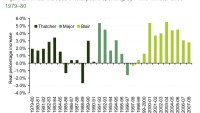
There's been some hubbub on the good ol' blogosphere about Darling's claim that Labour spending cuts would be "deeper and tougher" than Thatcher's.  Did Thatcher actually cut spending?  What would that indicatate about Labour's plans?  And so on. Part of the confusion is caused by the different metrics that are referred to as "spending".  So here's a quick guide to what Darling might have had in mind: OPTION 1: Real-terms total spending.  As the below graph from the IFS shows (taken from this excellent blogpost by the FT's Alex Barker), real-terms total public spending only fell in two years of the Thatcher premiership.  In all the other years it rose.  Indeed, spending increased by an average of 1.

Labour’s spending cuts exposed

From our UK edition

Darling has now exposed as false the Brown/Balls dividing line of "investment vs cuts". If Labour were to win, he said, the cuts would be worse than anything seen under Thatcher in the 1980s. This is Darling's problem: he's a dreadful liar. The IFS today laid out the scale of the cuts that would happen whoever wins the election, and the below graph is worth reprinting. Overall spending falls 12 percent (once dole and debt interest are taken into account). So when Darling says this is worse than anything in the 1980s, he is simply stating a fact. You'd never catch Balls or Brown doing that, by the way, and I hope that, when either pop up for interview, they will be asked if they agree with their Chancellor's assessment.

The two sides of Alistair Darling

From our UK edition

After delivering an insipid, insufficient Budget yesterday, Alistair Darling has now smuggled a little bit of honesty into the fiscal debate.  In interview with Nick Robinson, he has claimed that if Labour is re-elected its spending cuts "will be deeper and tougher" than Thatcher's.  Needless to say, that's a message which will not sit well with his Cabinet colleagues like Ed "investment vs cuts" Balls. And this is precisely why Darling is such a confusing figure.  Yes, he deserves some praise for being more upfront about the public finances than his predecessor ever could be, and for restricting the wilder excesses of Brown and Balls.  But it's hard to forget that he, as Chancellor, hasn't delivered a spending review when we need one most.

Labour’s plans require non-ringfenced Budgets to be cut by 25 percent in the next parliament

From our UK edition

At lunchtime, the press headed off to hear the referee's verdict on the Budget. The Institute for Fiscal Studies is now so respected that its view of the Budget largely determines the news agenda. Its briefings are now so popular that they can no longer be held in their basement. So, journalists, economists and accountants piled into a room at the University of London Union which is normally used for battle of the bands contests rather than Budget analysis. The most striking number the IFS presented was that if Labour ringfences the already protected areas of spending for the whole parliament, other departmental budgets will have to be cut by more than 25 percent. One dreads to think what the consequences of slicing a quarter off the defence Budget would be.

How to foil a Dispatches sting

From our UK edition

The producer and director behind the Dispatches lobbying sting, Philip Clothier, has a snappy article over at Prospect, in which he basically asks the question: how could MPs have been so stupid?  But it's his suggestion that some former ministers may have got off lightly which really caught my eye: "Meanwhile, one former Labour cabinet minister was interviewed, but the sound was so poor that we could only hear appetising phrases. He had the good fortune to be sitting in front of a brightly lit window, over-exposing the shot. And we just couldn't understand much of what another former minister said because of his thick accent." Cue all MPs adopting impenetrable accents, and sitting in front of windows, from now on.

Proscribing legalised drugs

From our UK edition

‘My wife says these drugs turned me into a zombie, but the truth is I wouldn’t know, as I have hardly any memory of the past 40 odd years.’ The Mail printed Keith Andrew’s testimony, a 74-year-old retired electrician who has guzzled prescribed benzodiazepines for nearly half a century. Andrew is one an estimated 1.5 million British people who have been addicted to valium and other tranquilisers. Whether addiction is voluntary or not is irrelevant. Anti-anxiety treatment remains a laxly regulated area of medicine: more than 8 million prescriptions are made each year and there are an estimated 100,000 illicit addicts currently using. In a fascinating piece in the Telegraph, Andrew M Brown outlines the side-effects of long-term ‘Benzos’.

A glass of clear, blue water?

From our UK edition

One of the most eye-catching stories this morning comes courtesy of ConservativeHome: "As part of the pre-election package, ConservativeHome expects Mr Osborne to announce that a Tory government will cancel Labour's National Insurance tax rise. The Tories will announce an alternative way of plugging the hole. Earlier this week Policy Exchange argued that the NI rise was a very damaging way of raising extra revenue." Sure, Cameron has hinted at this before, and there will be questions about how the Tories would fill the fiscal gap.  But that doesn't make this anything less of a smart move.  Not only does it makes sense economically, but it would give the Tories a clear, positive message to deploy on the doorstep.  I'd be astonished if Team Osborne didn't move on it.

Osborne’s weak response

From our UK edition

I was all set up to Fisk the post-Budget analysis which Darling normally gives to the Today programme after the Budget - but he wasn’t there. The Treasury refused to have him debate with Osborne which is what Today (unusually) seems to have assumed. Well, we’d best get used to hearing Osborne post-Budget day. At first, I thought it was a coup for the Tories - but as Evan Davis sharpened his claws, it soon appeared to have been a net negative. Osborne just didn’t sound confident. A series of exchanges left him looking unprepared. His line - that he will eliminate ‘the bulk’ of the annual overspend over the lifetime of the parliament - was challenged: what does it mean?

Darling and Brown get away with it

From our UK edition

Strange days, indeed.  While most of the frontpages today are unflattering for Labour – particularly, and unsurprisingly, those of the Telegraph and the Sun – I imagine that Brown & Co. will be quite pleased with the general tone of the Budget coverage.  Much of it mirrors the Independent's view that Darling "played a weak hand well".  Or, elsewhere, there's a kind of detached indifference about what is described as a "boring" Budget. Yes, if you like, you can take that as proof that the Darling-and-Mandelson approach to the public finances is less politically toxic, and a good degree more sensible, than the Balls-and-Brown approach.