Uk politics

The Lib Dems celebrate their achievements

From our UK edition

Sandals are being rattled in Birmingham this morning. The Liberal Democrat conference opens to a chorus celebrating the party’s achievements in government. Nick Clegg tells the Independent that “Liberal Democrat fingerprints” are all over flagship coalition policies on schools, welfare, pensions, banking reform and the NHS reforms. He says of the latter that the Liberal Democrats have tempered the Conservatives. Clegg will reiterate this point at a rally later this afternoon. Despite news that the Liberals seek an electoral accommodation with the Conservatives, senior party figures are at pains to accentuate their differences with the Tories.
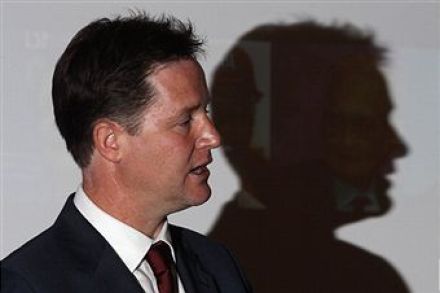
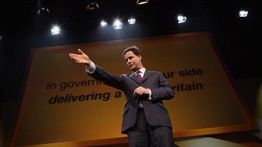
Clegg kicks off the conference

From our UK edition

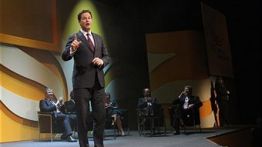
If you can judge a party’s mood by the number of bad jokes it tells, then the Liberal Democrats are in better form than last year. Their rally to open conference was characterised by a string of appalling gags. George Osborne was a particular target with both Don Foster and Sarah Teather trying to raise a laugh at his expense. However, several of Teather’s jokes, which moved into real bad taste territory, fell totally flat. The main speech of the rally, though, was Nick Clegg’s. Clegg, who was welcomed with a standing ovation, made his pitch that the party was governing from the centre, for the whole country.

Clegg’s humdinger of a rally

From our UK edition

That was a great wee speech by Nick Clegg. “We have only five ministers in the Cabinet,” he said. “Well, six if you include Ken Clarke.” His mission was quite tough: to go meet the membership of a party that had just lost half of its popular support, was spanked in an AV referendum, seen its troops massacred in English councils and seen its support in Scotland shrink to staff members and blood relatives – all simply because Clegg joined the Tories in government. But he made the case brilliantly. The BBC estimates that the Lib Dems have implemented three quarters of their manifesto he said, more than the Tories. “Not bad for a party with just 8 per cent of the seats.” He handled criticisms of him rather well.

Hughes implies that the 50p rate could be dropped

From our UK edition

The 50p rate is dominating the media backdrop to the Lib Dem conference. Simon Hughes has made the latest intervention, telling Sky News that the wealthy could and should be taxed in other ways if the 50p rate was “not very tax efficient”. He emphasised the importance of fairness by adding that you “don’t start (tax cuts) by taking the tax away from those who have the broadest shoulders.” Hughes’ position mirrors that of Clegg, as detailed in an interview with the Independent. This episode is a further indication that the economic arguments against the 50p rate are beginning to hold sway.

Making the NHS a battle ground

From our UK edition

Lord Rennard, the Lib Dems’ former chief executive and campaign supremo, is a frequent attendee at Westminster events. He usually makes just one point: the party’s polling may be poor, but the situation can be saved. Rennard points out that the party was delivered from disaster in 1997, thanks to targeted campaigning and a successful scheme to differentiate the party from Labour and the Tories. That campaign should be the model for the next one, which Rennard believes has already begun. He has elaborated on these ideas in the Guardian. He writes: ‘I always told candidates to think as much about the psychology of Maslow's "hierarchy of needs" as any market research.

Compassionate conservatism the key to gay marriage pledge

From our UK edition

When David Cameron spoke to the Carlton Club political dinner on Thursday night, he stressed that the Conservatives must not subcontract out compassion to their coalition partners. The Prime Minister’s desire to hold this ground can be seen at the speed with which Downing Street has briefed out that it was Cameron’s personal commitment that was key to the coalition’s decision to consult on how to introduce gay marriage. The message is clear, this isn’t just a bauble for the Lib Dems for the opening day of their conference. Personally, I think that the move on gay marriage is a welcome one.

Clegg biography claims the Lib Dems want a new coalition agreement

From our UK edition

Lib Dem conference this year brings with it the serialisation of Jasper Gerard’s biography of Nick Clegg. The focus will be on the claims that deputy Prime Minister has promised his wife he’ll only serve one term and that senior Lib Dems are interested in a soft electoral pact with the Tories. But, to my mind, the most interesting point is that the Lib Dems are keen on a new coalition agreement to cover the second half of the parliament. Coalition insiders have always admitted that the legislation mentioned in the agreement should have been mostly passed by 2012. But the Tories have been keen to spend the second half of the parliament concentrating on delivering on what’s already on the statue book rather than dealing with a whole new set of bills.

From the archives: The doomed euro

From our UK edition

It was doomed from the start; that’s the prognosis of those who think that the single currency’s crisis is near terminal, such are its structural and political weaknesses. People warned that it could be thus when the Euro was first launched. Bruce Anderson was among them:  Had Mr Blair been braver, he could have been in on this week's euro euphoria, Bruce Anderson, The Spectator, 9 January 1999 The combined political will of 11 nations - or at least of their political elites - assured an easy birth for the euro. But the euphoria should not deceive us.

Osborne: I know what it’s like to be in business

From our UK edition

George Osborne spoke to Telegraph’s Festival of Business this morning and he gave a speech that was dominated by the issue of growth, or rather its absence. He reiterated the tax cuts and entrepreneurial relief measures first unveiled in March’s Budget. Osborne didn’t limit himself to his list of accomplishments. It was an empathetic speech. He related his memories of the “ups and downs” of his father’s business, the drapers Osborne&Little. He acknowledged the pressures of running your own enterprise in conjunction with a busy family life; a constant struggle that is exacerbated during hard times. “I know the kinds of pressure you are under,” he said.

The Israel Palestine question

From our UK edition

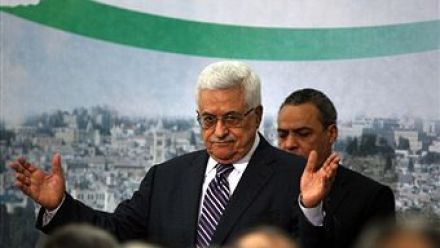
After a hiatus, the Middle East Peace Process is about to return to the international stage. The Palestinians are pushing at the UN for recognition. Nobody knows yet what they will actually ask for: full statehood or just upgrading their UN status to "non-member". But, whatever the language of the resolution, the issue will be contentious. By some estimates, 126 states are poised to back the Palestinian request, including France, India, Brazil, Spain. The US will not support a Palestinian move, nor is Germany likely to. Britain remains undecided, hoping to help the Palestinians draft a resolution that other Europeans can sign up to. It’s not clear what Britain and European governments should do.

“It started in Germany…”

From our UK edition

Bugger the Bundesbank — that seems to be ECB President Jean-Claude Trichet’s current raison d’être. The ECB, together with other global central banks, yesterday agreed to provide dollar funding to ease the mounting liquidity crisis in European banks, largely caused by American banks curtailing interbank lending in anticipation of another crisis. This unorthodox action runs contrary to the wishes of the German Bundesbank, adding to the pre-existing strain between the ECB and the German establishment over bond purchasing, tension that was epitomised by the resignation of Jurgen Stark last weekend. Obviously, central banks do not take this action every day and it is yet another indication that crisis is now impending.

Cameron’s Libyan gamble

From our UK edition

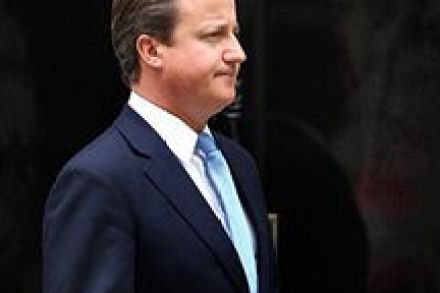
It is conventional wisdom that David Cameron won't get much of an electoral bounce from the Libya intervention, despite emerging as a bold and competent interventionist. People, the argument goes, are tired of warfare. A senior figure in Tony Blair’s No 10 told me yesterday that he did not think the PM would earn a lot of kudos, because with all the problems at home there is less tolerance for overseas adventurism. But this narrative overlooks a number of key points. First, the success of the operation has dealt with the charge that the government is less competent than it pretended to be. This was a serious charge, as the Prime Minister (and by extension the Conservative party) cannot withstand being called incompetent.

Time to recognise that the hospital is dead

From our UK edition

For many years, it has been Government policy to move healthcare out of hospitals and into community units and homes, and concentrate specialist surgeries in centres of clinical excellence. This is politically contentious: former Secretary of State for Health Patricia Hewitt was closing local maternity units, but she had to deal with the humiliation of Ivan Lewis, a minister in her department, fighting her changes in his own constituency. But the time has finally come to break our national addiction to hospitals. In a report published today by Reform, Professor Paul Corrigan, who was a health special advisor to Tony Blair, argues that “the old model and concept of the hospital are failing”, leading to poor standards of care in far too many bankrupt institutions.

What the riots mean for Ken Clarke

From our UK edition

The more we learn about the riots, the more it is becoming clear that experienced criminals were responsible for a lot of the looting. The Standard reports today that in London a quarter of those charged in relation to the riots had already been convicted of ten or more offences. What remains to be seen is if these hardened criminals instigated the riots, or simply took advantage of them. The involvement of these veterans of crime demonstrates the need both for better work on rehabilitating prisoners and for longer sentences to keep habitual criminals off the streets. The problem with Ken Clarke is that he, admittedly partly for budget reasons, only wants to see one side of this equation. The riots have been overshadowed by the brewing financial crisis.

Britain sues the ECB

From our UK edition

As the EU debt drama continues unspooling like a perversely watchable soap opera (the FT’s Neil Hume describes it as ‘eurozone crisis porn'), an intriguing sub-plot has emerged: Britain is suing the European Central Bank. The Treasury is unhappy with an ECB move to limit the kind of euro-denominated products that can pass through UK clearing houses, suspecting it’s a bid to shift financial activity from London to Paris/Berlin. So it’s taking legal action, the first of its kind by an EU member state. This is not the first UK-EU disagreement that has surfaced in recent months, underlining the tensions between Britain and the Continent as financial centres across Europe fight over a (shrinking) business pie.

Downing Street’s boundary review problem

From our UK edition

I understand that Number 10 will lean on Cabinet ministers not to object to what the boundary review does to their seats. This is an intriguing development because at least three Tory Secretaries of State are deeply unhappy with the proposed changes to their constituencies. It’ll be fascinating to see whether Downing Street can persuade them to hold their peace on the matter. Their disquiet reflects broader grumbling throughout the Tory parliamentary party. All sorts of conspiracy theories are doing the rounds. Number 10 needs to move quickly to offer some reassurance to nervous MPs. If the boundary review’s plan is to be made agreeable to the Tory parliamentary party, Cameron is going to have to persuade an awful lot of MPs to retire.

Wooing women the Tory way

From our UK edition

Back in June, Melanie McDonagh wrote that "the Tories are desperate to regain the female vote". Today's Guardian scoop, a government memo on the need to better appeal to women, proves she's right. In places, the document reads as if it were written by a group of men to whom women are very much from Venus. They are careful to spell out the revelation that "of course women's views differ as much as men's", and their response to discovering their weakness was apparently to find whoever they could in Number 10 without testicles and ask what they were doing wrong. However, it does at least show that the government recognises that it's losing ground with women at the moment, and that it'll take more than footage of Cameron taking his kids to school to recover.