Uk politics

Lansley’s trials

From our UK edition

Andrew Lansley will arrive in Manchester having been chased up the M6 by a flurry of negative stories about his NHS reforms. The Guardian has gone to town on the news that the Lords Health Committee has expressed concern about Lansley’s plan. Their reservations stem from Shirley Williams’ concerns about the diminished role of the secretary of state; she worries that this will dilute accountability over the health service, which she views as unacceptable given the vast sums of money the secretary of state controls. The Lords will debate these matters later this month and amendments are expected to be tabled. Elsewhere, the British Medical Association has also fired another salvo at Lansley, calling for the Bill to be scrapped.
A reform the Tories should shout about

From our UK edition

As of today, you can’t fire someone just for turning 65. The government has delivered its promise to scrap the Default Retirement Age (DRA), introduced by Labour in 2006 as a caveat to otherwise laudable equality legislation. This ends the practice of forced retirement regardless of someone’s ability to work. Killing it is one of the best things the coalition has done and the Tories should be making more of as they gather in Manchester. Of course, there will be some transition difficulties from scrapping (DRA), but they’re likely to be minor. Claims that older workers sticking around in their jobs will squeeze out the young are too simplistic – our jobs market isn’t ‘one in, one out’.

Osborne mulling child benefit u-turn

From our UK edition

Eric Pickles makes no bones that his bin policy is aimed at Middle Britain, and the Tories may soon announce more measures to butter up that vital electoral constituency. The Times reports (£) that Cameron and Osborne are seriously considering a u-turn on their controversial cut to child benefits over families in which parent earns more than £42,475, which is due to be introduced in January 2013. George Osborne apparently never does anything unless it yields a political dividend and this is an intriguing development, if it materialises. It reiterates that the Tories know they have a woman problem; identified by Melanie McDonagh in a magazine cover piece earlier this summer.

Ed Miliband, closet Glee fan?

From our UK edition

  What to make of Ed Miliband’s disclosure yesterday that Journey’s Don’t Stop Believin’ is his favourite song? Ben Brogan smells a rat: “If he's a Journey fan, then I'm a football expert”. But here’s the thing: you don’t have to be a Journey fan to like Don’t Stop Believin’. You just need to be a fan of Glee. For the uninitiated, Glee is an American musical TV series about (impossibly glamorous) nerds in an Ohio high school, who join an after-school music club and are intensely bullied by the cool, sporty kids in the school. But they stick to what they believe in, overcoming the bullies. Don’t Stop Believin’ (here) is the anthem of the series: the first and arguably best Glee cover song.

Tories pray for no more from Europe

From our UK edition

Tory strategists had hoped to keep Europe off the agenda at this year's party conference, but they seem to have failed already. The European Commission's threat about welfare claims has forced IDS into action. Ben Brogan reports that the work and pensions secretary was nothing short of visceral in his contempt for the "land grab", which will apparently cost £2.5 billion a year. But, IDS's rage is quiet compared to John Redwood's, who asks "Why won't he [William Hague] get on with renegotiating the UK position [in Europe]?" Next is the EU's Agency Workers Directive, which comes into force tomorrow.

Eric’ll fix it

From our UK edition

The papers report that Eric Pickles has beaten Caroline Spelman: bins will be collected on a weekly basis. Back in June, James reported how the DCLG and DEFRA were opposed to Pickles’ plan and that Spelman, who once advocated weekly collections in Opposition, had gone Whitehall native. It was a test, James said, of the government’s ability to master its civil servants. Pickles was very closely associated with the pledge and the impasse threatened to damage his burgeoning reputation in office. Now he is gloating in his hour of victory. “I may make passing reference to the scheme in my speech,” he told the Today programme in that garrulous manner of his.

An EU ruling that Cameron must fight

From our UK edition

A showdown with the EU may come sooner than we expect. The European Commission has today threatened to sue David Cameron’s government unless it starts letting EU citizens come here to claim benefits. Until now, any EU citizen could live here, but if they couldn’t find work, they were not entitled to claim benefits. This was widely accepted. Today, the EU has issued a statement saying: ‘Under UK law, certain social security benefits - namely Child Benefit, Child Tax Credit, State Pension Credit, Income-based Allowance for Jobseekers, Income-based Employment and Support Allowance - are only granted to persons with a "right to reside" in the UK. Other EU nationals have to fulfil additional conditions in order to pass a so-called 'right to reside' test.

Gearing up for the Tories

From our UK edition

Westminster is preparing for the Tory conference and Ben Brogan reports that a confident mood pervades the blue camp. The positive briefings have begun. The Guardian reveals that the speed limit on motorways is to be raised from 70 MPH to 80 MPH. This is a victory for Transport Secretary Philip Hammond over recalcitrant forces in Whitehall and the Health and Climate Change Secretaries. The Guardian adds that several welfare announcements will be made. It’s also likely that there’ll be further initiatives relating to the riots, perhaps inspired by Labour’s concerted assault on law and order. Meanwhile, the Eurozone crisis continues. Angela Merkel passed the controversial expansion of the EFSF this morning.

Miliband’s revealing Scottish gaffe

From our UK edition

Ed Miliband can’t name the candidates for leader of the Scottish Labour Party. Miliband’s discomfort during his excruciating BBC interview is fairly amusing. But, as James Kirkup notes, the Scottish Labour Party is a serious issue. It is the only check on Alex Salmond, which makes it essential to the future of the union. And it’s important for Labour’s electoral recovery, not that you’d realise that listening to the senior party. As I revealed on Sunday, Labour shadow minister Ivan Lewis displayed extraordinary complacency about Scotland at a fringe event, implying that Labour will return to power in Holyrood as a matter of course, no effort required. Miliband’s ignorance only compounds that sense.

Miliband meets the public, and a lot of Labour members

From our UK edition

Ed Miliband has just finished an hour and twenty minute long question and answer session. The audience was meant to be a mix of the general public and Labour members, but there seemed to be far more Labour members than anybody else. It would be easy to take the Michael out of the whole event. The questioner who walked out as the Labour leader was trying to answer his question, Miliband’s tendency to stare into the bleachers with his hand above his eyes and the technical glitches. One could also, rightly, say that the vast majority of questions were classic lefty fare. But there was the glimmer of something important here. There were flashes of the humour that comes across in private but not in public. In short, Miliband seemed far more himself than he did yesterday.

Getting over the expenses scandal

From our UK edition

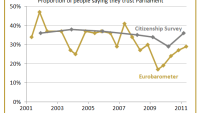
Parliament's reputation seems to have recovered from its nadir during the expenses scandal. According to the government's "citizenship survey", the proportion of people trusting parliament fell from 34 per cent in 2008-09 to 29 per cent in 2009-10, while the European Commission's "Eurobarometer" showed an even bigger drop: from 30 per cent in November 2008 to 17 per cent in July 2009. According to the most recent surveys, however, trust in parliament is back up to pre-scandal levels: Of course, two-thirds of people still do not trust Parliament - far from a ringing endorsement.

Hague: The euro is a burning building with no exit

From our UK edition

James Forsyth has interviewed the foreign secretary, William Hague, in tomorrow’s issue of the Spectator. Here is an extended version of the piece that will appear in the magazine. Politicians normally have to wait for the history books for vindication. But for William Hague it has come early. All his warnings about the dangers of the euro, so glibly mocked at the time, have come to pass. But, as he makes clear when I meet him in his study in the Foreign Office days before the start of Tory conference, he is not enjoying this moment. Rather, he is absorbed with trying to sort out the mess that others have created.

What Fleet Street made of Miliband’s speech

From our UK edition

Ed Miliband has been across the airwaves this morning, explaining that the values outlined in his speech yesterday will inform Labour’s policy direction over the next four years – a statement that calls to mind a crude saying regarding Sherlock Holmes. He is doing this because most commentators agree that his speech was incoherent. Here is a selection of the reaction in this morning: The Times’ leading column (£): ‘Generally he did better with his attacks than with phrases that sought to describe his vision. His larger problem — that people have difficulty seeing him as prime minister — is unlikely to have been affected much by this performance.

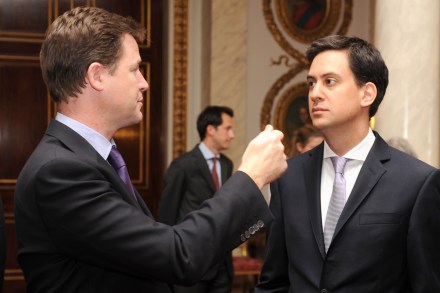
Miliband v Clegg: now it’s personal

From our UK edition

It's safe to say that Ed Miliband and Nick Clegg don't get on. Even before he was elected leader, Miliband told the New Statesman he would never work with the Lib Dem leader: "Given what he is supporting, I think it is pretty hard to go into coalition with him." He refused to share a platform with Clegg in the AV campaign, and then attacked him in Newcastle with a list of promises he accused the Lib Dems of breaking. All along, the plan has been to turn those who voted Lib Dem in 2010 against Clegg and lure them over to Labour. Whether it's working is hard to tell. In the latest Ipsos MORI poll, 52 per cent of 2010 Lib Dem voters said they were "dissatisfied" with Nick Clegg, but then only 23 per cent are "satisfied" with Ed Miliband.

How’s Miliband doing?

From our UK edition

In a word: badly. Ed Miliband has now led Labour for a full year, but has made no progress with regards to its standings in the polls. When he took over, the Labour party was at 37 per cent in the polls, according to Ipsos MORI. Considering that 60 per cent give the Coalition government the thumbs down, he's had ample opportunity to improve this figure. And yet he's failed. In their latest poll, MORI again have Labour on 37 per cent.   When it comes to his own personal ratings, the picture is even worse. As Miliband has become more well-known and more people have formed an opinion of him, the number "satisfied" with his performance has actually decreased. This month, it hit its lowest point to date at 31 per cent.

The danger to a free press

From our UK edition

“In Britain, a free press is non-negotiable,” Ivan Lewis has just said – before suggesting ways that Government might, ahem, oversee this freedom. The shadow culture secretary has an idea: a register system to license journalists. “As in other professions, the industry should consider whether people guilty of gross malpractice should be struck off,” he said. He wants “a new system of independent regulation including proper like-for-like redress, which means mistakes and falsehoods on the front page receive apologies and retraction on the front page”. It’s an odd type of independence: one that would be prescribed by the political elite. And what type of journalists might it target?

Ed’s “something for something” society

From our UK edition

Fraser’s already commented on the welfare angle of Ed Miliband’s keynote speech to the Labour party; the welfare proposals are part of a broad analytical sweep that can be reduced to the catchphrase, ‘the something for something society’. Miliband’s vision of society will reward those who work and abide by the rules at the expense of those who do not – those who loot, who fiddle expenses, those who pursue short-termism in business. According to the Guardian, he will also emphasise the importance of social mobility and equality. To that end, he will encourage universities to take more people from disadvantaged backgrounds.