Uk politics

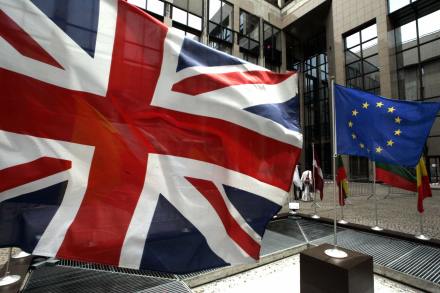
The euro sparks a Cabinet row

From our UK edition

Word reaches me of a vigorous exchange of views in Cabinet this week between Chris Huhne and Michael Gove over the European question. Huhne, who has form when it comes to Cabinet scraps, launched into a polemic against Tory Eurosceptics and insisted that the coalition not be "wagged by the Eurospecptic tail". It has, obviously, escaped Huhne’s notice that there are more Tory Euro-rebels than there are Lib Dem MPs. There then followed an even more incredible moment where Huhne implied that if he had been in power, the single currency would have worked and so it was unfair to suggest that he had been proved wrong.
The euro is destroying Europe

From our UK edition

This week's issue of The Spectator hits the newsstands today. Here, for CoffeeHousers, is James Forsyth's Politics column from it: Last week’s rebellion by David Cameron’s backbenchers in support of an EU referendum ended eight years of peace in the Tory party on the European question. Now, the offer by the Greek Prime Minister of a referendum on the bailout package — designed to appease nervous Greek Socialist party backbenchers — means that the uncertainty surrounding the eurozone will drag on into the New Year. George Osborne regards the confusion surrounding the future of the single currency as the single biggest obstacle to a British economic recovery.

Right to reply: Aid is one of the government’s greatest endeavours

From our UK edition

Peter Kellner recently explained that the BBC licence fee becomes less popular if you describe it as an annual cost rather than as a daily cost. When people are told it costs £145.50 a year 27 per cent more people disapprove than approve. When they are told that’s only the equivalent of 40p a day there's a striking turnaround: 8 per cent more people approve than disapprove. You see a similar thing with Britain’s development budget. When the aid budget is expressed in terms of billions of pounds, people object and they object strongly. When it’s presented in more human-sized ways it is much more popular.

PMQs or St Paul’s protest?

From our UK edition

The Hair Shirt walked abroad at PMQs today. Those attending the Square Mile sleepover finally forced their agenda into the political mainstream. The question is, what is their agenda? A protest that doesn’t define its programme allows others to define it for them. And today both party leaders tried to harness the anti-capitalist spirit for their own political ends. Ed Miliband claimed to be scandalised by a recent, and arguable, surge of 49 per cent in directors’ pay. He demanded that the PM take action. Cameron seemed equally appalled at the news that fat cats have been getting fatter during the recession. But he wasn’t taking any sermons from Labour.

Union bosses: Thanks for the concessions, but the strike’s still on

From our UK edition

The TUC have just released a statement responding to the tweaked public sector pensions package that I blogged about earlier. It is, in part, fairly conciliatory; saying that the group welcomes "this movement in the government’s position". But it does end with a warning: "unless and until further real progress is made and acceptable offers are made within those negotiations, unions remain firmly committed to continuing their preparations for the planned day of action on November 30.

Cameron versus Balls

From our UK edition

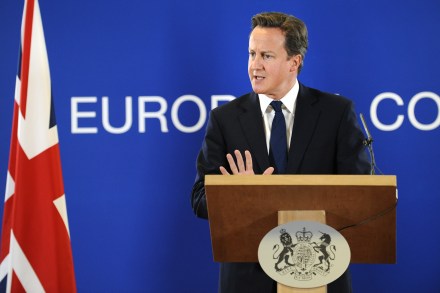
The real clash at PMQs today was between Ed Balls’ heckling and David Cameron’s temper. Balls was in a particularly chirpy mood. He started off his impression of an Australian slip fielder as soon as the Prime Minister arrived at the despatch box. The flat lining gesture made an early appearance, along with his signals telling Cameron to calm down.   But the moment when Balls seemed to really get under Cameron’s skin was when he pointed at the overwhelmingly male Treasury bench as Cameron talked about the importance of getting more women on boards. Two questions later, Cameron responded to a Balls’ heckle by saying that ‘the shadow Chancellor is wrong, even when he’s sitting down.

The Greek land mines that Cameron must avoid

From our UK edition

When the topic of Greece comes up at PMQs, David Cameron will need to avoid stepping on three land mines. The first task is not to say anything about what is going on in Athens, or Rome for that matter, that will exacerbate market anxieties. The second is a diplomatic challenge, to avoid anything that would sour Britain’s pitch ahead of the G20. The third, and perhaps most difficult one, is to keep his own backbenchers on side.   An ever growing number of Tories doubt that a 17 member Euro and fiscal union is in Britain’s, or Europe’s, interests. Already, some Tory backbenchers are talking about going to Greece, if invited, to campaign for a No vote. Cameron will need to avoid antagonising this group.

Right to reply: The aid debate we need to have

From our UK edition

As Fraser pointed out yesterday, the Spectator's debate on international aid is tonight (all CoffeeHousers welcome, tickets available here). To further set the stage for that debate, here's a response to Fraser's original post from the folk at Christian Aid: I'm glad that, in his post yesterday, the Spectator editor said he is in favour of aid, and that some of it is best done by governments. And, like him, I'm also in favour of aid spending being at least protected from cuts. On these two points we agree. That’s about the extent of our common ground. The British government made a commitment to devote 0.7 per cent of economic output to foreign aid at the UN way back in 1970 — and then quietly forgot about it.

The pensions battle rages on

From our UK edition

An "enhanced offer" is how Treasury types are describing the revised pensions package that will be put before union bosses today — and so it is. As far as we can tell, concessions have been made in three areas: i) the changes to public sector pensions will be spread across seven years, rather than five; ii) the accrual rate, which determines how much of a workers' salary is notionally set aside for their pension each year, will be made more generous; and iii) the "cost ceiling," which sets a cap on long-term taxpayer contributions, will be raised for various schemes. There could be more on offer, too. But all that, sadly, is unlikely to cool the quickening flames of industrial action.

Exclusive: The BBC to apologise for wronging Tyrie

From our UK edition

Here's one for newswatchers: a lesser spotted on-air apology from the BBC. During the Conservative Party conference, you may remember, they purported to show footage of Steve Hilton taking Andrew Tyrie into a corner to persuade him of the government's line. But they are about to publicly admit, during the 5pm bulletin on the BBC News Channel, that they misrepresented what actually happened — and they're sorry about it. Peter Oborne detailed the misrepresentation in his column last week; drawing attention to the clarifying blog post that the BBC's James Landale graciously wrote on the matter, two weeks ago.

The post-riots landscape

From our UK edition

Back in August, the riots were being talked about as an event that would redefine our politics. But the economic news has been so relentless that the post-riots issues have received minimal coverage. This, though, doesn’t make them any less important. This week, we’re seeing two strands of the government’s response. First, Louise Casey starts work at the DCLG on dealing with the 100,000 problem families that the government has identified. Second, the May and IDS report on gangs comes out. So far what’s been trailed from the report is the proposal to create a new offence of intent to supply fire-arms.

International aid in the dock

From our UK edition

The pledge to almost double Britain's international aid budget was made in the boom years, when the government actually had money. In the bust, there is something deeply strange — almost perverse — about borrowing money from China and giving it to India. It's time to reassess Britain's aid commitment, and The Spectator is having a debate about it tomorrow night. I hope CoffeeHousers will be able to come because it is, I think, a crucial issue. Alan Duncan is the man to thanks — or blame, depending on your point of view — for the Tories committing to spend 0.7 per cent of economic output on foreign aid.

Growth hits 0.5% in Q3 — a nation shrugs

From our UK edition

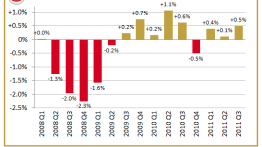
The growth number for the third quarter of this year is out, and it's a little bit better than expected: 0.5 per cent. Many economists were saying that we'd have to hit around 0.4 per cent to recoup the growth lost to the Royal Wedding and Japanese Tsunami in Q2, so we've managed that. But, that aside, this is not the time for party poppers and champagne corks. It may not be Econopocalypse, but it's not Mega Growth either. We are still living in a bleak, borderline stagflationary environment. Besides, I still reckon that we oughtn't get especially worked up about these quarterly figures anyway. For starters, the obsession over micro-percentage points can obscure the fact that many parts of the country are already in effective recession — and have been for decades.

Breaking: Ed Balls has a point

From our UK edition

The games have started a day early, folks. The latest quarterly growth figures are set to be released tomorrow morning, but already Ed Balls is waxing insistent about what they have to be: "Simply to stay on track for the Office for Budget Responsibility’s most recent forecast, already downgraded three times, we will need to see growth in the third quarter of 1.3 per cent. And to reach the OECD’s latest and more pessimistic forecast, we will need to see a figure next week of 0.9 per cent." To be fair — and this is not something you'll read often on Coffee House — the Shadow Chancellor has a point, although he's not making it explicitly. When he says that growth needs to hit 1.

Clegg’s tall tales won’t boost growth

From our UK edition

“The Deputy Prime Minister, Nick Clegg, will today announce proceeds from the government growth fund which will protect or safeguard 200,000 jobs.” This sentence contains everything that’s wrong about this government’s schizophrenic approach to economic recovery. Rather than cut taxes and let the economy grow, they increase tax — and then give people back a portion of the cash, expecting to be thanked as they do so. And, for good measure, dropping in a spurious jobs number. Nick Clegg was on the Today programme this morning, showcasing the phenomenon that retards so many economies: politicians seeking credit for giving one man’s money to another.

A declaration of independence?

From our UK edition

The British electorate, in a referendum held on Thursday 19th June 2014, votes to leave the EU. On Monday, 23 June 2014, the Prime Minister and the Leader of the Opposition send the following joint letter to the President of the EU Council, the President of the Commission and the heads of state and government of the other twenty-six EU member states. Dear Herman, José-Manuel, Angela, Nicolas, Silvio etc. etc. …, UK Resumption of Sovereignty On 19 June 2014, in a referendum, the British electorate voted decisively to leave the European Union. Her Majesty the Queen, in her capacity as Head of State of the United Kingdom, consented to her Government’s decision to implement the democratically-expressed choice of the British people.

The wisdom of Eurosceptic crowds

From our UK edition

How much does public opinion on Europe matter? A poll for today's Sunday Times found that 41 per cent want out of the EU and on the BBC1 Politics Show today, Jon Sopel confronted Douglas Alexander with this statistic. Wee Dougie replied that, on Monday's vote, he was in the "no" lobby with the leaders of all British political parties – so of course he was in the mainstream. This raises a crucial issue: the vast disconnect over Europe between the political elite and the masses. To declare my hand: I'm in favour of our EU membership and regard the free movement of people, goods and services as a noble endeavour (albeit one which the EU has yet to live up to). But I'm in the minority.

The paucity of the “99 per cent”

From our UK edition

A week may be a long time in politics, but it is no time at all in protest. As the inhabitants of Parliament Square have demonstrated, even a decade is as nothing so long as you have a constantly morphing cause, a council with no balls, and a small but steady stream of acolytes. Last weekend I watched a bridal party sneak in through the side entrance of St Paul's Cathedral. This weekend I went back, curious to see whether the protest that had kept them from entering through the main door had located a point yet. Walking up from Fleet Street the first sight that greets the visitor is a large banner saying 'root out usury.' A surge of Presbyterian nostalgia powered through me. Perhaps I could identify with this protest after all?

The Great Repatriation Question

From our UK edition

And the word of the weekend is ‘repatriate’. Not only do we have yet another poll showing that the British public, when asked, would prefer to tug powers back from Brussels, but there's also this eyecatching story in the Daily Telegraph. No.10, we're told, is pushing Whitehall departments to determine just exactly where Europe's influence could be counteracted. There is also a backbench group of Tory MPs providing covering ideas.  So why hasn't this been happening before now, particularly given how frustrated those around David Cameron have become with the constant torrent of EU directives? Part of the answer is that the events of the past week have made all this more urgent. But part of it is that, actually, this work has already been going on in Whitehall.