Uk politics

Will George Osborne play Santa next week?

From our UK edition

When George Osborne stands up next week to deliver the autumn statement, he’ll have some good news to deliver. Not only is autumn, the dreariest of the British seasons over, but borrowing has come in lower than expected and the OBR will upgrade the growth forecasts. But the return of growth, as I say in the magazine this week, poses a strategic dilemma for Osborne. If he declares the economic emergency over, the public might conclude it was safe to turn back to Labour. But equally he has to show voters that he’s sharing the proceeds of growth. I suspect that Osborne will steer clear of too many sweetners.

South Thanet polling highlights the Ukip threat in 2015

From our UK edition

It appears Laura Sandys has made the right decision to stand down at the next election. A new poll from Survation targeting her South Thanet constituency suggests that if a general election took place tomorrow, the Tories would fail to hold onto the seat. In the constituency once represented by Jonathan Aitken, the Conservatives have dropped 20 points since the last general election, pushing them into third place. Labour would take the seat with 35 per cent of the vote but most worryingly for some, Ukip’s vote has risen hugely, shooting into second place with 30 per cent: Constituency level polling is quite rare, so it’s always interesting to see how national trends filter down to a seat-by-seat basis.

Boris Johnson falls foul of the ‘you can’t say that’ rule

From our UK edition

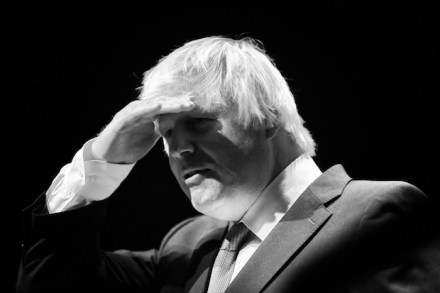
Last night, Sebastian Payne described Boris Johnson as being a politician who 'prides himself on being one of the few politicians who gets away with saying the unsayable'. He was covering the Mayor of London's lecture to the Centre for Policy Studies, where Boris said the following: 'Whatever you may think of the value of IQ tests, it is surely relevant to a conversation about equality that as many as 16 per cent of our species have an IQ below 85, while about 2 per cent have an IQ above 130. The harder you shake the pack, the easier it will be for some cornflakes to get to the top.

Scotland and the EU: Mariano Rajoy should just jog on.

From our UK edition

It's bad enough being lectured by politicians from Edinburgh or even London. That, I suppose, is to be expected however. Irritating but normal. It's rather different when foreigners - real foreigners - decide to interfere in our own constitutional rammy. It smacks of impertinence. When that intervention comes from the leader - to put it in Sun-speak - of a nation of donkey-slaying, rock-coveting bankrupts it's even less respectable. So the suggestion made yesterday by Mariano Rajoy, Prime Minister of what we still call Spain, that an independent Scotland would, by creating a new country, need to reapply for EU membership is hackle-raising stuff. You're tempted to reply jog on, pal. Of course Rajoy's remarks are not about Scotland at all. They are about Catalonia.

Boris Johnson: greed can be good

From our UK edition

Boris Johnson prides himself on being one of the few politicians who gets away with saying the unsayable. He stuck to that theme tonight with his Margaret Thatcher lecture to the Centre for Policy Studies, in which he argued that greed isn't a bad thing. He said: 'But I also hope that there is no return to that spirit of Loadsamoney heartlessness – figuratively riffling banknotes under the noses of the homeless; and I hope that this time the Gordon Gekkos of London are conspicuous not just for their greed – valid motivator though greed may be for economic progress – as for what they give and do for the rest of the population, many of whom have experienced real falls in their incomes over the last five years.

Miliband attacks PM for ‘intellectual collapse’ at tepid PMQs

From our UK edition

Commentators sometimes like to describe a particular session of Prime Minister's Questions as 'vintage'. If 'vintage' is the correct description for the good weeks, this one was more of a serving of tepid Blue Nun. David Cameron was in a very odd mood indeed. He was clearly pleased with an early quip referencing Miliband's Desert Island Discs appearance. He joked that Miliband 'isn't loving Marx, he's loving Engels instead'. The joke was so dreadful that the entire Chamber convulsed as though winded by a fast-moving cricket ball. Miliband attacked the Prime Minister on his inconsistency over payday loan caps and climate change policy. This was a good theme, and gave the Labour leader the killer line that what had happened this week was 'an intellectual collapse of their position'.

Cameron, Osborne and Crosby grilled by backbenchers: exclusive details

From our UK edition

Last night David Cameron, George Osborne and Lynton Crosby held a meeting with the Conservative parliamentary party. Coffee House has exclusive details of what took place. There was a presentation on how well the party was doing from the Prime Minister (without any new information), and one from Lynton Crosby in which the strategist asked Tory MP James Morris to stand up and take a round of applause for passing on the 'nightmare' email from the Ed Miliband's office to the Mail on Sunday. Sir George Young brought less exciting news that MPs will have to pull their weight a great deal more by serving on more statutory instrument committees. But backbenchers also had a chance to quiz their leaders on some of their big worries.

Immigration announcement aims to take stings out of a number of tails

From our UK edition

David Cameron knows that the only criticism from other parties of his plans to restrict welfare access for new migrants will be that he isn't being tough enough. Such is the fear on all sides of being accused of repeating what the Prime Minister describes in his FT article as the 'monumental mistake' of the last Labour government that the only option on the table for Ed Miliband and Nick Clegg will be to support the move. It will be interesting to see how Miliband fares at Prime Minister's Questions today. Given Labour has put forward its own 'tough' proposals and given Yvette Cooper went to such lengths to complain that the Immigration Bill wasn't harsh enough, the Labour leader may choose to argue that Cameron isn't going as far as Labour has now proposed.

Salmond is stuck in the ‘Yes2AV’ trap

From our UK edition

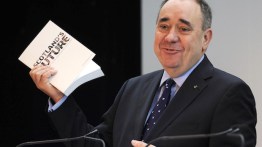
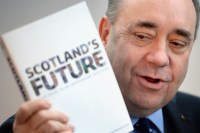
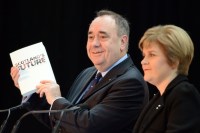
'When in the course of human events, it becomes necessary to one people to dissolve the political bands which have connected them with another', the best way of going about it probably isn't to write a 670-page document and then snarkily deride journalists who point out the obvious holes in it. As an old romantic, vaguely sympathetic to the dream of Scottish independence, I have long suspected that the SNP leadership are the greatest hindrance to the separatist cause. Alex Salmond's off-form, dull, dreary performance this morning only served to reconfirm that feeling. While separation is unlikely and potentially dangerous, increased devolution shouldn't be dismissed out of hand.

Andrew Mitchell vows to continue Plebgate fight

From our UK edition

So Andrew Mitchell is going to pursue his fight with the police over the 'plebgate' row, even though the Crown Prosecution Service said there was insufficient evidence to suggest the officer who claimed Andrew Mitchell called him a pleb was lying. The former Conservative chief whip told a press conference this afternoon that not only is he pursuing his libel action against The Sun newspaper, but that he will use this opportunity in court to force PC Toby Rowland, the officer who wrote the account of the altercation that involved the word 'pleb', to give his story under oath. Rowland is not one of the five police officers facing disciplinary action.

What’s hidden inside the Scottish Independence White Paper?

From our UK edition

Hidden away in the 650-page White Paper on Scottish Independence are a number of very interesting developments, none of which were championed by the SNP beforehand but every one of which has the potential to shape the campaign. Here are just a few of them: 1. A major move on nuclear weapons. The SNP’s position on Trident and nuclear weapons is well known. An independent Scotland would kick Trident out of its current base on the Clyde and become a 'non-nuclear' state with only conventional armed forces. Also, Scotland would be so defiantly anti-nuclear that it would not let ships carrying nuclear weapons enter its water or its ports. Oh really? What about this then?

Influential 1922 Committee chair backs rebel immigration call

From our UK edition

The swell of support continues for Nigel Mills' amendment to the Immigration Bill which would most likely land the British government in court by trying to extend transitional controls on Bulgarian and Romanian migrants to 2018. I have learned that Graham Brady, influential chair of the 1922 Committee, has now signed the amendment too, and the rebels organising behind it tell me they now have more than 40 backers. The list now includes a number of 1922 Committee executive members, including Nick de Bois, John Whittingdale, Charles Walker and Jason McCartney.

Alistair Darling: the flaws in Alex Salmond’s white paper on independence

From our UK edition

Nothing has changed as a result of today’s White Paper. There is nothing that we found out today that we didn’t already know. Yesterday Alex Salmond’s case for breaking up the UK was based on assertions. Today it is still based on assertions. The simple fact is that the nationalists have ducked the opportunity to answer any of the big questions about our country’s future. They promised us facts. What they have given us is a wish list with no prices attached. If this White Paper was going to be credible, it had to address the fundamental issues that people are concerned about. They didn’t. We still don’t know what currency we use if we vote to go it alone. We don’t know who would set our mortgage rates.

Scottish independence is a little more likely today than it was yesterday

From our UK edition

The argument about Scottish independence which, it should be said, is not a new one is best understood in terms of the Overton Window. James Overton, an American political scientist, suggested that the general public is only prepared to contemplate a relatively narrow range of political opinions and policies. Those that fall outwith this window of plausibility are discounted; the task for politicians and other advocates is to shift the window so that ideas once considered heretical now appear orthodox common-sense. Overton suggested there were six phases to this process. A idea would move from being unthinkable to radical to acceptable to sensible to popular before, finally, becoming policy. Scottish independence is currently somewhere between acceptable and sensible.

Number 10 defends policies as excess winter deaths soar by 29%

From our UK edition

The Health department says there is a perfectly good explanation for a 29% rise in the number of excess winter deaths to 31,100 in 2012/13. It is pointing to research by Public Health England which linked the rise to a longer flu season and continuing cold weather late into the winter and early spring. But as Fraser argued in his Telegraph column earlier this year, there is still not nearly enough that is being done to combat excess winter deaths, whether or not this year's 29% rise is a one-off. The Prime Minister's official spokesman didn't seem particularly keen to suggest that there was anything else, beyond NHS planning and public health spending, that should be done, when he responded to the figures today.

A funny argument for independence

From our UK edition

Is today's Scottish independence White Paper really an argument for independence? I ask only because the section on currency and monetary policy is essentially arguing for the union. It says: 'The Commission's analysis shows that it will not only be in Scotland's interests to retain Sterling but that - post independence - this will also benefit the rest of the UK. 'Under such an arrangement, monetary policy will be set according to economic conditions across the Sterling Area with ownership and governance of the Bank of England undertaken on a shareholder basis.

Can Silicon Valley ever be replicated in London?

From our UK edition

Trying to clone Silicon Valley has been a cornerstone of this coalition’s business policy. Rohan Silva, until recently the PM's policy guru, spent several years in government and opposition creating the ‘Silicon Roundabout', an attempt to provide a new leg for the UK’s economy in East London. Depending on who you believe, the East London Tech City project has either been a roaring success or a waste of time. Despite all the encouragement from the government, the main challenge is recreating the enticement of Silicon Valley in Shoreditch — something that may be impossible.