Uk politics

A choice for Tories: Goldman Sachs or UKIP?

From our UK edition

Hats-off to James Kirkup for noticing that Goldman Sachs have suggested they would "drastically" cut their UK workforce (and operations) should Britain decide to leave the European Union. That is the view of Michael Sherwood, the fellow responsible for running Goldman's european operations. I am sure eurosceptics will dismiss this as the usual scaremongering just as Scottish nationalists dismiss warnings that some businesses (RBS?) might shift their operations south in the event Scotland votes for independence next year. This is but one of the many ways in which the european and Scottish questions overlap or dovetail with one another. Perhaps it is only scaremongering! But what if it isn't?

Cameron focuses on long-term plan for Autumn Statement, not short-term goodies

From our UK edition

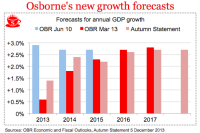
Much of the meat of the Autumn Statement has already been briefed, which raises the question of what's left to get excited about tomorrow. There will likely still be a number of crowd-pleasing announcements, but ministers are clearly keen to clear some space on the decks to focus on the figures that George Osborne will announce on the deficit and the updated growth forecasts. And a lightly-filled rather than overflowing goody bag from the Chancellor also gives him the opportunity to drive home his message about the 'responsible recovery' and a responsible government, rather than one that starts handing out prizes the moment the recovery appears on the horizon.

PMQs: Labour’s constant attacks make a Lib-Lab coalition unlikely

From our UK edition

Today’s PMQs showed that Labour still have no plan for Nick Clegg other than to attack him. With Clegg standing in for Cameron, Harriet Harman didn’t try and tease out any differences between the coalition partners but instead attacked him as the best deputy any Tory Prime Minister could have and as an accelerator on the Tory agenda not a brake. On one level, this makes sense. There are a certain number of votes on the centre-left of British politics that Labour and the Lib Dems are competing for. Painting the Lib Dems as Tory accomplices helps Labour in this market. But on another, these highly personal attacks on Clegg make a Lib-Lab coalition that much harder to imagine.

Tory attacks on Alistair Darling show that WMD Unionism is MAD

From our UK edition

I don't really understand why politicians spend so much time talking to journalists. Most of the time little good can come from doing so. Of course, from a personal or professional perspective, this is fine and adds greatly to the gaiety of trade and nation. Nevertheless... Take, for instance, the reports in today's Financial Times and Daily Mail in which "senior" government sources stick their shivs into Alistair Darling. The leader of the Unionist campaign fighting next year's referendum on Scottish independence is, we are informed, "comatose most of the time". A different (I think) Downing Street figure complains that Darling is a "dreary figurehead". Meanwhile in the Mail, Gerri Peev finds another "senior parliamentary figure" who complains that Darling is "useless".

New constituency polling: who would vote Ukip?

From our UK edition

What do the Liberal Democrats and Ukip have in common? According to the second round of Survation’s constituency polling, they are both locally outperforming their national trends. Thanks to the Ukip donor Alan Bown, we can see how the seats of Great Grimsby and Dudley North would vote, were there a general election tomorrow: These seats are important because they are numbers nine and ten on the Conservatives’ target list for the 2015 election (requiring a one per cent swing to win). Both suggest some worrying trends for the Tories. Since 2010, Labour’s voting share has risen by six/seven points, while the Conservatives have dropped 11/12 points. The Lib Dems have dropped nine points in both while Ukip have risen by 16 and 14 points respectively.

Sketch: Alan Rusbridger’s select committee interrogation

From our UK edition

Guardian editor, Alan Rusbridger, was quizzed about the Snowden leaks in select committee today. The chair was amply filled by Keith Vaz who always comes across as well-fed, well-meaning and well-nigh useless. He began by thanking the Harry Potter clone for showing up at all. ‘I didn’t know it was optional,’ said Rusbridger frostily. Vaz wondered if the Guardian boss loved his country. Rusbridger affected surprise at the question and said he loved our principles of free speech and democracy. He was a patriot. Labour members toadied up to him and hailed his paper as a champion of liberty. But the Tories were ready to lock him in the slammer and grind the key into iron filings.

Coffee Shots: Boris Johnson’s Christmas cheer

From our UK edition

If only Boris Johnson had enjoyed as fun a day as his mannequin in Madame Tussauds. While the Mayor struggled with an IQ test set by LBC's Nick Ferrari, his waxwork was donning a cheery Christmas jumper for Save the Children's Christmas jumper campaign.

Boris Johnson’s Tory colleagues refuse to stick up for him on IQ comments

From our UK edition

Boris Johnson insisted today that critics of his comments about IQ had chosen to 'wilfully misconstrue what I said'. He told LBC radio this morning that 'what I was saying actually is that there is too much inequality, and my speech was actually a warning, as correctly reported by many newspapers, actually a warning against letting this thing go unchecked. Because if you look at what's happened in the last 20 to 30 years, there's been a widening in income between rich and poor - there's no question about that.' He also managed to fail an IQ test, which was an inevitable consequence of this whole debacle. But Labour is keen to use the Mayor's comments as a stick with which to beat the Conservatives as a whole.

Could ‘norms’ be influencing controversial fitness-to-work tests?

From our UK edition

Every so often, when another strange case crops up of someone being declared fit as a fiddle for work who then dies a few days later, or who cannot walk, talk or feed themselves, questions are asked about how on earth the government could have got its fitness-to-work tests quite so wrong. These Work Capability Assessments run by ATOS Healthcare on behalf of the Work and Pensions department, are a cross-party mess: set up by Labour and continued by the Coalition. I've written before about the problems with their design and the contract between the DWP and ATOS, but another element that makes the test even messier has come to my attention this week.

PM dodges ‘small island’ moment in China

From our UK edition

David Cameron's visit to China is rather different to some of his recent trips. Firstly, as Douglas Murray outlined yesterday, he's not making as big a noise about human rights as he did when he was in Sri Lanka recently (and in Sri Lanka, it wasn't just noise: it was the body language, with an awkward handshake summing up how he felt about Sri Lankan President Mahinda Rajapaksa). Secondly, he's not going to bother getting all Love, Actually about the country he represents. When he was in St Petersburg, the Prime Minister got rather overexcited about a comment from a Putin official about Britain being a 'small island no-one listens to'. His wife Samantha now jokes that the Prime Minister in Richard Curtis' film is also called David and that her David fancies imitating the fictional one.

PISA rankings are a shot in the arm for education reformers

From our UK edition

Like measuring water by the handful, calculating the success of the education system at a time of rampant grade inflation is an impossible task. If exam results go up every year how can we know if are our children are actually getting a better education or if exams are just getting easier? Part of the answer is international comparisons – which is why the OECD PISA rankings published today do actually matter. The last time they were published, in 2009, they showed that as a country we slipped to 25th in reading, 28th in maths and 16th in science. Yet at the same time domestic UK exam results were getting better. If you think that doesn’t add up, that’s because it doesn’t.

Fallon: green energy isn’t the government’s energy priority

From our UK edition

Michael Fallon is the Spectator's Minister of the Year, nicknamed the 'Minister for Royal Shale' for his dual role in the privatisation of the postal service and getting fracking going in this country. He's also the minister whose thinking most closely mirrors Number 10's stance on the energy market at present, and so his speech at the Spectator's energy conference yesterday wasn't just an important glimpse into current government policy, but also future Conservative policymaking on energy.listen to ‘Michael Fallon speaking at the Spectator's Energy Conference’ on Audioboo Significantly, the Energy Minister told the conference that the most important issues were 'security of supply, affordability, and playing our part in combating climate change. And that for me is the order.

Caroline Flint and Ed Davey clash over who cares most about consumers

From our UK edition

One of the Conservatives' great victories in government has been to portray the party as on the side of consumers against behemoth and sometimes inefficient producers. Take education, where Michael Gove has set to tackling the 'Blob' of the education establishment on behalf of parents who want real choice over their children's education. Or the NHS, where Jeremy Hunt has styled himself as the patients' champion, standing up to a resistant NHS establishment on standards of care. But this isn't the case on every front. Today's Commons statement on energy bills by Ed Davey underlined the struggle the Coalition faces in presenting a convincing case for being a consumer champion when it comes to the cost of living.

When oh when will we ever be able to talk about immigration (sensibly)?

From our UK edition

I do wish we were never allowed to speak about immigration. That seems the only way to prevent folk from spouting - and writing - rubbish on the subject. But of course there is no conspiracy intent on stifling discussion on immigration. Not even a liberal, metropolitan or elitist conspiracy. Sorry. You can say all the things you think you can't say. And we know this because many, even most, of them are said all the time. So often, in fact, that they lack novelty. And we also know that no-one really wants to have a conversation about immigration. Conversation would require some back and forth. It might even allow the possibility someone might change their mind. Just imagine that.

Ed Davey focuses fire on Labour – for now

From our UK edition

Of all the ministers involved in the Coalition negotiations over energy bills, Ed Davey has had quite the worst experience. He has had to water down his conference bullishness about standing up to the Tories to a sort of amiable plea that the Lib Dems really are keeping the Coalition green. When his departmental junior Michael Fallon won 'Minister of the Year' at the Spectator awards this year, one of the judges observed that he had 'kneecapped Ed Davey'. In his interview on Today this morning, Davey went for Labour, and dodged suggestions that he and his party had lost out.

Naked politicians and the Emperor’s New Clothes: Labour’s Autumn Statement challenge

From our UK edition

The Autumn Statement isn't until Thursday, but already it's clear what the attack lines will be from both sides. As James explained earlier, the Tories and Lib Dems will want to focus on the 'responsible recovery', which means fewer giveaways than a Chancellor might be tempted to make at this stage in a parliament and which feeds into the Conservative narrative that voters should let them finish the job by re-electing them in 2015. From Labour's part, it's that this Autumn Statement was written by Ed Miliband at his party's conference in Brighton. Labour MPs are now very keen to talk about Coalition politicians dancing to Labour's tune. Meanwhile, Ed Balls is quite keen to talk about naked politicians.

Osborne wants to talk about ‘the responsible recovery’ but energy bills are still Topic A

From our UK edition

In the minds of government strategists, the autumn statement is the moment when the coalition gets to turn the conversation back to the broader economy and away from Ed Miliband’s focus on the cost of living. But the first five minutes of George Osborne’s pre-statement interview with Andrew Marr were dominated by the action the government is taking in response to Miliband’s pledge to freeze energy bills. The problem for the coalition on energy bills is that the £50 it is taking off bills now might well not be enough to stop bills rising next year. If household bills go up again in 2014, Miliband’s price freeze is going to continue to look attractive to voters.

Michael Gove and Boris Johnson: partners in power?

From our UK edition

Boris Johnson's speech at the Centre for Policy Studies, much misrepresented, is still grabbing headlines. Boris gave the Margaret Thatcher memorial lecture, so it’s no surprise it has been interpreted as a bid to succeed her. But another relationship is just as intriguing: was Boris also stealing Michael Gove’s clothes? The Mayor said much about the significance of the Conservatives' past, but the Govian aspects of his speech offer a glimpse of what the party's immediate future might look like, particularly when it comes to a future leadership contest. Boris' 'cornflake packet' argument about meritocracy is a classic piece of Govian thinking. Posing the question 'what would Maggie do?